


Universal gestational age effects on cognitive and basic mathematic processing: 2 cohorts in 2 countries
- PMID: 25842966
- PMCID: PMC4441098
- DOI: 10.1016/j.jpeds.2015.02.065
Universal gestational age effects on cognitive and basic mathematic processing: 2 cohorts in 2 countries
Abstract
Objective: To determine whether general cognitive ability, basic mathematic processing, and mathematic attainment are universally affected by gestation at birth, as well as whether mathematic attainment is more strongly associated with cohort-specific factors such as schooling than basic cognitive and mathematical abilities.
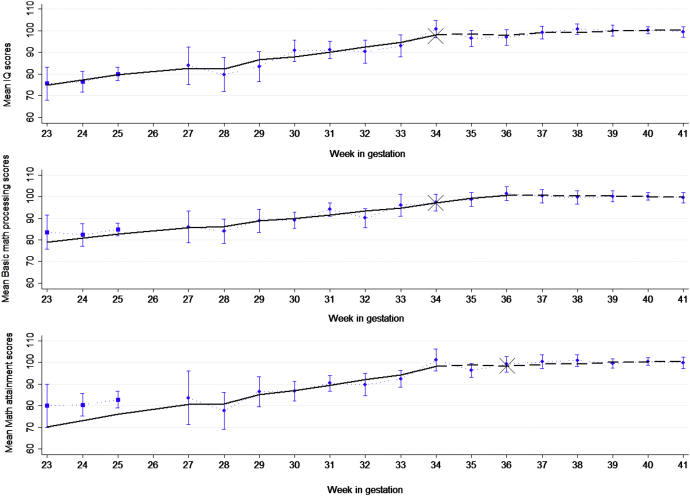
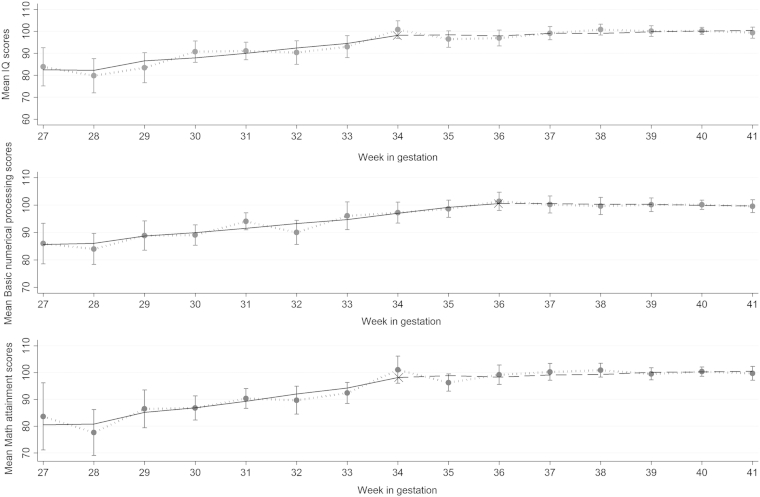
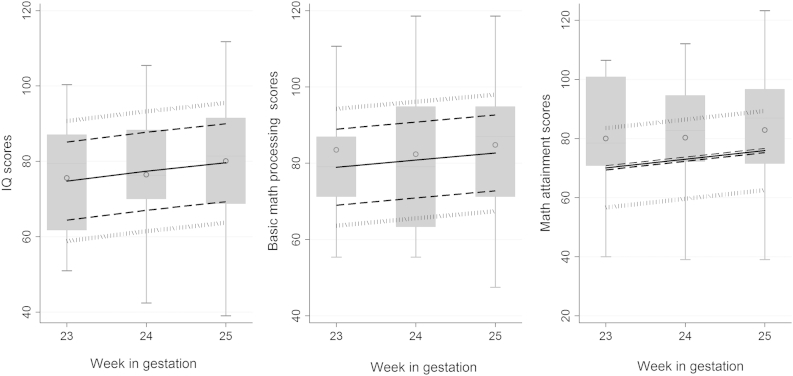
Study design: The Bavarian Longitudinal Study (BLS, 1289 children, 27-41 weeks gestational age [GA]) was used to estimate effects of GA on IQ, basic mathematic processing, and mathematic attainment. These estimations were used to predict IQ, mathematic processing, and mathematic attainment in the EPICure Study (171 children <26 weeks GA).
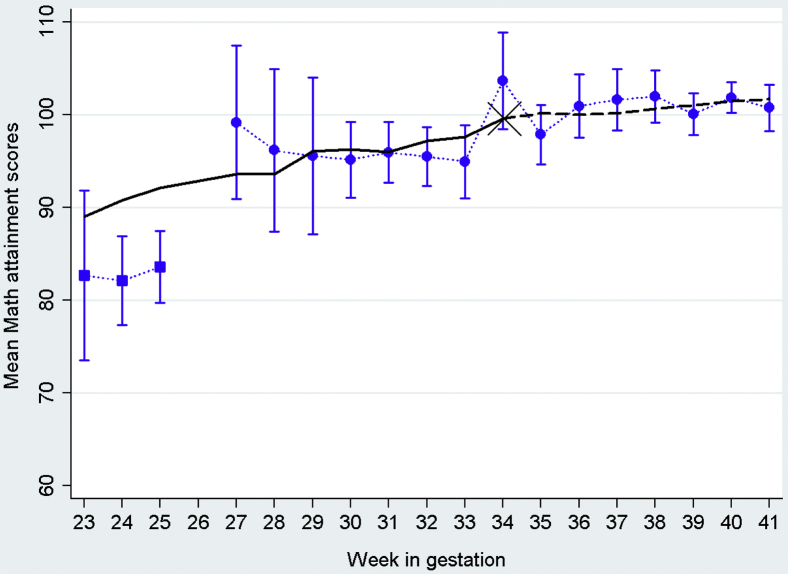
Results: For children born <34 weeks GA, each lower week decreased IQ and mathematic attainment scores by 2.34 (95% CI: -2.99, -1.70) and 2.76 (95% CI: -3.40, -2.11) points, respectively. There were no differences among children born 34-41 weeks GA. Similarly, for children born <36 weeks GA, mathematic processing scores decreased by 1.77 (95% CI: -2.20, -1.34) points with each lower GA week. The prediction function generated using BLS data accurately predicted the effect of GA on IQ and mathematic processing among EPICure children. However, these children had better attainment than predicted by BLS.
Conclusions: Prematurity has adverse effects on basic mathematic processing following birth at all gestations <36 weeks and on IQ and mathematic attainment <34 weeks GA. The ability to predict IQ and mathematic processing scores from one cohort to another among children cared for in different eras and countries suggests that universal neurodevelopmental factors may explain the effects of gestation at birth. In contrast, mathematic attainment may be improved by schooling.
Copyright © 2015 The Authors. Published by Elsevier Inc. All rights reserved.
Figures
References
-
- March of Dimes. PMNCH. Save the Children. WHO . In: Born too soon: the global action report on preterm birth. Howson C., Kinney M., Lawn J., editors. World Health Organization; Geneva: 2012.
-
- Quigley M., Poulsen G., Boyle E.M., Wolke D., Field D., Alfirevic Z. Early term and late preterm birth are associated with poorer school performance at age 5 years: a cohort study. Arch Dis Child Fetal Neonatal Ed. 2012;97:F167–F173. - PubMed
Publication types
MeSH terms
Grants and funding
LinkOut - more resources
Full Text Sources
Other Literature Sources
