


Impact and factors associated with nighttime and early morning symptoms among patients with chronic obstructive pulmonary disease
- PMID: 25844033
- PMCID: PMC4368031
- DOI: 10.2147/COPD.S76157
Impact and factors associated with nighttime and early morning symptoms among patients with chronic obstructive pulmonary disease
Abstract
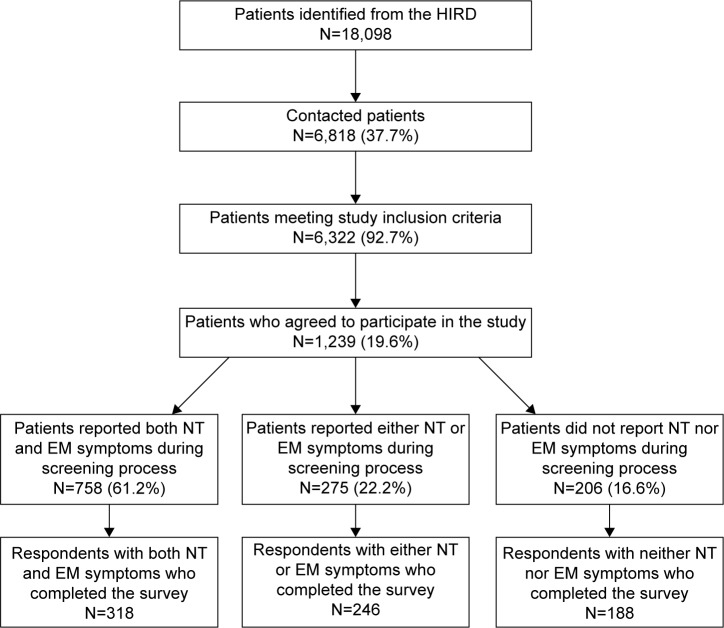
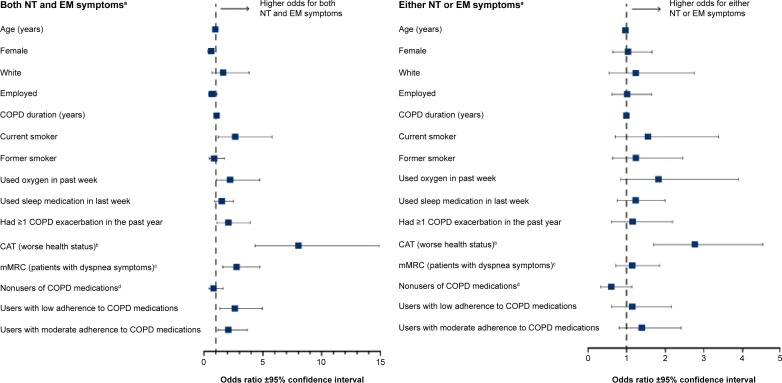
Patients with chronic obstructive pulmonary disease (COPD) exhibit poor sleep quality and consider morning as the worst time of day for their symptoms. While work has been done to characterize nighttime (NT) and early morning (EM) symptoms in various populations, the impact and factors associated with NT/EM symptoms among patients with COPD in the United States is not well understood. Commercially insured patients aged ≥40 years with one or more medical claim for COPD and one or more pharmacy claim for COPD maintenance medication were identified from the HealthCore Integrated Research Database between September 1, 2010 and August 31, 2011. Consenting respondents were asked whether they had COPD symptoms on at least three nights or at least three mornings during the past week. Respondents were then either assigned to one of three symptom groups to complete the survey or excluded if their predefined group quota limit had been met. Survey completers completed the survey with questions about COPD symptoms and other commonly used patient-reported outcome measures. Respondents with NT/EM symptoms were asked about the frequency, severity, and impact of the symptoms on sleep, morning activities, and anxiety levels. Among respondents with symptoms, 73.1% of respondents with NT symptoms (N=376) and 83% of respondents with EM symptoms (N=506) experienced at least three distinct types of symptoms over the past week, with cough being the most frequently reported symptom. Approximately half of respondents with NT or EM symptoms perceived their symptoms as moderate to very severe, with a majority reporting their symptoms affected their NT sleep and morning activities, and more than half felt anxious due to their symptoms. Multinomial logistic regression showed COPD patients with both or either NT/EM symptoms were associated with poorer health status compared to those without. Improved disease management may reduce NT/EM symptoms and improve health status in patients with COPD.
Keywords: chronic airflow obstruction; chronic limitation of activity; quality of life; sleep.
Figures
References
-
- Anderson B, Conner K, Dunn C, Kerestes G, Lim K, Myers C, Olson J, Raikar S, Schultz H, Setterlund L, Institute for Clinical Systems Improvement Diagnosis and Management of Chronic Obstructive Pulmonary Disease (COPD) [Accessed February 4, 2015]. Updated March 2013:7 [cited June 27, 2013]. Available from: https://www.icsi.org/_asset/yw83gh/COPD.pdf.
-
- Mannino DM, Homa DM, Akinbami LJ, Ford ES, Redd SC. Chronic obstructive pulmonary disease surveillance – United States, 1971–2000. Respir Care. 2002;47(10):1184–1199. - PubMed
-
- United States Department of Health and Human Services. National Institutes of Health; National Heart Lung and Blood Institute . Morbidity and Mortality: 2012 Chartbook on Cardiovascular, Lung and Blood Diseases. Bethesda: National Heart, Lung, and Blood Institute; 2012. [Accessed June 27, 2013]. [cited June 27, 2013]. Available from: http://www.nhlbi.nih.gov/research/reports/2012-mortality-chart-book.
-
- Chronic Obstructive Pulmonary Disease (COPD) Fact Sheet [web-page on the Internet] Chicago: American Lung Association; 2013. [Accessed October 22, 2013]. [cited October 22, 2013] Available from: http://www.lung.org/lung-disease/copd/resources/facts-figures/COPD-Fact-....
Publication types
MeSH terms
LinkOut - more resources
Full Text Sources
Medical
Research Materials
Miscellaneous
