. 2015 Mar 25:6:19.
doi: 10.1186/s13229-015-0015-2. eCollection 2015.

Complex nature of apparently balanced chromosomal rearrangements in patients with autism spectrum disorder

Affiliations

Complex nature of apparently balanced chromosomal rearrangements in patients with autism spectrum disorder

Anne-Claude Tabet et al. Mol Autism. .

Abstract

Background: Apparently balanced chromosomal rearrangements can be associated with an abnormal phenotype, including intellectual disability and autism spectrum disorder (ASD). Genome-wide microarrays reveal cryptic genomic imbalances, related or not to the breakpoints, in 25% to 50% of patients with an abnormal phenotype carrying a microscopically balanced chromosomal rearrangement. Here we performed microarray analysis of 18 patients with ASD carrying balanced chromosomal abnormalities to identify submicroscopic imbalances implicated in abnormal neurodevelopment.

Methods: Eighteen patients with ASD carrying apparently balanced chromosomal abnormalities were screened using single nucleotide polymorphism (SNP) arrays. Nine rearrangements were de novo, seven inherited, and two of unknown inheritance. Genomic imbalances were confirmed by fluorescence in situ hybridization and quantitative PCR.

Results: We detected clinically significant de novo copy number variants in four patients (22%), including three with de novo rearrangements and one with an inherited abnormality. The sizes ranged from 3.3 to 4.9 Mb; three were related to the breakpoint regions and one occurred elsewhere. We report a patient with a duplication of the Wolf-Hirschhorn syndrome critical region, contributing to the delineation of this rare genomic disorder. The patient has a chromosome 4p inverted duplication deletion, with a 0.5 Mb deletion of terminal 4p and a 4.2 Mb duplication of 4p16.2p16.3. The other cases included an apparently balanced de novo translocation t(5;18)(q12;p11.2) with a 4.2 Mb deletion at the 18p breakpoint, a subject with de novo pericentric inversion inv(11)(p14q23.2) in whom the array revealed a de novo 4.9 Mb deletion in 7q21.3q22.1, and a patient with a maternal inv(2)(q14.2q37.3) with a de novo 3.3 Mb terminal 2q deletion and a 4.2 Mb duplication at the proximal breakpoint. In addition, we identified a rare de novo deletion of unknown significance on a chromosome unrelated to the initial rearrangement, disrupting a single gene, RFX3.

Conclusions: These findings underscore the utility of SNP arrays for investigating apparently balanced chromosomal abnormalities in subjects with ASD or related neurodevelopmental disorders in both clinical and research settings.


Figures
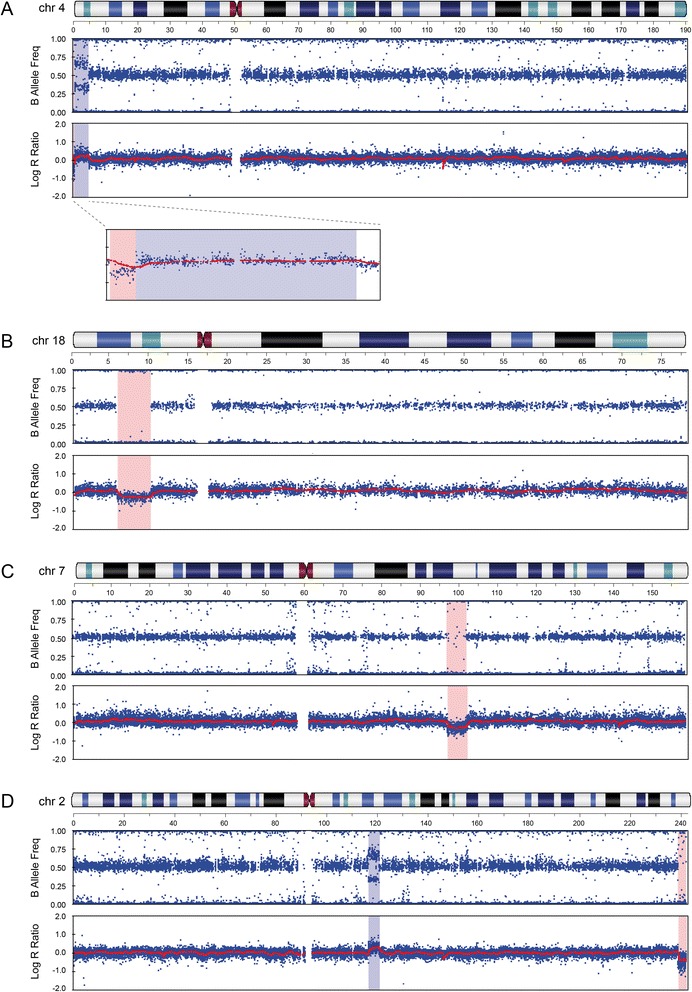
Figure 1
Figure 1
SNP arrays of patients with clinically significant findings. (A) Patient 1 (46,XY,der(4)t(4;acro p)dn) has a copy number loss of 541 kb in 4p16.3 and a gain of 4.29 Mb in 4p16.2p16.3. The distal deleted and duplicated 4p segments are shown in detail below. (B) Patient 2 (t(5;18)(q11.2;p11.2)dn) has deletion of 4.21 Mb in 18p11.31p11.22. (C) Patient 3 (46,XY,inv(11)(p14q23.2)dn) had no imbalance on chromosome 11 but the SNP array revealed a de novo deletion of 4.3 Mb in 7q21.3q22.1. (D) Patient 4 (46,XY,inv(2)(q14.2q37.3)mat) has a maternally inherited paracentric inversion of chromosome 2q, with a 2q14.1q14.2 duplication of 4.2 Mb at the proximal breakpoint, and a 2q37.3 deletion of 3.5 Mb extending to the telomere.
Figure 2
Figure 2
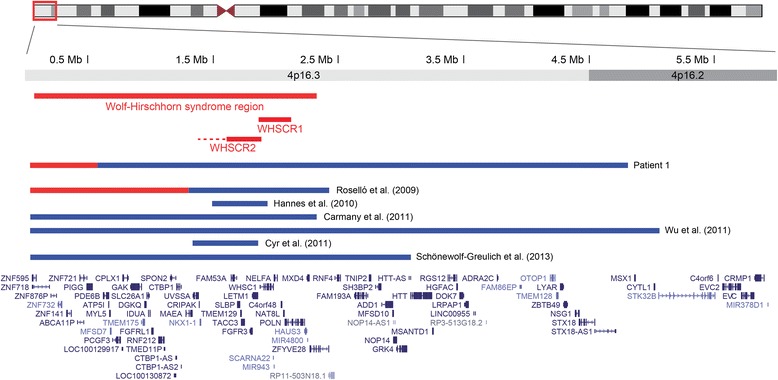
Duplication of the Wolf-Hirschhorn region in patient 1. Map of chromosome 4 (1-6,000,000, hg19) showing the rearrangement detected in patient 1 and previously reported overlapping rearrangements. The region commonly deleted in Wolf-Hirschhorn syndrome and the two proposed critical regions (WHSCR1 and WHSCR2) are represented. Horizontal blue lines represent duplications, and red lines indicate deletions. RefSeq genes are indicated at the bottom of the map.
Figure 3
Figure 3
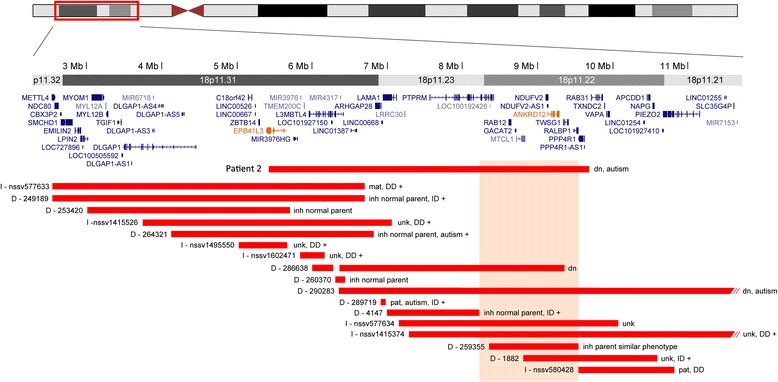
18p11.31-p11.22 deletion in patient 2. Map of chromosome 18 (2,500,000-11,700,000, hg19) showing the rearrangement detected in patient 2 and overlapping deletions from the DECIPHER (D) and ISCA (I) databases. The deletions are represented with horizontal red lines. RefSeq genes are indicated in blue. The phenotype is indicated when available. The + sign indicates additional morphological features. Two genes within the deleted region in patient 2 with a high haploinsufficiency score are indicated in orange. Most of the deletions in the distal region are inherited, usually from normal parents, whereas two other de novo deletions as well as one inherited from a parent with a similar phenotype overlap the proximal region, highlighted in peach. DD, developmental delay; dn, de novo; ID, intellectual disability; inh, inherited; mat, maternal; pat, paternal; unk, unknown inheritance.

References

    1. Jacobs PA, Browne C, Gregson N, Joyce C, White H. Estimates of the frequency of chromosome abnormalities detectable in unselected newborns using moderate levels of banding. J Med Genet. 1992;29(2):103–8. doi: 10.1136/jmg.29.2.103. - DOI - PMC - PubMed
    1. Warburton D. De novo balanced chromosome rearrangements and extra marker chromosomes identified at prenatal diagnosis: clinical significance and distribution of breakpoints. Am J Hum Genet. 1991;49(5):995–1013. - PMC - PubMed
    1. Gribble SM, Prigmore E, Burford DC, Porter KM, Ng BL, Douglas EJ, et al. The complex nature of constitutional de novo apparently balanced translocations in patients presenting with abnormal phenotypes. J Med Genet. 2005;42(1):8–16. doi: 10.1136/jmg.2004.024141. - DOI - PMC - PubMed
    1. De Gregori M, Ciccone R, Magini P, Pramparo T, Gimelli S, Messa J, et al. Cryptic deletions are a common finding in “balanced” reciprocal and complex chromosome rearrangements: a study of 59 patients. J Med Genet. 2007;44(12):750–62. doi: 10.1136/jmg.2007.052787. - DOI - PMC - PubMed
    1. Higgins AW, Alkuraya FS, Bosco AF, Brown KK, Bruns GA, Donovan DJ, et al. Characterization of apparently balanced chromosomal rearrangements from the developmental genome anatomy project. Am J Hum Genet. 2008;82(3):712–22. doi: 10.1016/j.ajhg.2008.01.011. - DOI - PMC - PubMed

LinkOut - more resources