The effect of long Roux-en-Y gastrojejunostomy in gastric cancer patients with type 2 diabetes and body mass index < 35 kg/m(2): preliminary results
- PMID: 25844356
- PMCID: PMC4384281
- DOI: 10.4174/astr.2015.88.4.215
The effect of long Roux-en-Y gastrojejunostomy in gastric cancer patients with type 2 diabetes and body mass index < 35 kg/m(2): preliminary results
Abstract
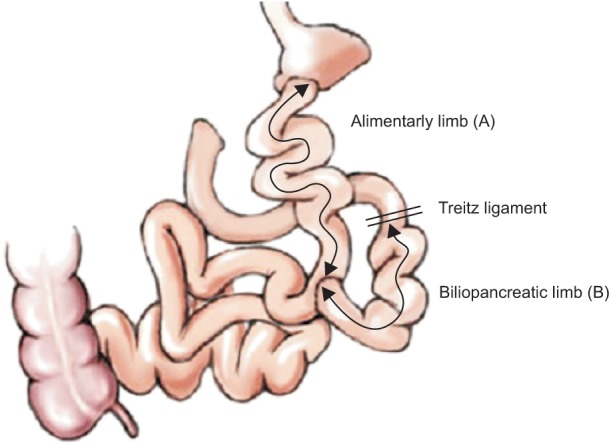
Purpose: We applied a long Roux-en-Y (RY) gastrojejunostomy (bypassed jejunum over 100 cm) as a reconstruction method for diabetes control to gastric cancer patients with type 2 diabetes and body mass index (BMI) < 35 kg/m(2). The effect of this procedure on diabetes control was assessed.
Methods: We prospectively performed modified RY gastrojejunostmy after curative radical distal gastrectomy. Thirty patients had completed a 1-year follow-up. Patients were followed concerning their diabetic status. The factors included in the investigation were length of bypassed jejunum, BMI and its reduction ratio, glycated hemoglobin (HbA1c), fasting blood glucose, and duration of diabetes. Diabetic status after surgery was assessed in three categories: remission, improvement, and stationary. In evaluation of surgical effects on diabetes control, remission and improvement groups were regarded as effective groups, while stationary was regarded as an ineffective group.
Results: At postoperative one year, statistical significance was observed in the mean BMI and HbA1c. Diabetes control was achieved in 50% of the patients (remission, 30%; improvement, 20%). BMI reduction ratio, preoperative HbA1c, and duration of diabetes were correlated to the status of type 2 diabetes mellitus. The preoperative HbA1c was the most influential predictor in diabetic control.
Conclusion: The effect of long RY gastrojejunostomy after gastrectomy for diabetes control could be contentious but an applicable reconstruction method for diabetes control in gastric cancer patients with type 2 diabetes and BMI < 35 kg/m(2). Diabetes remission is expected to be higher in patients with greater BMI reduction, short duration of diabetes, and lower preoperative HbA1c.
Keywords: Bariatric surgery; Roux-en-Y anastomosis; Stomach neoplasms; Type 2 diabetes mellitus.
Conflict of interest statement
Figures
References
-
- Mingrone G, Panunzi S, De Gaetano A, Guidone C, Iaconelli A, Leccesi L, et al. Bariatric surgery versus conventional medical therapy for type 2 diabetes. N Engl J Med. 2012;366:1577–1585. - PubMed
-
- Shukla AP, Ahn SM, Patel RT, Rosenbaum MW, Rubino F. Surgical treatment of type 2 diabetes: the surgeon perspective. Endocrine. 2011;40:151–161. - PubMed
-
- Dixon JB, Zimmet P, Alberti KG, Rubino F International Diabetes Federation Taskforce on Epidemiology and Prevention. Bariatric surgery: an IDF statement for obese Type 2 diabetes. Arq Bras Endocrinol Metabol. 2011;55:367–382. - PubMed
-
- Buchwald H, Avidor Y, Braunwald E, Jensen MD, Pories W, Fahrbach K, et al. Bariatric surgery: a systematic review and meta-analysis. JAMA. 2004;292:1724–1737. - PubMed
-
- Chiellini C, Rubino F, Castagneto M, Nanni G, Mingrone G. The effect of biliopancreatic diversion on type 2 diabetes i n pat ients wit h BMI <35 kg/m2. Diabetologia. 2009;52:1027–1030. - PubMed
LinkOut - more resources
Full Text Sources
Other Literature Sources
Research Materials