


Chronic obstructive pulmonary disease in primary care: an epidemiologic cohort study from the Canadian Primary Care Sentinel Surveillance Network
- PMID: 25844366
- PMCID: PMC4382041
- DOI: 10.9778/cmajo.20140040
Chronic obstructive pulmonary disease in primary care: an epidemiologic cohort study from the Canadian Primary Care Sentinel Surveillance Network
Abstract
Background: Chronic obstructive pulmonary disease (COPD) is mostly managed within primary care, but there is little Canadian evidence from this setting. This study was undertaken to determine the prevalence of physician-diagnosed COPD in primary care practices, and the degree of comorbidity with other chronic conditions, and to assess patterns of medication prescribing.
Methods: The Canadian Primary Care Sentinel Surveillance Network is a national "network of networks" whose member practices use electronic medical records (EMRs). At the time of the study, it included data from 444 physicians from 10 networks in 8 provinces. We conducted an epidemiologic cohort study of all patients who had EMR data collected by the network at the end of 2012. Validated case-finding algorithms were used to identify cases of COPD. We used descriptive statistics and multivariate modelling analyses to calculate the prevalence of COPD, its association with key demographic factors and comorbidities, and patterns of medication prescribing.
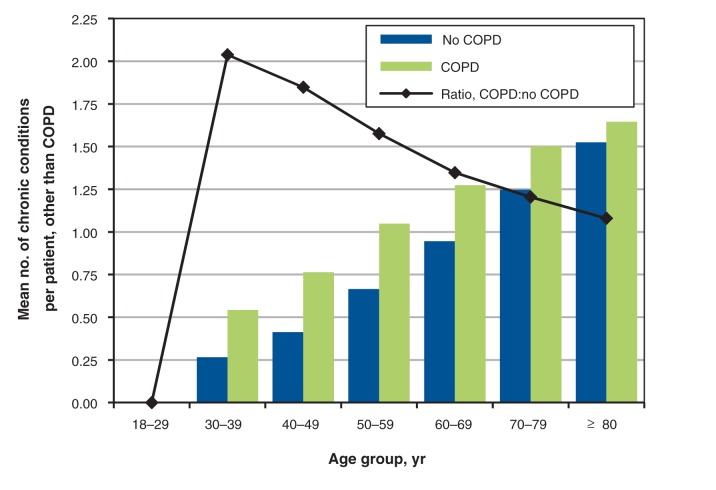
Results: The observed prevalence of COPD was 4.0% (10 043/250 346), which represents a population prevalence of 3.4% using age-sex standardization. Comorbidity was common, with prevalence ratios ranging from 1.1 for the presence of a single comorbid condition to 1.9 for 4 or more comorbid conditions. Anticholinergic agents (63%), short- (48%) and long-acting (38%) β-agonists and inhaled corticosteroids (41%) were the most commonly used medications.
Interpretation: The prevalence of physician-diagnosed COPD in Canadian primary care practices was similar to that reported in other practice-based studies at about 3%-4%. Most patients had comorbid conditions and were taking multiple medications. EMR data may be useful to assess both the epidemiology and management of COPD in primary care practices.
Conflict of interest statement
Figures

References
-
- Buist AS, Vollmer WM, McBurnie MA. Worldwide burden of COPD in high- and low-income countries. Part I. the burden of obstructive lung disease (BOLD) initiative. Int J Tuberc Lung Dis 2008;12:703-8. - PubMed
-
- Halbert RJ, Natoli JL, Gano A, et al. Global burden of COPD: systematic review and meta-analysis. Eur Respir J 2006;28:523-32. - PubMed
-
- Murray CJL, Abdalla S, Dharmaratne SD, et al. Disability-adjusted life years (DALYs) for 291 diseases and injuries in 21 regions, 1990–2010: a systematic analysis for the global burden of disease study 2010. Published erratum in Lancet 2013;381:628]. Lancet 2012;380:2197-223. - PubMed
-
- Pauwels RA, Rabe KF. Burden and clinical features of chronic obstructive pulmonary disease (COPD). Lancet 2004;364:613-20. - PubMed
LinkOut - more resources
Full Text Sources
Other Literature Sources
