. 2014:2014:378263.
doi: 10.1155/2014/378263.

Stroke Recovery: Surprising Influences and Residual Consequences

Affiliations

Stroke Recovery: Surprising Influences and Residual Consequences

Argye E Hillis et al. Adv Med. 2014.

Abstract

There is startling individual variability in the degree to which people recover from stroke, and the duration of time over which recovery of some symptoms occur. There are a variety of mechanisms of recovery from stroke, which take place at distinct time points after stroke and are influenced by different variables. We review recent studies from our laboratory that unveil some surprising findings, such as the role of education in chronic recovery. We also report data showing that the consequences that most plague survivors of stroke and their caregivers are not dependence in activities of daily living, but loss of more high level functions, such as empathy or written language. These results have implications for rehabilitation and management of stroke.


Figures
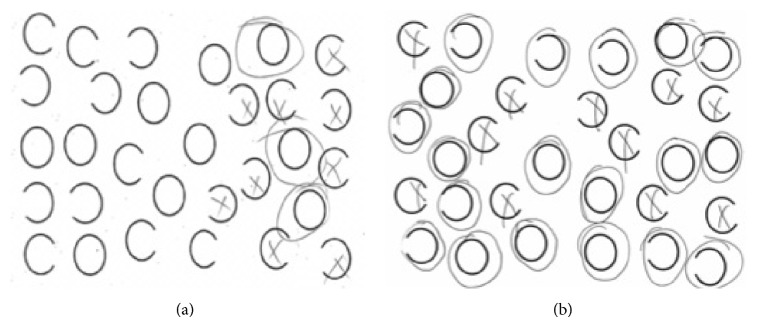
Figure 1
Figure 1
Contrasting performance of patients with viewer-centered and stimulus-centered neglect on the gap-detection test [24] (in this task the patient is asked to circle all the complete circles and put an X over circles that have a gap on the left or right side). (a) Performance by a patient with a right frontoparietal stroke and viewer-centered neglect on the gap-detection test. Note that he misses all of the stimuli on the left side of the view but detects left gaps in circles on the right view. (b) Performance by a patient with a right temporal stroke and stimulus-centered neglect on the gap-detection test. Note that he fails to detect the left gaps in circles on the right and left sides of the view.
Figure 2
Figure 2
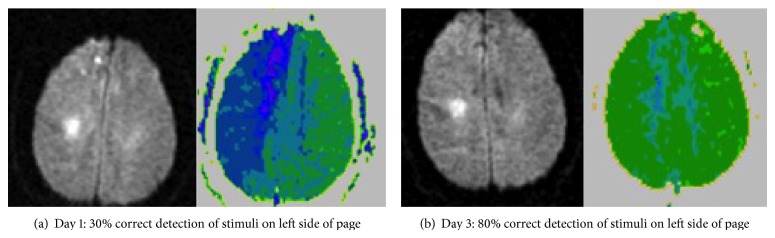
(a) Diffusion-weighted image (DWI; left), showing small subcortical infarct and perfusion-weighted image (PWI; right) of a patient with severe viewer-centered neglect at Day 1. (b) DWI and PWI of the same patient at Day 3, after viewer-centered neglect recovered, as indicated by recovery of detecting stimuli on the left and copying stimuli on the left of a scene. PWI shows that reperfusion of the right frontoparietal cortex was associated with recovery of viewer-centered neglect. In this case, reperfusion was brought about with induced blood pressure elevation.
Figure 3
Figure 3
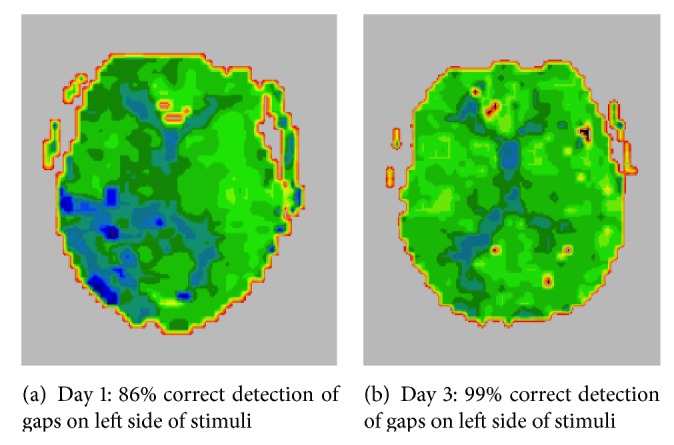
(a) PWI of a patient with severe stimulus-centered neglect at Day 1. (b) PWI of the same patient at Day 6, after stimulus-centered neglect recovered, as indicated by recovery of detecting gaps on the left sides of circles (irrespective of their location w.r.t. the viewer) and copying the left halves of stimuli on both sides of a scene. PWI shows that reperfusion of the right temporal cortex was associated with recovery of stimulus-centered neglect. In this case, reperfusion was brought about by urgent carotid endarterectomy.

References

    1. Farrell B., Godwin J., Richards S., Warlow C. The United Kingdom transient ischaemic attack (UK-TIA) aspirin trial: final results. Journal of Neurology Neurosurgery and Psychiatry. 1991;54(12):1044–1054. doi: 10.1136/jnnp.54.12.1044. - DOI - PMC - PubMed
    1. Wade D., Collin C. The Barthel ADL index: a standard measure of physical disability? Disability & Rehabilitation. 1988;10(2):64–67. doi: 10.3109/09638288809164105. - DOI - PubMed
    1. Cameron J. I., Stewart D. E., Streiner D. L., Coyte P. C., Cheung A. M. What makes family caregivers happy during the first 2 years post stroke? Stroke. 2014;45(4):1084–1089. doi: 10.1161/STROKEAHA.113.004309. - DOI - PubMed
    1. Acler M., Robol E., Fiaschi A., Manganotti P. A double blind placebo RCT to investigate the effects of serotonergic modulation on brain excitability and motor recovery in stroke patients. Journal of Neurology. 2009;256(7):1152–1158. doi: 10.1007/s00415-009-5093-7. - DOI - PubMed
    1. Nys G., Van Zandvoort M., De Kort P., et al. Domain-specific cognitive recovery after first-ever stroke: A follow-up study of 111 cases. Journal of the International Neuropsychological Society. 2005;11(7):795–806. doi: 10.1017/S1355617705050952. - DOI - PubMed

LinkOut - more resources