


Conventional 3T brain MRI and diffusion tensor imaging in the diagnostic workup of early stage parkinsonism
- PMID: 25845807
- PMCID: PMC4495265
- DOI: 10.1007/s00234-015-1515-7
Conventional 3T brain MRI and diffusion tensor imaging in the diagnostic workup of early stage parkinsonism
Abstract
Introduction: The aim of this study is to evaluate whether the diagnostic accuracy of 3 T brain MRI is improved by region of interest (ROI) measures of diffusion tensor imaging (DTI), to differentiate between neurodegenerative atypical parkinsonism (AP) and Parkinson's disease (PD) in early stage parkinsonism.
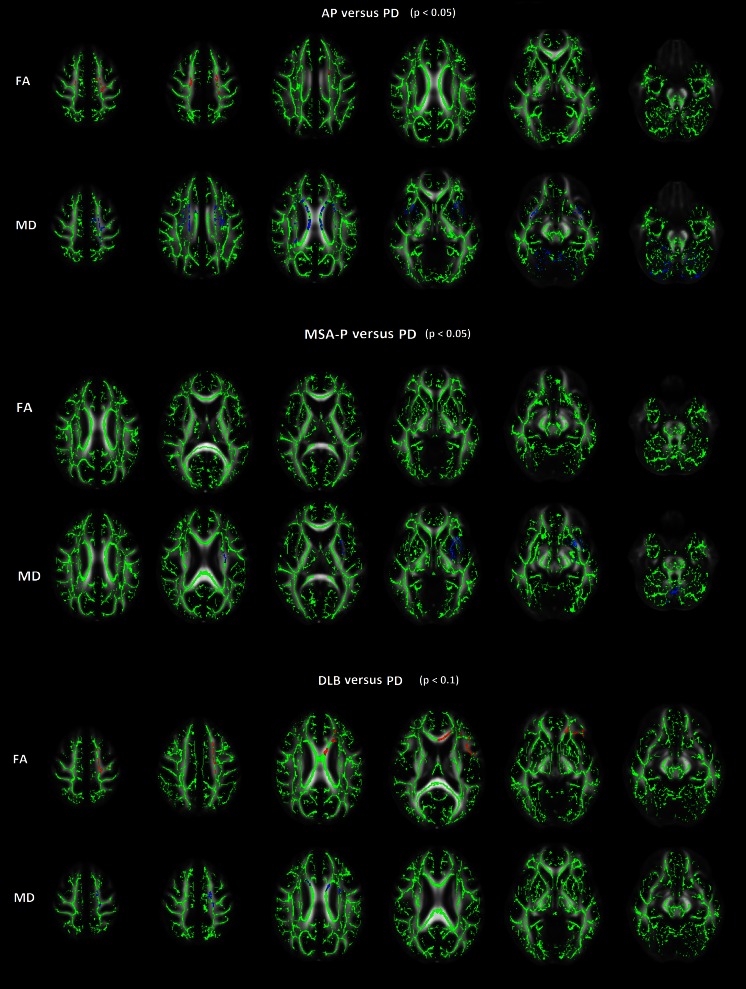
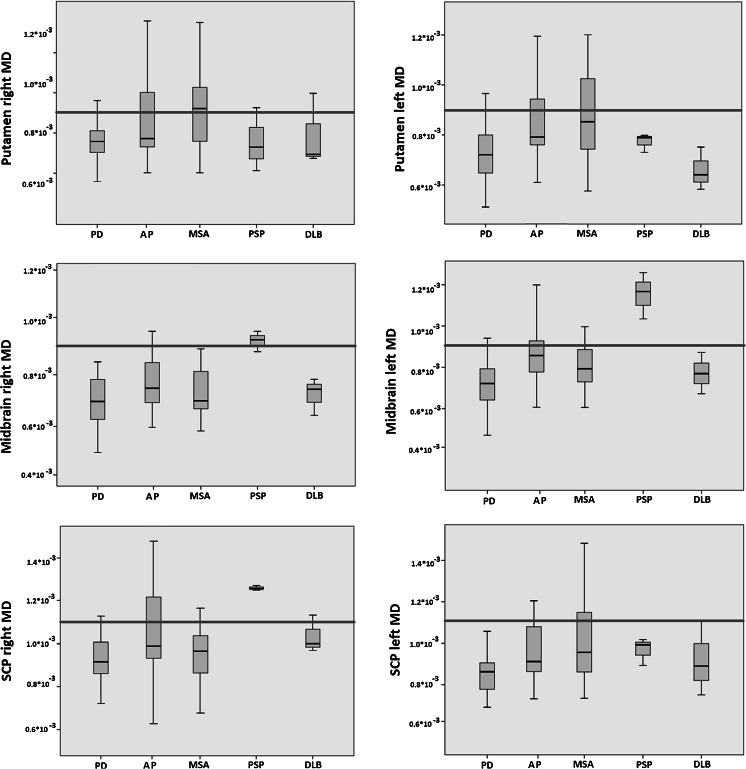
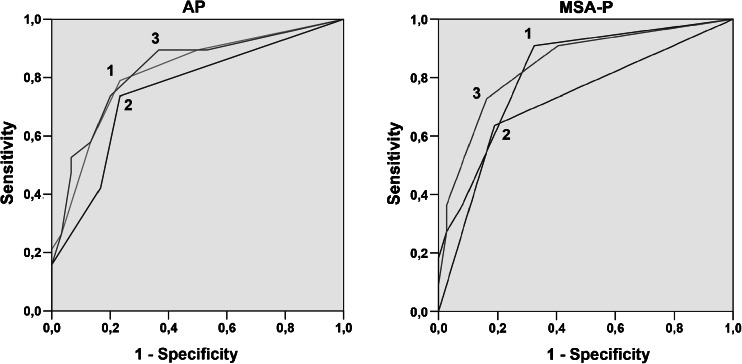
Methods: We performed a prospective observational cohort study of 60 patients presenting with early stage parkinsonism and initial uncertain diagnosis. At baseline, patients underwent a 3 T brain MRI including DTI. After clinical follow-up (mean 28.3 months), diagnoses could be made in 49 patients (30 PD and 19 AP). Conventional brain MRI was evaluated for regions of atrophy and signal intensity changes. Tract-based spatial statistics and ROI analyses of DTI were performed to analyze group differences in mean diffusivity (MD) and fractional anisotropy (FA), and diagnostic thresholds were determined. Diagnostic accuracy of conventional brain MRI and DTI was assessed with the receiver operating characteristic (ROC).
Results: Significantly higher MD of the centrum semiovale, body corpus callosum, putamen, external capsule, midbrain, superior cerebellum, and superior cerebellar peduncles was found in AP. Significantly increased MD of the putamen was found in multiple system atrophy-parkinsonian form (MSA-P) and increased MD in the midbrain and superior cerebellar peduncles in progressive supranuclear palsy (PSP). The diagnostic accuracy of brain MRI to identify AP as a group was not improved by ROI measures of MD, though the diagnostic accuracy to identify MSA-P was slightly increased (AUC 0.82 to 0.85).
Conclusion: The diagnostic accuracy of brain MRI to identify AP as a group was not improved by the current analysis approach to DTI, though DTI measures could be of added value to identify AP subgroups.
Figures

References
-
- Brooks DJ. Morphological and functional imaging studies on the diagnosis and progression of Parkinson’s disease. J Neurol. 2000;247:11–18. - PubMed
Publication types
MeSH terms
LinkOut - more resources
Full Text Sources
Other Literature Sources
Medical
Miscellaneous
