Nonrapid Eye Movement-Predominant Obstructive Sleep Apnea: Detection and Mechanism
- PMID: 25845901
- PMCID: PMC4543259
- DOI: 10.5664/jcsm.5010
Nonrapid Eye Movement-Predominant Obstructive Sleep Apnea: Detection and Mechanism
Abstract
Study objectives: Obstructive sleep apnea (OSA) can be severe and present in higher numbers during rapid eye movement (REM) than nonrapid eye movement (NREM) sleep; however, OSA occurs in NREM sleep and can be predominant. In general, ventilation decreases an average 10% to 15% during transition from wakefulness to sleep, and there is variability in just how much ventilation decreases. As dynamic changes in ventilation contribute to irregular breathing and breathing during NREM sleep is mainly under chemical control, our hypothesis is that patients with a more pronounced reduction in ventilation during the transition from wakefulness to NREM sleep will have NREM- predominant rather than REM-predominant OSA.
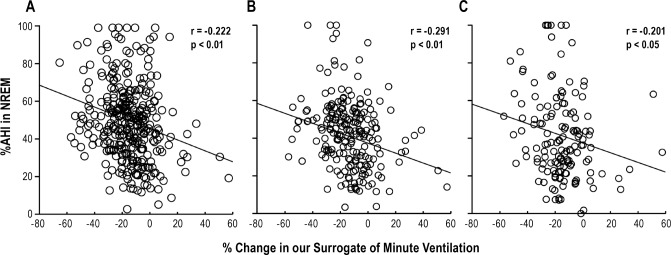
Methods: A retrospective analysis of 451 consecutive patients (apnea-hypopnea index [AHI] > 5) undergoing diagnostic polysomnography was performed, and breath-to-breath analysis of the respiratory cycle duration, tidal volume, and estimated minute ventilation before and after sleep onset were examined. Values were calculated using respiratory inductance plethysmography. The correlation between the percent change in estimated minute ventilation during wake-sleep transitions and the percentage of apnea-hypopneas in NREM sleep (%AHI in NREM; defined as (AHI-NREM) / [(AHI-NREM) + (AHI-REM)] × 100) was the primary outcome.
Results: The decrease in estimated minute ventilation during wake-sleep transitions was 15.0 ± 16.6% (mean ± standard deviation), due to a decrease in relative tidal volume. This decrease in estimated minute ventilation was significantly correlated with %AHI in NREM (r = -0.222, p < 0.01).
Conclusions: A greater dynamic reduction in ventilation back and forth from wakefulness to sleep contributes to the NREM predominant OSA phenotype via induced ventilatory instability.
Keywords: NREM-predominant OSA; obstructive sleep apnea; respiratory physiology during sleep.
© 2015 American Academy of Sleep Medicine.
Figures

References
-
- Koo BB, Dostal J, Ioachimescu O, Budur K. The effects of gender and age on REM-related sleep-disordered breathing. Sleep Breath. 2008;12:259–64. - PubMed
-
- Asyali MH, Berry RB, Khoo MC. Assessment of closed-loop ventilatory stability in obstructive sleep apnea. IEEE Trans Biomed Eng. 2002;49:206–16. - PubMed
-
- Hudgel DW, Gordon EA, Thanakitcharu S, Bruce EN. Instability of ventilatory control in patients with obstructive sleep apnea. Am J Respir Crit Care Med. 1998;158:1142–9. - PubMed
Publication types
MeSH terms
LinkOut - more resources
Full Text Sources
Other Literature Sources
Research Materials