Review
. 2015 Jun 24;4(9):1268-85.
doi: 10.1002/adhm.201400760. Epub 2015 Apr 7.

Biomaterials for Bone Regenerative Engineering

Affiliations
Review

Biomaterials for Bone Regenerative Engineering

Xiaohua Yu et al. Adv Healthc Mater. .

Abstract

Strategies for bone tissue regeneration have been continuously evolving for the last 25 years since the introduction of the "tissue engineering" concept. The convergence of the life, physical, and engineering sciences has brought in several advanced technologies available to tissue engineers and scientists. This resulted in the creation of a new multidisciplinary field termed as "regenerative engineering". In this article, the role of biomaterials in bone regenerative engineering is systematically reviewed to elucidate the new design criteria for the next generation of biomaterials for bone regenerative engineering. The exemplary design of biomaterials harnessing various materials characteristics towards successful bone defect repair and regeneration is highlighted. Particular attention is given to the attempts of incorporating advanced materials science, stem cell technologies, and developmental biology into biomaterials design to engineer and develop the next generation bone grafts.

Keywords: biomaterials; bone; composites; osteogenesis; regenerative engineering.


Figures

Fig 1
Fig 1
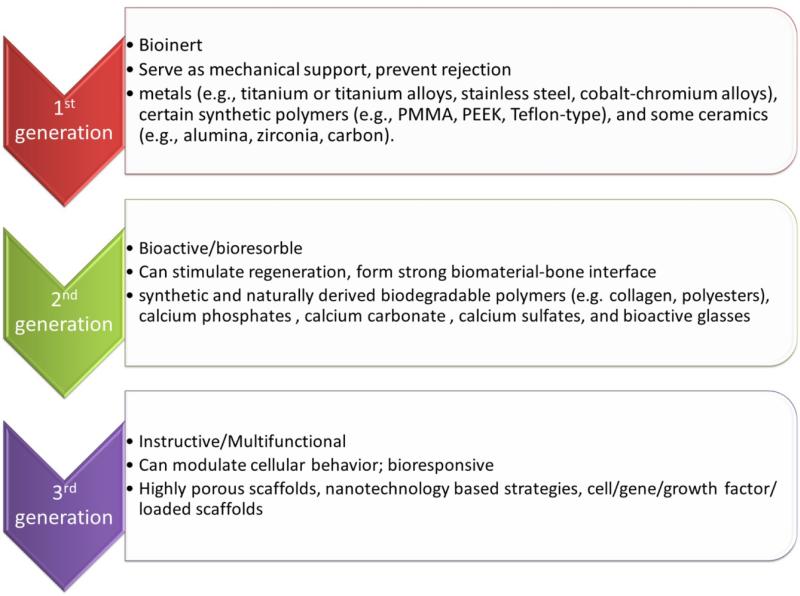
Evolution of biomaterials from 1st generation to 3rd generation with improving functionality
Fig 2
Fig 2
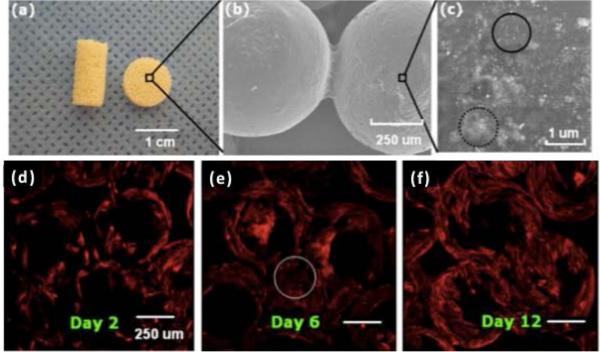
Macro, micro and nano structure of PNEPhA-20 nHAp composite microsphere scaffolds. (a) Optical image showing cylindrical (10 mm length & 4.5 mm diameter) and disk (2 mm thick & 8 mm diameter) shaped scaffolds fabricated using the dynamic solvent sintering method. Cylindrical scaffolds were used for mechanical testing, and disk shaped scaffolds for porosity and in vitro cell studies. (b) SEM showing the microstructure of the scaffolds where the adjacent microspheres are fused via the dynamic solvent sintering method. (c) High magnification scanning electron micrograph showing nano HAp particle dispersion on a microsphere surface. The circled regions show nHAp mono (solid line) and poly (dotted line) dispersion. Cytoskeletal actin distribution of primary rat osteoblast cells grown on composite microsphere matrix for (d) 2, (e) 6 and (f) 12 days. The circled region shows higher initial cell proliferation at the microsphere adjoining areas. DAPI (nuclei stain) emission is not included because of its interference with polymer PNEPhA blue emission[211]. Figures reproduced with permission
Fig 3
Fig 3
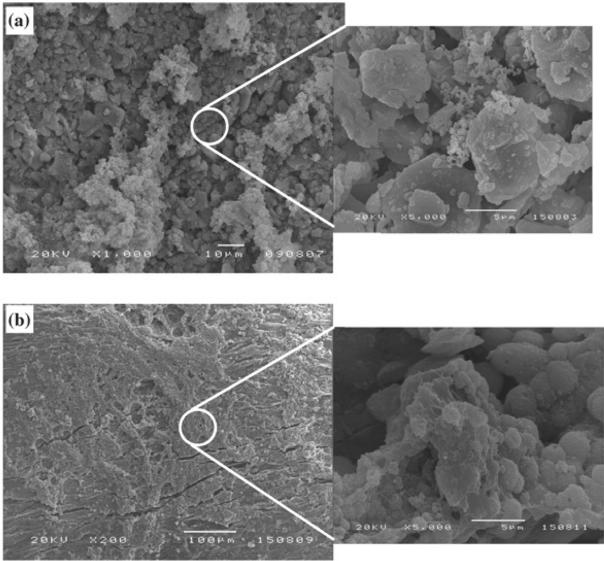
SEM micrographs showing surfaces of BioglassI-coated PDLLA foams after degradation in contact with SBF for: (a) 7 days and (b) 28 days. The micrographs reveal formation of HA crystals and development of a surface HA layer[228]. Figures reproduced with permission
Fig 4
Fig 4
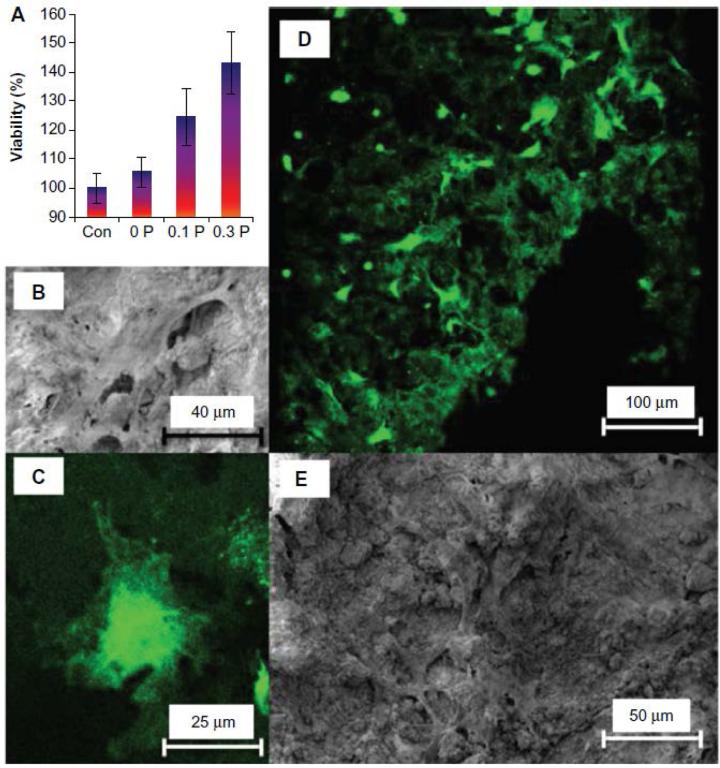
Effect of incorporation of PEDOT on bone tissue engineering scaffolds: (A) Cytoplasmic content of human mesenchymal stem cells on the 0 P, 0.1 P, and 0.3 P scaffolds in comparison to tissue culture plastic (control sample) shows that the number of viable cells increases by increasing the poly(3,4-ethylenedioxythiophene) poly(4-styrene sulfonate) concentration in the composition of scaffolds. The values are mean ± standard deviation (number of samples =3). (B) Scanning electron microscopy and (C) confocal fluorescent microscopy images of a cell on the 0.3 P scaffold. (D) Scanning electron microscopy and (E) confocal fluorescent image of cell distribution on the 0.3 P scaffold. Enhanced cell attachment is observed for the conductive scaffolds[268]. Figures reproduced with permission
Fig 5
Fig 5
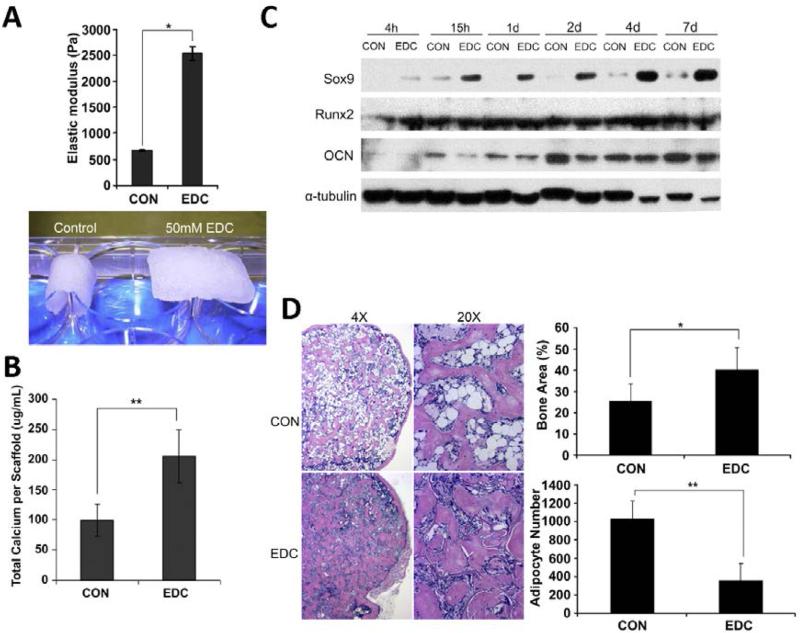
Influence of scaffold mechanical properties on stem cell-mediated bone regeneration: A) The elastic modulus of the scaffolds was significantly increased after EDC-treatment. EDC-treated scaffold were able to resistant deformation due to gravitational force. B) Total calciumwas increased by EDC-treatment in osteoblasts (n ¼ 3). **p < 0.01. C) Chondrogenic and osteogenic protein levels on different scaffolds were detected by Western blot analysis. The experiments were repeated at least 2 times, and the representative data are shown. D) Histologic analysis of new bone formation. EDC scaffolds significantly enhanced the bone volume fraction (BVF). Moreover, the adipocyte numbers in the EDC group were significantly lower than in the CON group (n ¼ 7 or 9). Data are expressed as means ? SD. *p < 0.01; **p < 0.001 Figures reproduced with permission
Fig 6
Fig 6
Stiffness of biomaterials influence the behavior of stem cells such as adhesion and cell fate commitment: A) mMSC grown on alginate matrices with different stiffness and immunofluorescence stained for OCN (green) and nuclear (DAPI, blue)[273] B) hMSC plated on PDMS micropost arrays with varying rigidity controlled by indicated heights and imaged with scanning electron microscope (SEM). Scale bar, 30 μm C) ALP and Lip staining on hMSCs after 14 d culture in bipotential differentiation medium on micropost arrays of indicated rigidities. Scale bar, 300 μm[277]. Figures reproduced with permission
Fig 7
Fig 7
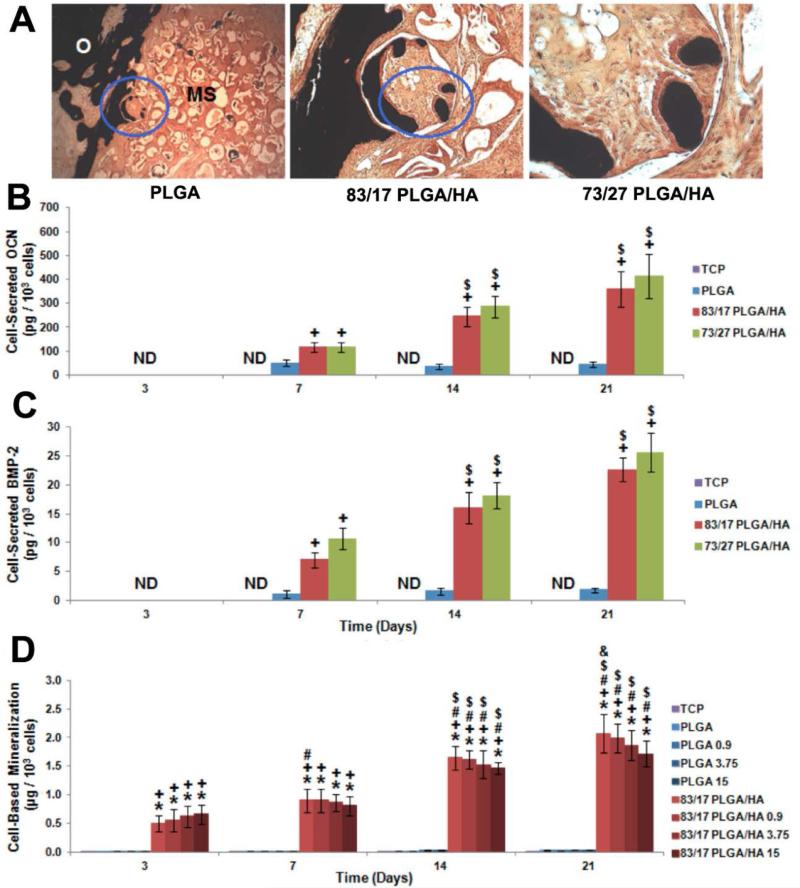
Simple signaling molecules for inductive bone regenerative engineering: A) New bone formation visualized by von Kossa staining on scaffolds with different composition microspheres B) OCN expression by MSCs after seeded on various PLGA/HA scaffolds: the presence of HA in scaffolds contributed to the majority of OCN production. C) BMP-2 secreted from MSCs grown on PLGA/HA scaffolds for various time: significant BMP-2 expression was only observed in HA containing groups. D) Mineralization assessed by Alizarin Red staining after seeding MSCs on various scaffolds: cell mediated mineralization was only observed on HA containing groups[283]. Figures reproduced with permission

References

    1. Baroli B. J. Pharm. Sci. 2009;98:1317. - PubMed
    1. Brinker MR, O'Connor DP. J. Bone Joint Surg. Am. 2004;86-A:290. - PubMed
    1. Laurencin C, Khan Y, El-Amin SF. Expert Rev. Med. Devices. 2006;3:49. - PubMed
    1. Parikh SN. J. Postgrad. Med. 2002;48:142. - PubMed
    1. Santos MI, Reis RL. Macromol. Biosci. 2010;10:12. - PubMed

Publication types

Substances

LinkOut - more resources