. 2015 Jul;97(1):166-78.
doi: 10.1111/mmi.13018. Epub 2015 May 9.

Extracellular zinc induces phosphoethanolamine addition to Pseudomonas aeruginosa lipid A via the ColRS two-component system

Affiliations

Extracellular zinc induces phosphoethanolamine addition to Pseudomonas aeruginosa lipid A via the ColRS two-component system

Emily M Nowicki et al. Mol Microbiol. 2015 Jul.

Abstract

Gram-negative bacteria survive harmful environmental stressors by modifying their outer membrane. Much of this protection is afforded upon remodeling of the lipid A region of the major surface molecule lipopolysaccharide (LPS). For example, the addition of cationic substituents, such as 4-amino-4-deoxy-L-arabinose (L-Ara4N) and phosphoehthanolamine (pEtN) at the lipid A phosphate groups, is often induced in response to specific environmental flux stabilizing the outer membrane. The work herein represents the first report of pEtN addition to Pseudomonas aeruginosa lipid A. We have identified the key pEtN transferase which we named EptAPa and characterized its strict activity on only one position of lipid A, contrasting from previously studied EptA enzymes. We further show that transcription of eptAP a is regulated by zinc via the ColRS two-component system instead of the PmrAB system responsible for eptA regulation in E. coli and Salmonella enterica. Further, although L-Ara4N is readily added to the same position of lipid A as pEtN under certain environmental conditions, ColR specifically induces pEtN addition to lipid A in lieu of L-Ara4N when Zn2+ is present. The unique, specific regulation of eptAP a transcription and enzymatic activity described in this work demonstrates the tight yet inducible control over LPS modification in P. aeruginosa.


Figures

Fig 1
Fig 1
Lipid A structure of P. aeruginosa with and without inducible modifications. A) Canonical, hexa-acylated, bis-phosphorylated lipid A structure is shown in black. Phosphorylation of the lipid A phosphate groups by LpxT, which occurs in standard growth media, is indicated in brown. B) Inducible modifications to P. aeruginosa lipid A are indicated in color, including addition of a palmitate chain by PagP (green), removal of the 3-hydroxydecanoate acyl chain by PagL (pink), hydroxylation of the C12 secondary acyl chain(s) by LpxO (orange), addition of L-Ara4N at the lipid A phosphate groups by ArnT (blue), and pEtN addition by EptA (red).
Fig 2
Fig 2
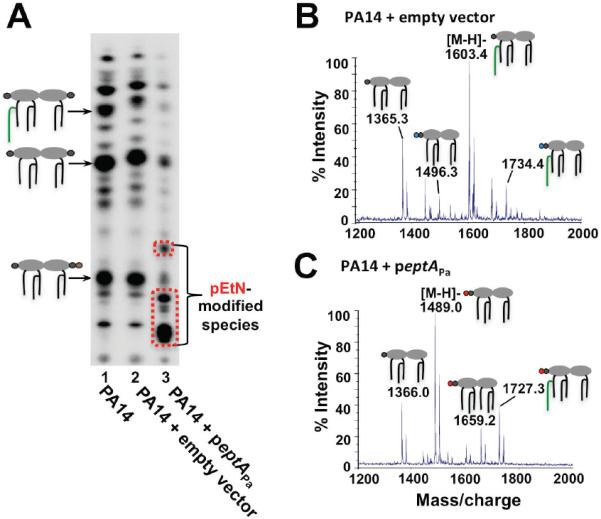
Heterologous expression of a P. aeruginosa eptA ortholog results in pEtN addition to the lipid A. A) Cells were grown in MOPS minimal medium. Major 32P-labeled lipid A species are indicated with a cartoon corresponding to the lipid A structure; colors of modification groups are the same as those used in Fig. 1. Expression of PA14_39020 (eptAPa) in P. aeruginosa results in modified lipid A species. B) MALDI-TOF MS analysis of PA14 + empty vector grown in MOPS minimal medium reveals no pEtN addition to the molecule, while C) analysis of PA14 + peptAPa shows pEtN modification of the lipid A. The fractions most representative of pEtN modification are shown.
Fig 3
Fig 3
EptAPa adds pEtN exclusively to the lipid A 4' phosphate group. A) Cells were grown in LB broth. Major 32P-labeled lipid A species are indicated with a cartoon corresponding to the lipid A structure; colors of modification groups are the same as those used in Fig. 1. Heterologous expression of eptAPa in BN2 results in a pEtN-modified species, while expression of either the lpxEFn or lpxFFn phosphatase results in an increased of monophosphorylated species. Co-expression of lpxEFn and eptAPa results in pEtN addition to the 1-dephosphorylated lipid A molecule, while no pEtN addition of 4' –dephosphorylated species is detected. B) MALDI-TOF analysis of lipid A isolated from BN2 coexpressing lpxEFn and eptAPa corroborates the presence of a monophosphorylated, pEtN-modified species. C) MALDI-TOF analysis of lipid A isolated from BN2 coexpressing lpxFFn and eptAPa reveals that when the 4' phosphate group is removed, pEtN addition does not occur.
Fig 4
Fig 4
Zn2+ induces transcription of eptAPa. A) Cells were grown in LB broth. Major 32P-labeled lipid A species are indicated with a cartoon corresponding to the lipid A structure; colors of modification groups are the same as those used in Fig. 1. Both heterologous expression of eptAPa as well as addition of 2mM ZnSO4 to the media results in pEtN addition to lipid A. This modification is not detectable in the eptAPa mutant, but restored upon complementation with peptAnprom. B) Relative gene expression of eptAPa and arnT in response to Zn2+. Transcription of eptAPa is induced by 2mM ZnSO4 approximately 21-fold. Zn2+ downregulates arnT transcription by >4-fold. Ratios were standardized relative to expression of the housekeeping control gene, clpX. C), D) and E). MALDI-TOF MS analysis of lipid A prepared from cells grown in LB broth. C) Analysis of PA14 + 2mM ZnSO4 reveals pEtN addition to lipid A, while D) ΔeptAPa + 2mM ZnSO4 shows no pEtN modification, but instead L-Ara4N addition. E) Complementation of ΔeptAPa with peptAnprom restores pEtN addition to the lipid A in response to Zn2+. The fractions most representative of pEtN modification are shown.
Fig 5
Fig 5
The two-component system response regulator ColR activates eptAPa transcription. A) Putative eptAPa promoter ColR binding sites are in bold and boxed; nucleotides that deviate from the conserved recognition sequence in P. putida ((T/C)(T/C)NA(C/G)NN(T/C)TTTTT(C/G)AC) are indicated in red. The number of base pairs between ColR sites or upstream of the start codon is indicated. B) Semi-quantitative RT-PCR of cDNA prepared from cells grown in MOPS minimal medium. While eptAPa is not transcribed in PA14, expression of colR in trans results in eptAPa transcription. C) Lipid A was isolated from 32P-labeled cells grown in MOPS minimal medium and separated by TLC. Only expression of the colR response regulator, and not pmrA or phoP, results in pEtN modification of lipid A. D) MALDI-TOF MS analysis of PA14 + pcolR grown in MOPS minimal medium reveals pEtN-modified lipid A. The fraction most representative of pEtN modification is shown.
Fig 6
Fig 6
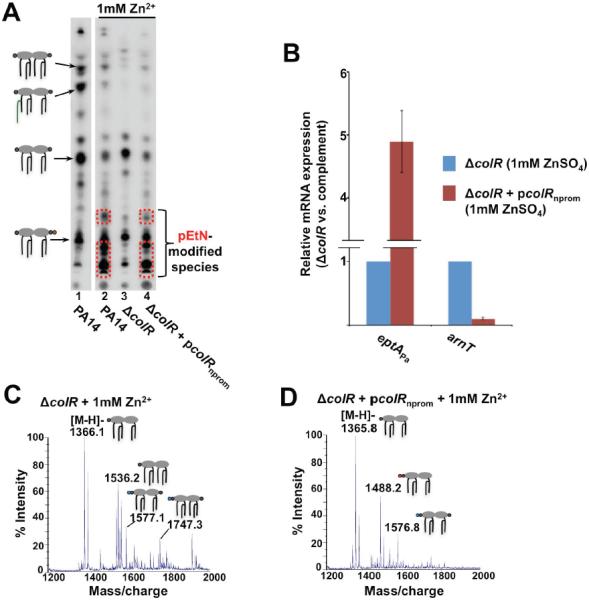
Deletion of colR results in loss of Zn2+-induced pEtN modification of P. aeruginosa lipid A. A) Lipid A was isolated from 32P-labeled cells grown in LB broth and separated by TLC. While pEtN modification of lipid A is detectable for PA14 + 1mM ZnSO4, no such modification occurs in PA14ΔcolR in response to Zn2+. Modification is restored in the complemented mutant. B) Relative gene expression of eptAPa and arnT in response to Zn2+ in the ΔcolR mutant or complemented mutant. Transcription of eptAPa in the presence of 1mM ZnSO4 is induced >4-fold in a ColR-dependent manner. An approximately 10-fold decrease in arnT transcription in the presence of 1mM ZnSO4 is also dependent on ColR. Ratios were standardized relative to expression of the housekeeping control gene, clpX. C) and D). MALDI-TOF MS analysis of lipid A prepared from cells grown in LB broth. C) No pEtN modification is detected in the PA14ΔcolR mutant grown in LB + 1mM ZnSO4. D) Complementation of PA14ΔcolR with pcolRnprom restores the Zn2+-dependent pEtN addition to the lipid A. The fractions most representative of pEtN modification are shown.
Fig 7
Fig 7
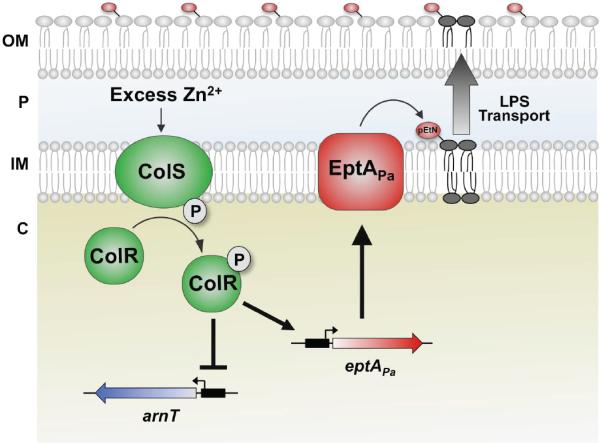
Proposed model of pEtN addition to P. aeruginosa lipid A. Upon sensing excess Zn2+, the ColS sensor kinase (green) autophosphorylates and transfers a phosphate group to the response regulator ColR (green). ColR then acts as a transcription factor, inducing transcription of eptAPa (red) while inhibiting that of arnT (blue). EptAPa protein is synthesized and transfers pEtN to the 4′-phosphate group of lipid A in the inner membrane. Lipid A is then transported to the bacterial cell surface. Following transport to the outer membrane, the 3-hydroxydecanoate acyl chain is removed by PagL (indicated in the model). In some instances, PagP can modify the lipid A (not shown). Cellular components are labelled as follows: OM, outer membrane; P, periplasm; IM, inner membrane; C, cytoplasm).

References

    1. Ainsaar K, Mumm K, Ilves H, Hõrak R. The ColRS signal transduction system responds to the excess of external zinc, iron, manganese, and cadmium. BMC Microbiol. 2014;14:162. - PMC - PubMed
    1. Andreini C, Bertini I, Cavallaro G, Holliday GL, Thornton JM. Metal ions in biological catalysis: from enzyme databases to general principles. JBIC J Biol Inorg Chem. 2008;13:1205–1218. - PubMed
    1. Bader MW, Sanowar S, Daley ME, Schneider AR, Cho U, Xu W, et al. Recognition of Antimicrobial Peptides by a Bacterial Sensor Kinase. Cell. 2005;122:461–472. - PubMed
    1. Ballesta S, Conejo MC, García I, Rodríguez-Martínez JM, Velasco C, Pascual A. Survival and resistance to imipenem of Pseudomonas aeruginosa on latex gloves. J Antimicrob Chemother. 2006;57:1010–1012. - PubMed
    1. Bhat R, Marx A, Galanos C, Conrad RS. Structural studies of lipid A from Pseudomonas aeruginosa PAO1: occurrence of 4-amino-4-deoxyarabinose. J Bacteriol. 1990;172:6631–6636. - PMC - PubMed

Publication types

MeSH terms

LinkOut - more resources