


Air pollution exposure: a novel environmental risk factor for interstitial lung disease?
- PMID: 25846532
- PMCID: PMC4388120
- DOI: 10.1378/chest.14-1299
Air pollution exposure: a novel environmental risk factor for interstitial lung disease?
Abstract
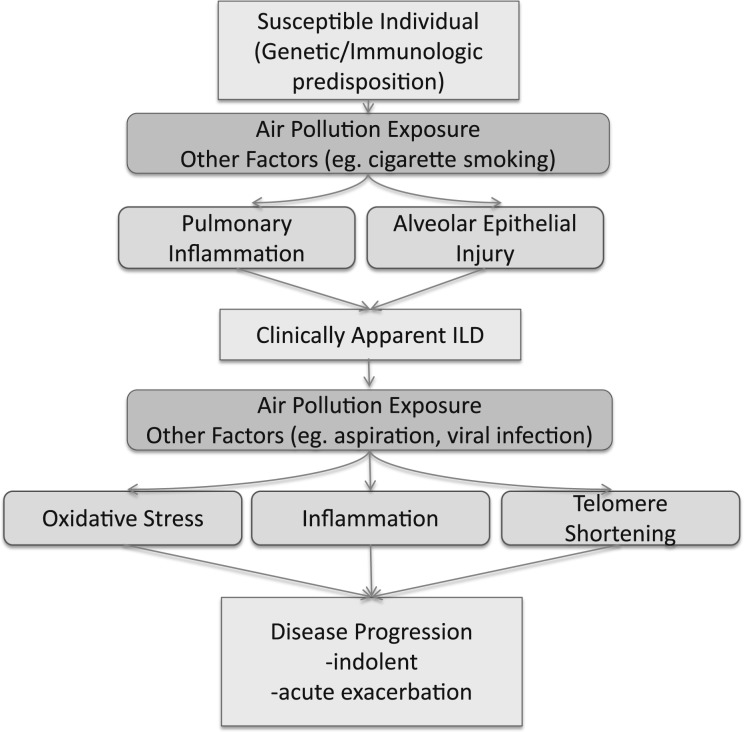
Air pollution exposure is a well-established risk factor for several adverse respiratory outcomes, including airways diseases and lung cancer. Few studies have investigated the relationship between air pollution and interstitial lung disease (ILD) despite many forms of ILD arising from environmental exposures. There are potential mechanisms by which air pollution could cause, exacerbate, or accelerate the progression of certain forms of ILD via pulmonary and systemic inflammation as well as oxidative stress. This article will review the current epidemiologic and translational data supporting the plausibility of this relationship and propose a new conceptual framework for characterizing novel environmental risk factors for these forms of lung disease.
Figures
References
-
- Pinkerton KE. A Critical Review of the Particulate Matter Toxicology Literature for Senate Bill 25 Review of the Particulate Matter Standard. Sacramento, CA: California Environmental Protection Agency, Air Resources Board, Research Division; 2002:1-93.
-
- Ayyagari VN, Januszkiewicz A, Nath J. Pro-inflammatory responses of human bronchial epithelial cells to acute nitrogen dioxide exposure. Toxicology. 2004;197(2):149-164. - PubMed
-
- Solomon C, Christian DL, Chen LL, et al. Effect of serial-day exposure to nitrogen dioxide on airway and blood leukocytes and lymphocyte subsets. Eur Respir J. 2000;15(5):922-928. - PubMed
-
- Frampton MW, Boscia J, Roberts NJ, Jr, et al. Nitrogen dioxide exposure: effects on airway and blood cells. Am J Physiol Lung Cell Mol Physiol. 2002;282(1):L155-L165. - PubMed
Publication types
MeSH terms
LinkOut - more resources
Full Text Sources
Other Literature Sources
Medical
