


Cortical activity is more stable when sensory stimuli are consciously perceived
- PMID: 25847997
- PMCID: PMC4413285
- DOI: 10.1073/pnas.1418730112
Cortical activity is more stable when sensory stimuli are consciously perceived
Abstract
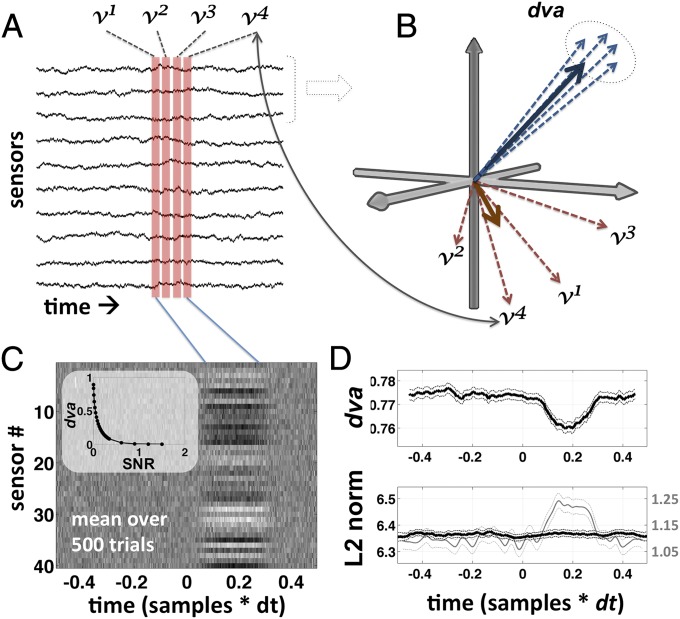
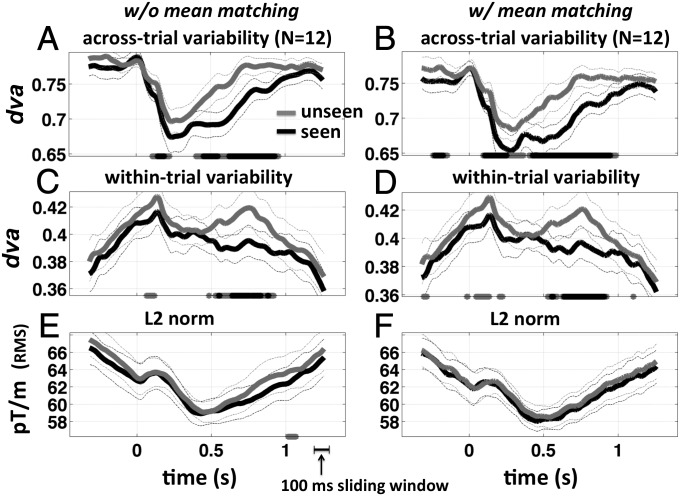
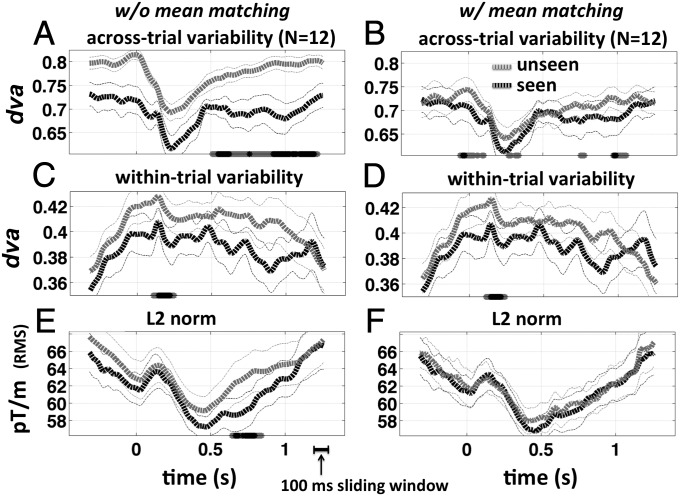
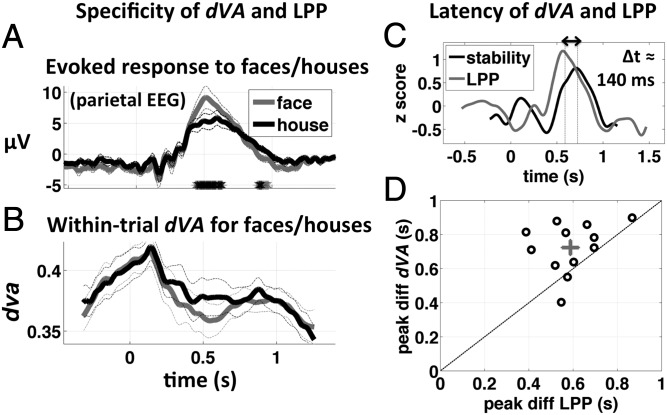
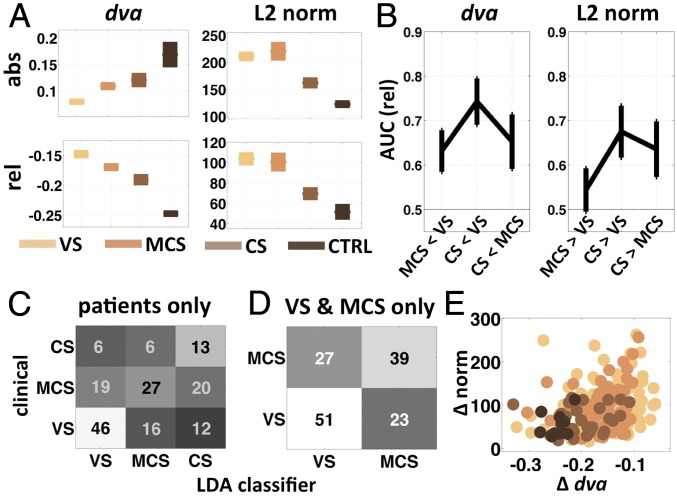
According to recent evidence, stimulus-tuned neurons in the cerebral cortex exhibit reduced variability in firing rate across trials, after the onset of a stimulus. However, in order for a reduction in variability to be directly relevant to perception and behavior, it must be realized within trial--the pattern of activity must be relatively stable. Stability is characteristic of decision states in recurrent attractor networks, and its possible relevance to conscious perception has been suggested by theorists. However, it is difficult to measure on the within-trial time scales and broadly distributed spatial scales relevant to perception. We recorded simultaneous magneto- and electroencephalography (MEG and EEG) data while subjects observed threshold-level visual stimuli. Pattern-similarity analyses applied to the data from MEG gradiometers uncovered a pronounced decrease in variability across trials after stimulus onset, consistent with previous single-unit data. This was followed by a significant divergence in variability depending upon subjective report (seen/unseen), with seen trials exhibiting less variability. Applying the same analysis across time, within trial, we found that the latter effect coincided in time with a difference in the stability of the pattern of activity. Stability alone could be used to classify data from individual trials as "seen" or "unseen." The same metric applied to EEG data from patients with disorders of consciousness exposed to auditory stimuli diverged parametrically according to clinically diagnosed level of consciousness. Differences in signal strength could not account for these results. Conscious perception may involve the transient stabilization of distributed cortical networks, corresponding to a global brain-scale decision.
Keywords: consciousness; correlated variability; directional variance; dynamical systems; pattern similarity.
Conflict of interest statement
The authors declare no conflict of interest.
Figures
Comment in
-
Perceptual choice boosts network stability: effect of neuromodulation?Trends Cogn Sci. 2015 Jul;19(7):362-4. doi: 10.1016/j.tics.2015.05.007. Epub 2015 Jun 1. Trends Cogn Sci. 2015. PMID: 26044825
References
-
- Schurger A, Pereira F, Treisman A, Cohen JD. Reproducibility distinguishes conscious from nonconscious neural representations. Science. 2010;327(5961):97–99. - PubMed
Publication types
MeSH terms
LinkOut - more resources
Full Text Sources
Other Literature Sources
