


Percutaneous aspiration versus catheter drainage of liver abscess: A retrospective review
- PMID: 25848403
- PMCID: PMC4321198
- DOI: 10.4066/AMJ.2015.2240
Percutaneous aspiration versus catheter drainage of liver abscess: A retrospective review
Abstract
Background: A review of the effectiveness and outcomes in liver abscess drainage performed by different operators using percutaneous aspiration (PA) and catheter drainage (PCD), respectively, from 2008-2013 at Sir Charles Gairdner Hospital, a tertiary hospital in Australia.
Methods: Forty-two patients (29 males and 13 females; aged between 28-93 years; median age of 67 years) with liver abscesses underwent either ultrasound or CT-guided PA (n=22) and PCD (n=20) in conjunction with appropriate antimicrobial therapy. A median of 18 Gauge needle and 10 French catheters were utilised.
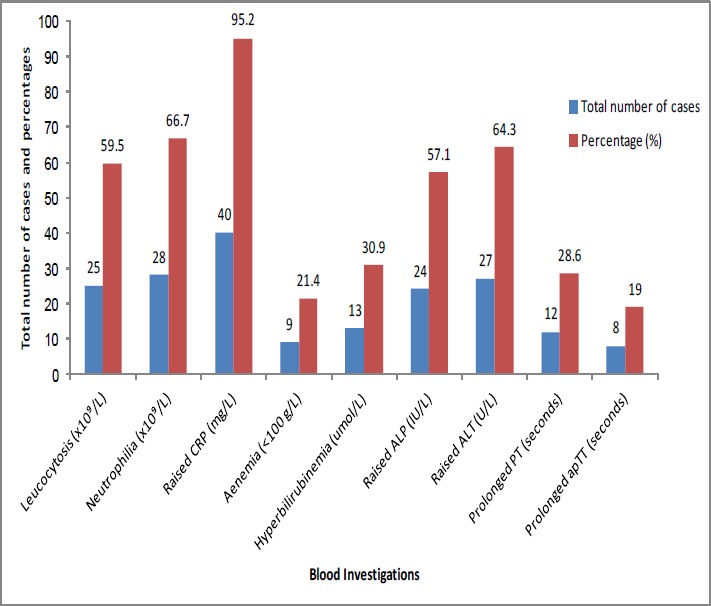
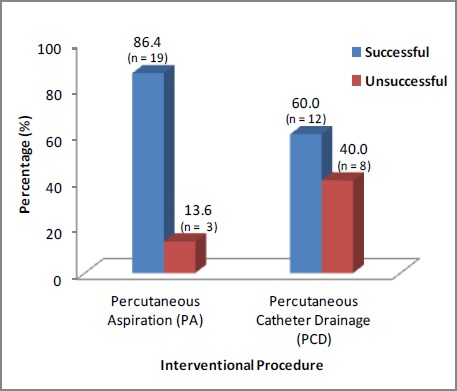
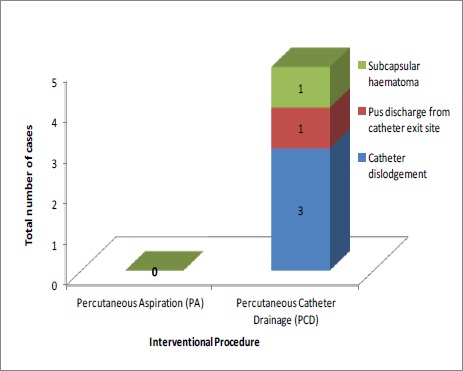
Results: Nineteen (86.4 per cent) PA cases and 12 (60 per cent) PCD cases were successfully drained on a single attempt (p=0.08). More male patients (69 per cent) than females (31 per cent) were observed. Portal sepsis (42.9 per cent) was the most common cause identified. Fever (47.6 per cent) was the most frequent clinical presentation on admission. Thirty-two patients (76.2 per cent) had solitary abscesses with a right lobe (59.5 per cent) predilection. CRP was significantly raised. The PCD group observed a significantly larger abscess size (p=0.01). Klebsiella pneumoniae was the most common organism isolated in both pus (33.3 per cent) and blood cultures (11.9 per cent). Five procedure-related complications were noted, all in the PCD group. Thirty-day mortality was 2.4 per cent. No difference was observed in clinical and treatment outcomes in both groups.
Conclusion: The null hypothesis that both PA and PCD are equally effective in the drainage of liver abscess cannot be rejected. Apart from PA being simpler and safer to perform, the higher incidence of indwelling catheter-associated complications suggests that a trial of PA should always be attempted first.
Keywords: Aspiration; catheter drainage; interventional radiology; liver abscess.
Conflict of interest statement
The authors declare that they have no competing interests.
Figures
References
-
- Zerem E, Hadzic A. Sonographically guided percutaneous catheter drainage versus needle aspiration in the management of pyogenic liver abscess. AJR. Am J Roentgenol. 2007;3:W138–2. doi:10.2214/ajr.07.2173. - PubMed
-
- Liu CH, Gervais DA, Hahn PF, Arellano RS, Uppot RN, Mueller PR. Percutaneous hepatic abscess drainage: do multiple abscesses or multiloculated abscesses preclude drainage or affect outcome? Vasc Interv Radiol. 2009;8:1059–65. doi: 10.1016/j.jvir.2009.04.062. - PubMed
-
- Ng WC, Li WH, Cheung MT. Audit of management of pyogenic liver abscess in a tertiary referral hospital. Surgical Practice. 2008;1:7–10. doi:10.1111/j.1744- 1633.2007.00385.x.
LinkOut - more resources
Full Text Sources
Research Materials
Miscellaneous