Heroin activates ATF3 and CytC via c-Jun N-terminal kinase pathways to mediate neuronal apoptosis
- PMID: 25848832
- PMCID: PMC4400970
- DOI: 10.12659/MSMBR.893827
Heroin activates ATF3 and CytC via c-Jun N-terminal kinase pathways to mediate neuronal apoptosis
Abstract
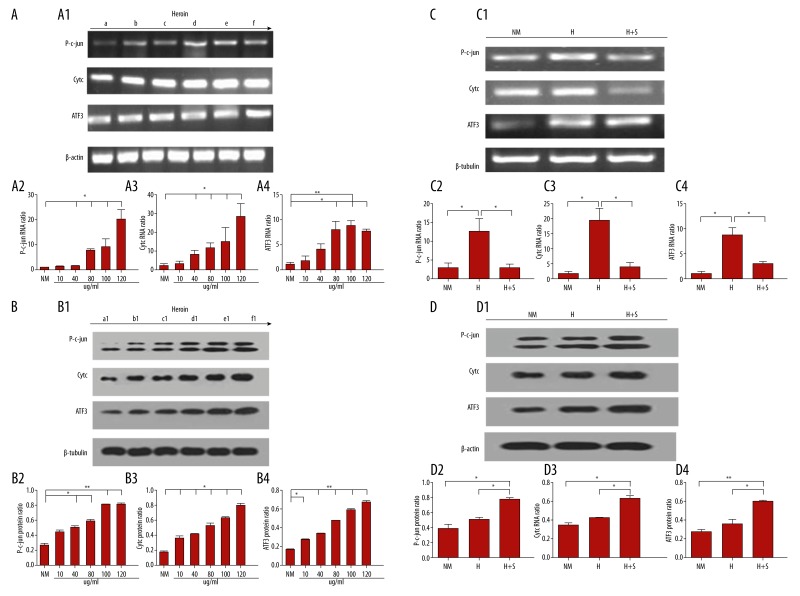
BACKGROUND Drug abuse and addiction has become a major public health problem that impacts all societies. The use of heroin may cause spongiform leukoencephalopathy (SLE). MATERIAL AND METHODS Cerebellar granule cells were derived from 7-day-old Sprague-Dawley rat pups. Neurons were dissociated from freshly dissected cerebella by mechanical disruption in the presence of 0.125% trypsin and DNaseI and then seeded at a density of 4×10^6 cells/ml in Dulbecco's modified Eagle's medium/nutrient mixture F-12 ham's containing 10% fetal bovine serum and Arc-C(sigma) at concentrations to inhibit glial cell growth inoculated into 6-well plates and a small dish. RESULTS We found that heroin induces the apoptosis of primary cultured cerebellar granule cells (CGCS) and that the c-Jun N-terminal kinase (JNK) pathway was activated under heroin treatment and stimulated obvious increases in the levels of C-jun, Cytc, and ATF3mRNA. CYTC and ATF3 were identified as candidate targets of the JNK/c-Jun pathway in this process because the specificity inhibitors SP600125 of JNK/C-jun pathways reduced the levels of C-jun, Cytc, and ATF3mRNA. The results suggested that SP600125 of JNK/C-jun can inhibit heroin-induced apoptosis of neurons. CONCLUSIONS The present study analyzes our understanding of the critical role of the JNK pathway in the process of neuronal apoptosis induced by heroin, and suggests a new and effective strategy to treat SLE.
Figures

References
-
- Jordan MT, Bryant SM, Aks SE, et al. A five-year review of the medical outcome of heroin body stuffers. J Emerg Med. 2009;36(3):250–56. - PubMed
-
- Nutt D, King LA, Saulsbury W, et al. Development of a rational scale to assess the harm of drugs of potential misuse. Lancet. 2007;369(9566):1047–53. - PubMed
-
- Di Chiara G, Bassareo V. Reward system and addiction: what dopamine does and doesn’t do. Curr Opin Pharmacol. 2007;7(1):69–76. - PubMed
-
- Büttner A, Mall G, Penning R, et al. The neuropathology of heroin abuse. Forensic Sci Int. 2000;113(1–3):435–42. - PubMed
-
- Vassilev LT, Vu BT, Graves B, et al. In vivo activation of the p53 pathway by small-molecule antagonists of MDM2. Science. 2004;303(5659):844–48. - PubMed
MeSH terms
Substances
LinkOut - more resources
Full Text Sources
Molecular Biology Databases
Research Materials
Miscellaneous