Review
. 2015 Oct:124:104-10.
doi: 10.1016/j.nlm.2015.03.005. Epub 2015 Apr 4.

Interneuron epigenomes during the critical period of cortical plasticity: Implications for schizophrenia

Affiliations
Review

Interneuron epigenomes during the critical period of cortical plasticity: Implications for schizophrenia

Hirofumi Morishita et al. Neurobiol Learn Mem. 2015 Oct.

Abstract

Schizophrenia, a major psychiatric disorder defined by delusions and hallucinations, among other symptoms, often with onset in early adulthood, is potentially associated with molecular and cellular alterations in parvalbumin-expressing fast spiking interneurons and other constituents of the cortical inhibitory GABAergic circuitry. The underlying mechanisms, including the role of disease-associated risk factors operating in adolescence such as drug abuse and social stressors, remain incompletely understood. Here, we summarize emerging findings from animal models, highlighting the ability of parvalbuminergic interneurons (PVI) to induce, during the juvenile period, long-term plastic changes in prefrontal and visual cortex, thereby altering perception, cognition and behavior in the adult. Of note, molecular alterations in PVI from subjects with schizophrenia, including downregulated expression of a subset of GABAergic genes, have also been found in juvenile stress models of the disorder. Some of the transcriptional alterations observed in schizophrenia postmortem brain could be linked to changes in the epigenetic architecture of GABAergic gene promoters, including dysregulated DNA methylation, histone modification patterns and disruption of promoter-enhancer interactions at site of chromosomal loop formations. Therefore, we predict that, in the not-to-distant future, PVI- and other cell-type specific epigenomic mappings in the animal model and human brain will provide novel insights into the pathophysiology of schizophrenia and related psychotic diseases, including the role of cortical GABAergic circuitry in shaping long-term plasticity and cognitive function of the cerebral cortex.

Keywords: Cortical plasticity; Critical period; Epigenome; Parvalbuminergic interneuron; Schizophrenia.


Figures

Figure 1
Figure 1. Central role of PVIs in developmental critical period for cortical plasticity
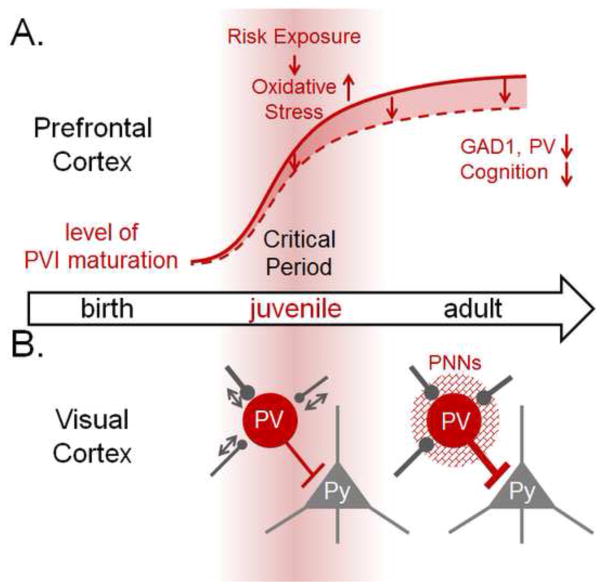
(A) Protracted maturation of PVIs in prefrontal cortex plays a key role in the pathophysiology of SCZ. A heightened vulnerability of PVIs during juvenile development to exposure to risk factors, which collectively cause oxidative stress, results in subsequent deviation from the normal course of development (red line) into maladaptive trajectories (dotted line). This leads to lasting deficits in the expression of neuropsychiatric risk genes (e.g. GAD1, PV), and schizophrenia-related cognitive behaviors in the adult. Red background represents the extent of plasticity. (B) Protracted postnatal maturation of perisomatic innervation of PVIs triggers the onset of experience-dependent plasticity in visual cortex. During critical period, PVIs and their inputs are plastic (arrows). Visual deprivation rapidly leads to the reduction of excitatory inputs onto PVIs and PVI activity within one day leading to the disinhibition of pyramidal (Py) neurons. This in turn triggers the expression of global ocular dominance plasticity after a few days in visual cortex. After the critical period, expression of molecular brakes including perineuronal nets (PNNs: mesh around PVIs) limits rapid PVI plasticity as well as subsequent global plasticity. These mechanisms of plasticity associated with PVIs will provide a novel framework for the future investigation of PVI-dependent regulation of prefrontal cortex maturation in health and disease.
Figure 2
Figure 2. Epigenetic regulation at the GAD1/GAD67 gene locus
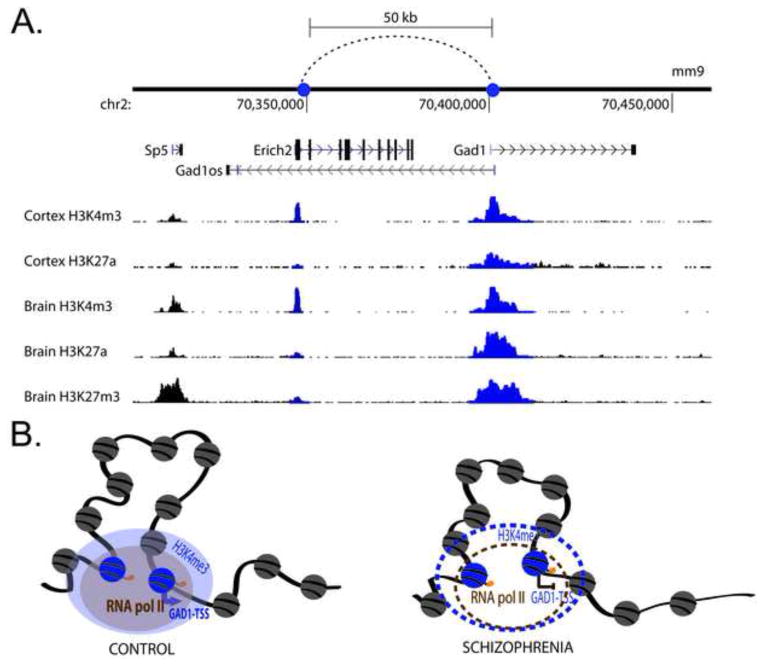
(A) Chromosomal loopings between 5′ end of Gad1-TSS and regulatory sequences 50kb upstream marked by a H3K4me3 peak and additional histone modifications in human and mouse cortex. It is selectively labeled with H3K4me3 sites in cortex (Bernstein, Birney, Dunham, Green, Gunter, and Snyder, 2012). (B) This 50-kb loop also exists in humans and is characterized by RNA polymerase II binding and H3K4me3 sites. The loop is weakened in the prefrontal cortex of subjects with schizophrenia along with decreased GAD1 gene expression, loss of the H3K4me3 mark, altered levels of CpG island, and probably also RNA polymerase II binding.

Similar articles

Cited by

References

    1. Aberg KA, McClay JL, Nerella S, Clark S, Kumar G, Chen W, Khachane AN, Xie L, Hudson A, Gao G, Harada A, Hultman CM, Sullivan PF, Magnusson PK, van den Oord EJ. Methylome-Wide Association Study of Schizophrenia: Identifying Blood Biomarker Signatures of Environmental Insults. JAMA Psychiatry 2014 - PMC - PubMed
    1. Akbarian S, Huang HS. Molecular and cellular mechanisms of altered GAD1/GAD67 expression in schizophrenia and related disorders. Brain Res Rev. 2006;52:293–304. - PubMed
    1. Andreassen OA, Thompson WK, Dale AM. Boosting the power of schizophrenia genetics by leveraging new statistical tools. Schizophr Bull. 2014;40:13–17. - PMC - PubMed
    1. Aton SJ, Broussard C, Dumoulin M, Seibt J, Watson A, Coleman T, Frank MG. Visual experience and subsequent sleep induce sequential plastic changes in putative inhibitory and excitatory cortical neurons. Proc Natl Acad Sci U S A. 2013;110:3101–3106. - PMC - PubMed
    1. Auta J, Smith RC, Dong E, Tueting P, Sershen H, Boules S, Lajtha A, Davis J, Guidotti A. DNA-methylation gene network dysregulation in peripheral blood lymphocytes of schizophrenia patients. Schizophr Res. 2013;150:312–318. - PMC - PubMed

Publication types

MeSH terms