. 2015 May;21(5):506-11.
doi: 10.1038/nm.3787. Epub 2015 Apr 6.

Metformin activates a duodenal Ampk-dependent pathway to lower hepatic glucose production in rats

Affiliations

Metformin activates a duodenal Ampk-dependent pathway to lower hepatic glucose production in rats

Frank A Duca et al. Nat Med. 2015 May.

Erratum in

Abstract

Metformin is a first-line therapeutic option for the treatment of type 2 diabetes, even though its underlying mechanisms of action are relatively unclear. Metformin lowers blood glucose levels by inhibiting hepatic glucose production (HGP), an effect originally postulated to be due to a hepatic AMP-activated protein kinase (AMPK)-dependent mechanism. However, studies have questioned the contribution of hepatic AMPK to the effects of metformin on lowering hyperglycemia, and a gut-brain-liver axis that mediates intestinal nutrient- and hormone-induced lowering of HGP has been identified. Thus, it is possible that metformin affects HGP through this inter-organ crosstalk. Here we show that intraduodenal infusion of metformin for 50 min activated duodenal mucosal Ampk and lowered HGP in a rat 3 d high fat diet (HFD)-induced model of insulin resistance. Inhibition of duodenal Ampk negated the HGP-lowering effect of intraduodenal metformin, and both duodenal glucagon-like peptide-1 receptor (Glp-1r)-protein kinase A (Pka) signaling and a neuronal-mediated gut-brain-liver pathway were required for metformin to lower HGP. Preabsorptive metformin also lowered HGP in rat models of 28 d HFD-induced obesity and insulin resistance and nicotinamide (NA)-streptozotocin (STZ)-HFD-induced type 2 diabetes. In an unclamped setting, inhibition of duodenal Ampk reduced the glucose-lowering effects of a bolus metformin treatment in rat models of diabetes. These findings show that, in rat models of both obesity and diabetes, metformin activates a previously unappreciated duodenal Ampk-dependent pathway to lower HGP and plasma glucose levels.


Figures
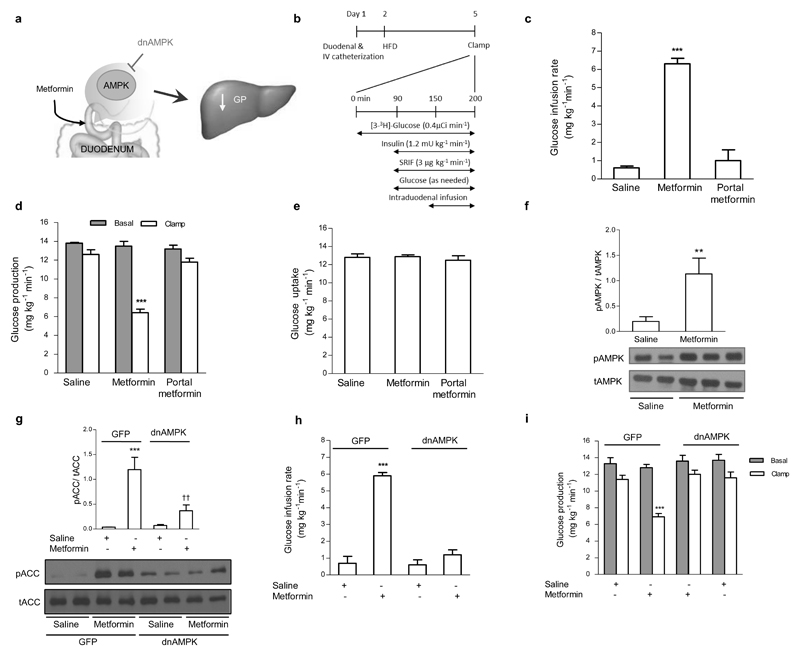
Figure 1
Figure 1. Intraduodenal metformin infusion activates duodenal AMPK to lower GP in the preasbsorptive state.
(a) Schematic representation of the working hypothesis. Intraduodenal preabsorptive metformin triggers duodenal AMPK to lower hepatic glucose production. (b) Experimental procedure and pancreatic (basal insulin) euglycemic clamp protocol. (c,d,e) The glucose infusion rate (c) and rate of GP (d), and rate of glucose uptake (e) during the pancreatic (basal insulin) euglycemic in HFD-fed rats with intraduodenal saline (n=7) or metformin infusions (n=6), or portal vein metformin infusion (n=5). (f) Duodenal mucosa pAMPK protein expression normalized to tAMPK in HFD-fed rats with intraduodenal saline or metformin (**p < 0.01, calculated by unpaired t-test; n=6,6). (g) pACC protein expression normalized to tACC in HEK 293 cells infected with either GFP or dnAMPK and treated with saline or metformin for 6 hours (***p < 0.001, between saline within viral group; ††p < 0.01, between viral group within treatment; as calculated by one-way ANOVA with Tukey’s post hoc test; n=4 per treatment). (h,i) The glucose infusion rate (h) and rate of GP (i) during the pancreatic (basal insulin) euglycemic clamp in HFD-fed with either duodenal GFP or dnAMPK infection, infused with intraduodenal saline (n=5 each group) or metformin (n=7 each group). Values are shown as mean ± s.e.m. Unless noted, ***p < 0.001, versus all other groups as calculated by ANOVA with Tukey’s post hoc test. AMPK, AMP-activated protein kinase; GP, glucose production; HFD, high fat diet; SRIF, somatostatin, ACC, Acetyl-CoA carboxylase.
Figure 2
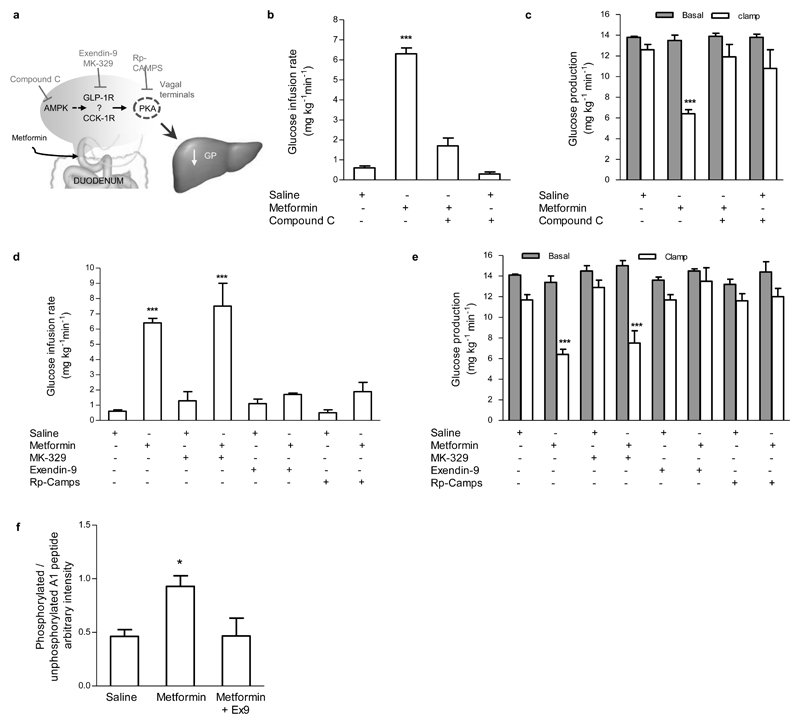
Figure 2. A duodenal AMPK – GLP-1R – PKA signaling pathway is required for metformin to lower GP.
(a) Schematic representation of the working hypothesis. Intraduodenal metformin activates duodenal AMPK, GLP-1R, and PKA to lower GP. (b,c) The glucose infusion rate (b) and rate of GP (c) during the pancreatic (basal insulin) euglycemic clamp in HFD-fed rats with intraduodenal compound C administration alone (n=5) or in combination with metformin (n=6). (d,e) The glucose infusion rate (d) and rate of GP (e) during the pancreatic (basal insulin) euglycemic clamp in HFD-fed rats with intraduodenal MK-329, exendin-9, and Rp-CAMPS administration with saline (n=5 for each) or in combination with metformin (n=6 for each group). (f) Duodenal PKA activity quantification of clamp tissue of HFD-fed rats treated with either saline, metformin, or metformin with exendin-9 (n=5 for each group). Values are shown as mean ± s.e.m. *p < 0.05, ***p < 0.001, versus all other groups, as calculated by one-way ANOVA with Tukey’s post hoc test. AMPK, AMP-activated protein kinase; GLP-1R, glucagon-like peptide-1 receptor; PKA, protein kinase A; GP, glucose production; HFD, high fat diet.
Figure 3
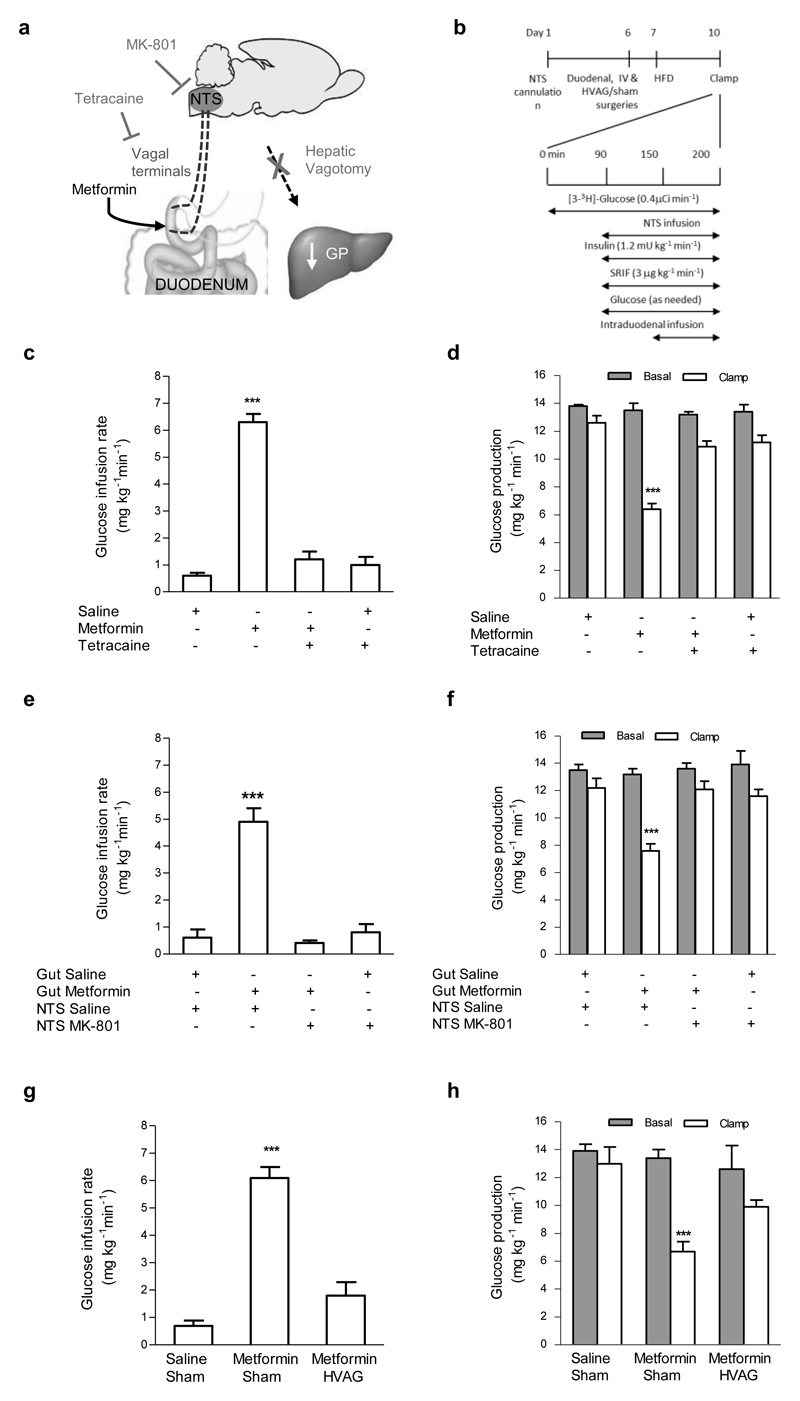
Figure 3. A gut-brain-liver neuronal axis is required for the GP-lowering effect of metformin.
(a) Schematic representation of the working hypothesis. Duodenal metformin triggers the afferent nerve terminals in the duodenum, and signals via NMDA receptors at the level of the NTS, which signals via the hepatic vagus to lower GP. (b) Experimental procedure and pancreatic (basal insulin) euglycemic clamp protocol with NTS infusion. (c,d) The glucose infusion rate (c) and rate of GP (d) in HFD-fed rats infused with intraduodenal tetracaine alone (n=5) or in combination with metformin (n=6). (e,f) The glucose infusion rate (e) and rate of GP (f) in HFD-fed rats with intraduodenal saline or metformin and DVC saline (n=4,5) or MK-801 (n=5,6). (g,h) The glucose infusion rate (g) and rate of GP (h) in HFD-fed rats with intraduodenal metformin with either a sham surgery (n=5) or HVAG (n=6). Values are shown as mean ± s.e.m. ***p < 0.001, versus saline, as calculated by one-way ANOVA with Tukey’s post hoc test. GP, glucose production; NMDA, N-Methyl-D-aspartate; NTS, nucleus of the solitary tract; HFD, high-fat diet; SRIF, somatostatin; HVAG hepatic vagotomy.
Figure 4
Figure 4. Intraduodenal infusion of metformin lowers GP in obese and diabetic rats, while the overall acute glucose-lowering effect of a bolus intragstric treatment of metformin is dependent on duodenal AMPK signaling.
(a) Experimental procedure and pancreatic (basal-insulin) euglycemic clamp protocol for 28 day HFD-fed rats. (b,c) The glucose infusion rate (b), rate of GP (c) during the pancreatic (basal insulin) euglycemic clamp in 28 day HFD-fed rats with intraduodenal saline or metformin infusion (***p < 0.001, versus saline as compared by unpaired t-test; n=6 for each group). (d,e) Plasma glucose levels (d) and the rate of GP (e) in NA-STZ/HFD induced hyperglycemic rats with intraduodenal saline or metformin (n=8 for each group). (f) Experimental procedure and gastric infusion protocol. (g,h) The plasma glucose levels (different letter denotes significant difference of p < 0.05 between groups as calculated by two-way ANOVA with Tukey’s post hoc test) (g) and the percent suppression of plasma glucose from basal levels (**p < 0.01, versus saline as compared by unpaired t-test within each timepoint) (h) in NA-STZ/HFD induced hyperglycemic rats injected with either intraduodenal GFP or dnAMPK for 5 days with a gastric bolus treatment of metformin (n=8 for each group). Values are shown as mean ± s.e.m. Unless noted, ***p < 0.001, versus saline, as calculated by one-way ANOVA with Tukey’s post hoc test. GP, glucose production; AMPK, AMP-activated protein kinase; NA, nicotinamide; STZ, streptozotocin. HFD, high fat diet.

Comment in

References

    1. Taylor SI. Deconstructing type 2 diabetes. Cell. 1999;97:9–12. - PubMed
    1. Hundal RS, et al. Mechanism by which metformin reduces glucose production in type 2 diabetes. Diabetes. 2000;49:2063–2069. - PMC - PubMed
    1. Radziuk J, Zhang Z, Wiernsperger N, Pye S. Effects of metformin on lactate uptake and gluconeogenesis in the perfused rat liver. Diabetes. 1997;46:1406–1413. - PubMed
    1. Stumvoll M, Nurjhan N, Perriello G, Dailey G, Gerich JE. Metabolic effects of metformin in non-insulin-dependent diabetes mellitus. N Engl J Med. 1995;333:550–554. - PubMed
    1. Owen MR, Doran E, Halestrap AP. Evidence that metformin exerts its anti-diabetic effects through inhibition of complex 1 of the mitochondrial respiratory chain. Biochem J. 2000;348(Pt 3):607–614. - PMC - PubMed

Publication types

MeSH terms