


Significance of microbial asynchronous anabolism to soil carbon dynamics driven by litter inputs
- PMID: 25849864
- PMCID: PMC4387914
- DOI: 10.1038/srep09575
Significance of microbial asynchronous anabolism to soil carbon dynamics driven by litter inputs
Abstract
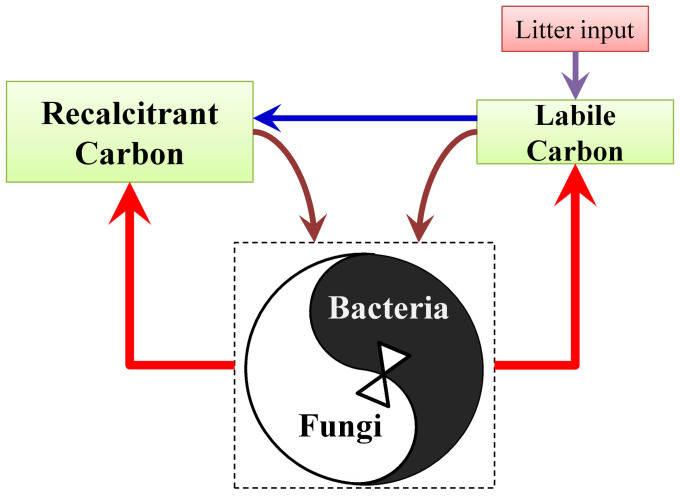
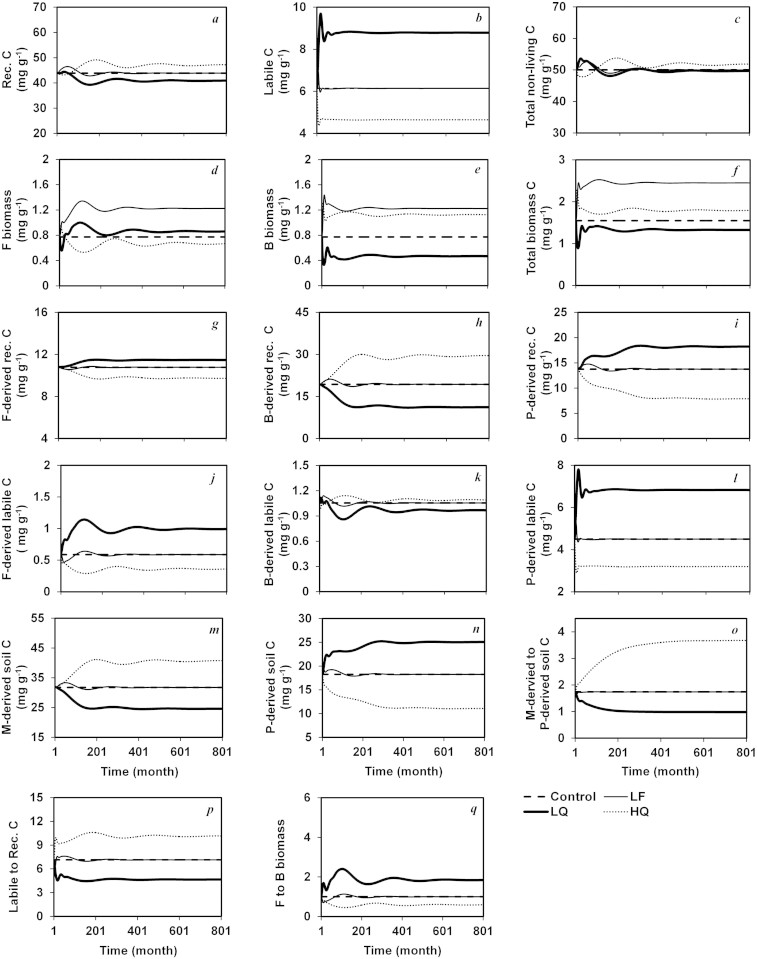
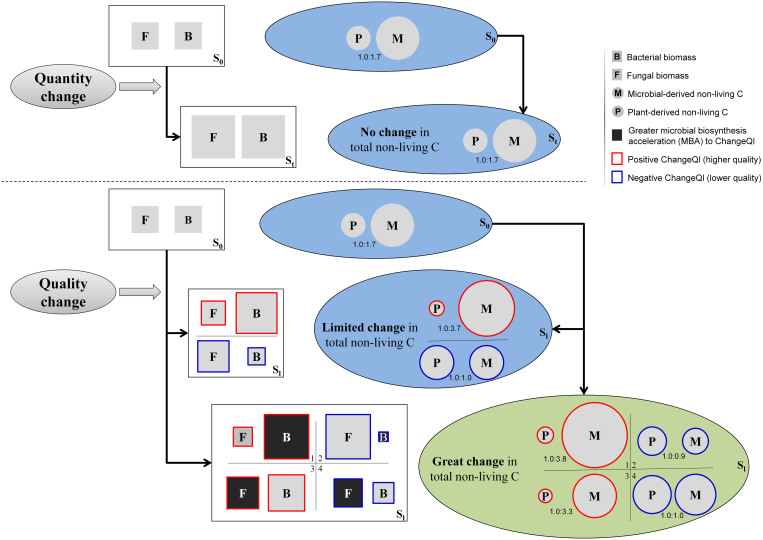
Soil organic carbon (SOC) plays an important role in the global carbon cycle. However, it remains largely unknown how plant litter inputs impact magnitude, composition and source configuration of the SOC stocks over long term through microbial catabolism and anabolism, mostly due to uncoupled research on litter decomposition and SOC formation. This limits our ability to predict soil system responses to changes in land-use and climate. Here, we examine how microbes act as a valve controlling carbon sequestrated from plant litters versus released to the atmosphere in natural ecosystems amended with plant litters varying in quantity and quality. We find that litter quality - not quantity - regulates long-term SOC dynamics under different plausible scenarios. Long-term changes in bulk SOC stock occur only when the quality of carbon inputs causes asynchronous change in a microbial physiological trait, defined as "microbial biosynthesis acceleration" (MBA). This is the first theoretical demonstration that the response of the SOC stocks to litter inputs is critically determined by the microbial physiology. Our work suggests that total SOC at an equilibrium state may be an intrinsic property of a given ecosystem, which ultimately is controlled by the asynchronous MBA between microbial functional groups.
Figures
References
-
- Eswaran H., Van Den Berg E. & Reich P. Organic carbon in soils of the world. Soil Sci. Soc. Am. J. 57, 192–194, 10.2136/sssaj1993.03615995005700010034x (1993). - DOI
-
- Balser T. C. in Encyclopedia of soils in the environment (ed Hillel D., ed. ) 195–207 (Elsevier, 2005).
-
- Davidson E. A. & Janssens I. A. Temperature sensitivity of soil carbon decomposition and feedbacks to climate change. Nature 440, 165–173 (2006). - PubMed
-
- Rustad L., Huntington T. & Boone R. Controls on soil respiration: Implications for climate change. Biogeochemistry 48, 1–6 (2000).
-
- Liang C. & Balser T. C. Warming and nitrogen deposition lessen microbial residue contribution to soil carbon pool. Nat Commun 3, 1222 (2012). - PubMed
MeSH terms
Substances
LinkOut - more resources
Full Text Sources
Other Literature Sources
