


Guns, Impulsive Angry Behavior, and Mental Disorders: Results from the National Comorbidity Survey Replication (NCS-R)
- PMID: 25850688
- PMCID: PMC5116908
- DOI: 10.1002/bsl.2172
Guns, Impulsive Angry Behavior, and Mental Disorders: Results from the National Comorbidity Survey Replication (NCS-R)
Abstract
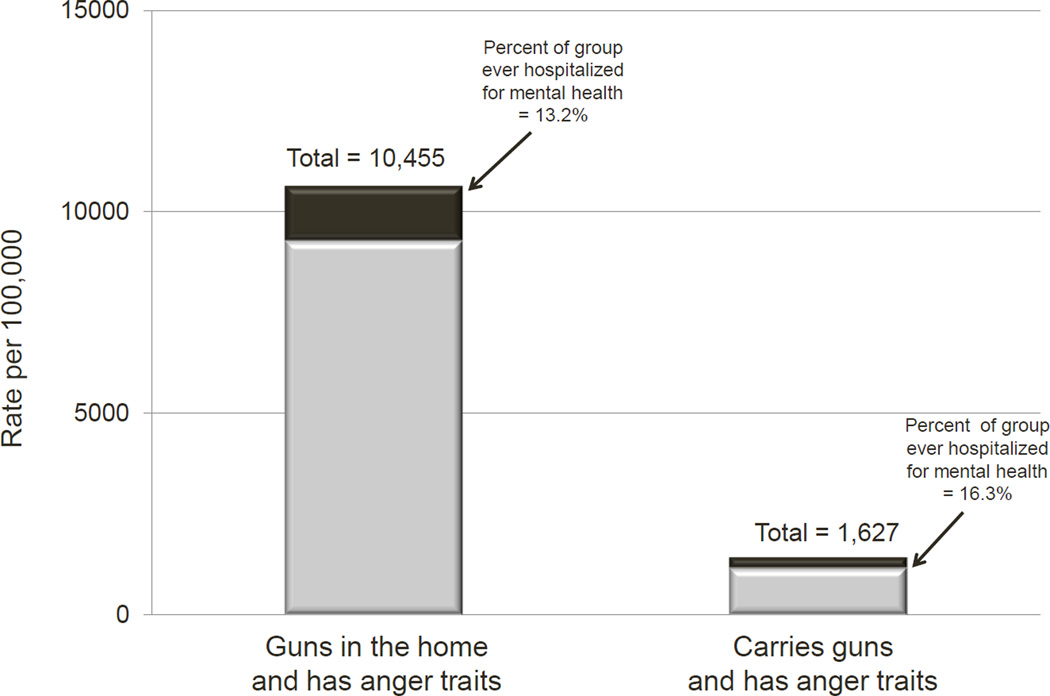
Analyses from the National Comorbidity Study Replication provide the first nationally representative estimates of the co-occurrence of impulsive angry behavior and possessing or carrying a gun among adults with and without certain mental disorders and demographic characteristics. The study found that a large number of individuals in the United States self-report patterns of impulsive angry behavior and also possess firearms at home (8.9%) or carry guns outside the home (1.5%). These data document associations of numerous common mental disorders and combinations of angry behavior with gun access. Because only a small proportion of persons with this risky combination have ever been involuntarily hospitalized for a mental health problem, most will not be subject to existing mental health-related legal restrictions on firearms resulting from a history of involuntary commitment. Excluding a large proportion of the general population from gun possession is also not likely to be feasible. Behavioral risk-based approaches to firearms restriction, such as expanding the definition of gun-prohibited persons to include those with violent misdemeanor convictions and multiple DUI convictions, could be a more effective public health policy to prevent gun violence in the population.
Copyright © 2015 John Wiley & Sons, Ltd.
Conflict of interest statement
None of the other authors has any potential conflicts to report.
Figures
Comment in
-
Access to firearms in the USA: angry and impulsive behaviour in people with and without mental disorders.Evid Based Ment Health. 2016 Feb;19(1):22. doi: 10.1136/eb-2015-102254. Epub 2015 Dec 30. Evid Based Ment Health. 2016. PMID: 26718967 Free PMC article. No abstract available.
References
-
- Adams JR, Drake RE. Shared decision-making and evidence-based practice. Community Mental Health Journal. 2006;42:87–105. - PubMed
-
- American Psychiatric Association. Diagnostic and Statistical Manual of Mental Disorders, (DSM-IV) Fourth. Washington, DC: American Psychiatric Association; 1994.
-
- Appelbaum PS. Public safety, mental disorders, and guns. JAMA Psychiatry. 2013;70(6):565–566. - PubMed
-
- Bayer JK, Peay MY. Predicting intentions to seek help from professional mental health services. Australian and New Zealand Journal of Psychiatr. 1997;31:504–513. - PubMed
-
- Buckley PF, Wirshing DA, Bhushan P, Pierre JM, Resnick SA, Wirshing WC. Lack of insight in schizophrenia: impact on treatment adherence. CNS Drugs. 2007;21:129–141. - PubMed
Publication types
MeSH terms
Grants and funding
LinkOut - more resources
Full Text Sources
Other Literature Sources
Medical
