. 2015 Apr 8:6:6553.
doi: 10.1038/ncomms7553.

Mammalian adaptation of influenza A(H7N9) virus is limited by a narrow genetic bottleneck

Affiliations

Mammalian adaptation of influenza A(H7N9) virus is limited by a narrow genetic bottleneck

Hassan Zaraket et al. Nat Commun. .

Abstract

Human infection with avian influenza A(H7N9) virus is associated mainly with the exposure to infected poultry. The factors that allow interspecies transmission but limit human-to-human transmission are unknown. Here we show that A/Anhui/1/2013(H7N9) influenza virus infection of chickens (natural hosts) is asymptomatic and that it generates a high genetic diversity. In contrast, diversity is tightly restricted in infected ferrets, limiting further adaptation to a fully transmissible form. Airborne transmission in ferrets is accompanied by the mutations in PB1, NP and NA genes that reduce viral polymerase and neuraminidase activity. Therefore, while A(H7N9) virus can infect mammals, further adaptation appears to incur a fitness cost. Our results reveal that a tight genetic bottleneck during avian-to-mammalian transmission is a limiting factor in A(H7N9) influenza virus adaptation to mammals. This previously unrecognized biological mechanism limiting species jumps provides a measure of adaptive potential and may serve as a risk assessment tool for pandemic preparedness.


Conflict of interest statement

While this study had no corporate funding, R.G.W. and E.A.G. are currently performing a different research study funded by F. Hoffmann-LaRoche, Ltd., Basel, Switzerland. The remaining authors declare no competing financial interests.

Figures
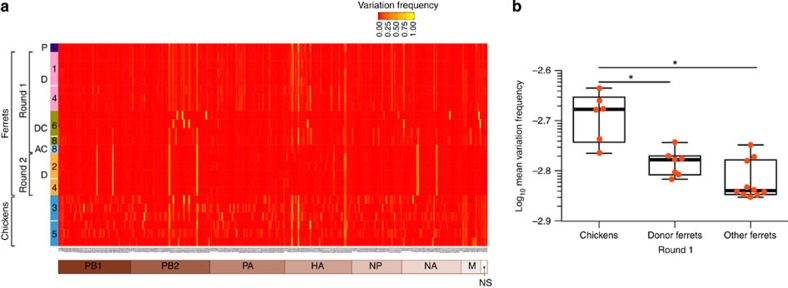
Figure 1
Figure 1. Mutation frequency in A/Anhui/1/13 (H7N9) influenza viruses collected from chickens and ferrets.
(a) Heat map showing nucleotide substitutions identified in chicken (oropharyngeal swabs) and ferret (nasal washes) virus isolates by using Illumina Mi Seq. Only mutations with a frequency >0.03 are shown. Numbers on the y axis represent the day post inoculation. (b) Mean variation frequency. Mean variation frequency for each sample was calculated using positions that are variable in at least one of the examined samples. If a site has a minor variant frequency above zero in any of the samples this was included in the nominator and the denominator of the proportion was the total number of variable sites that was variable in all samples. Variation frequency was expressed as the negative log. ‘Donor ferrets Round 1' are ferrets inoculated with parental A/Anhui/1/13 (H7N9) influenza virus; ‘Other ferrets' are contact ferrets in round 1 of experiments and donor ferrets in round 2. *P<0.05, two-tailed Mann–Whitney U-test. P, parental virus; D, donor; DC, direct contact; AC, airborne contact.
Figure 2
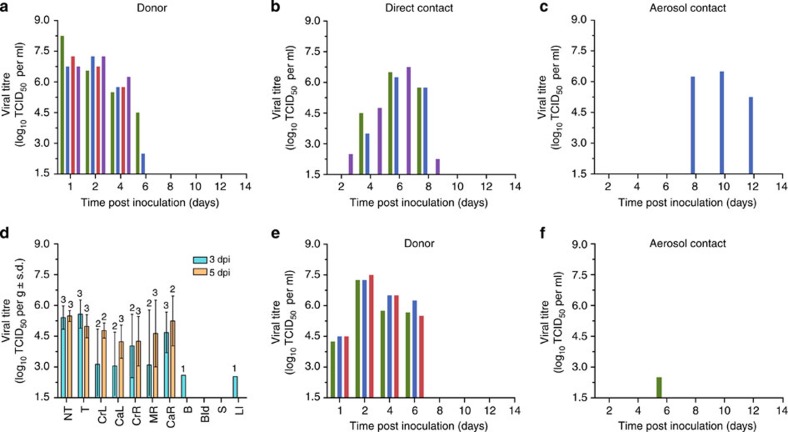
Figure 2. Replication and transmission of A/Anhui/1/2013 (H7N9) influenza virus in ferrets.
(ac) Nasal wash virus titres in animals during round 1 experiment. Coloured bars represent individual ferrets within each group. (d) Viral titres in the tissues collected from H7N9-infected ferrets on the indicated days post inoculation. The numbers of tissue samples with virus titres higher than the limit of detection (1.5 log10TCID50 per gram, n=3) are indicated above each bar (e,f). Nasal wash titres in round 2 experiment in which the donors were inoculated with virus previously transmitted by airborne contact. Coloured bars represent individual ferrets within each group. NT, nasal turbinates; T, trachea; lung lobes: CrL, cranial left; CaL, caudal left; CrR, cranial right; MR, middle right; CaR, caudal right; B, brain; Bld, blood; S, spleen; LI, large intestine.
Figure 3
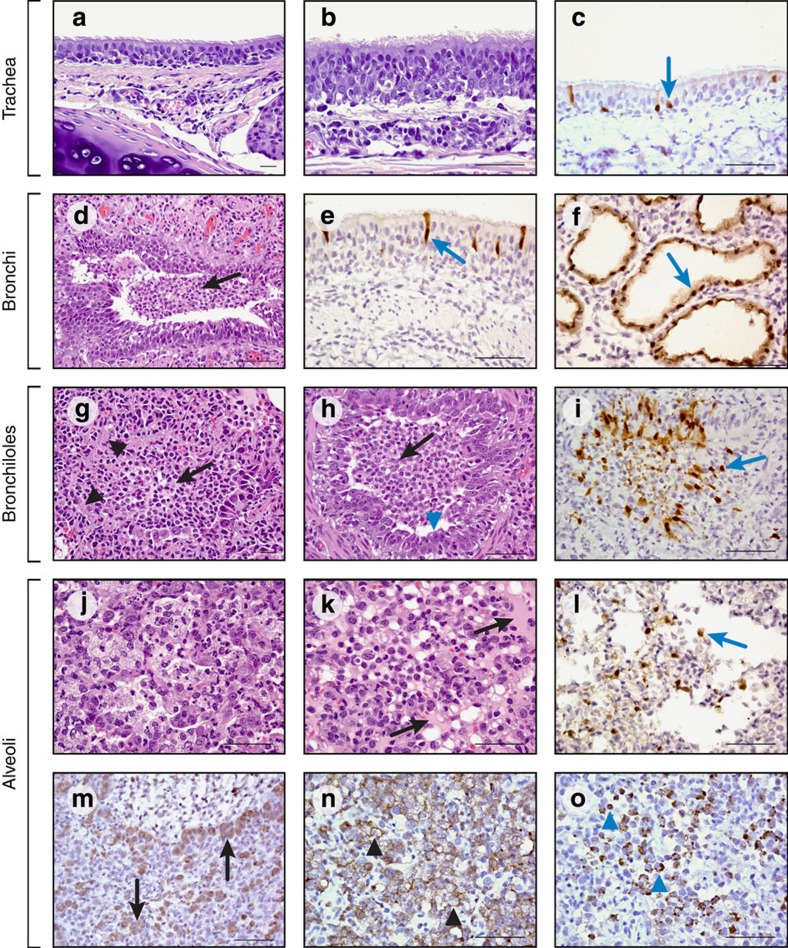
Figure 3. Histologic findings in the respiratory tracts of ferrets inoculated with A/Anhui/1/2013 (H7N9) influenza virus.
Representative features observed in tracheas (ac), bronchi (df), bronchioles (gi) and alveoli (jo) on day 3 (a,d,g,h,i,j,k,n,o) and day 5 (b,c,e,f,l,m) post inoculation. Stains were hematoxylin and eosin (a,b,d,g,h,j,k) or immunohistochemical stains for influenza A virus nucleoprotein (c,e,f,i,l), pneumocyte type II cells (m; surfactant protein c), macrophages (n; ionized calcium-binding adapter molecule 1), and neutrophils (o; myeloperoxidase). Influenza A was detected in tracheas (c), bronchi (e), submucosal glands (f), bronchioles (i) and alveolar epithelial cells (l) (blue arrows). (ac) Tracheas showed multifocal epithelial hyperplasia (b) and mucosal and submucosal (a,b) neutrophil and lymphocyte infiltration. (df) Bronchi showed multifocal epithelial hyperplasia, submucosal gland epithelial necrosis, macrophage and neutrophil infiltration, and luminal macrophages, neutrophils and cellular debris (d, black arrow). (gi) Bronchioles showed epithelial necrosis (g, black arrowheads), regenerative hyperplasia (h, blue arrowhead), and marked luminal macrophage, neutrophil and lymphocyte infiltrates admixed with cellular debris (g,h, black arrows). (jo) Peribronchiolar alveoli (j,k) had varying degrees of pneumocyte necrosis and regeneration (type II hyperplasia; m, black arrows), macrophage infiltration (n, black arrowheads), neutrophil infiltration (o, blue arrowheads), oedema (k, black arrow) and cellular debris. Scale bars, 20μ—h, m; 50μ—a,b,c,e,f,g,i,j,k,l,n,o; 100μ—d.
Figure 4
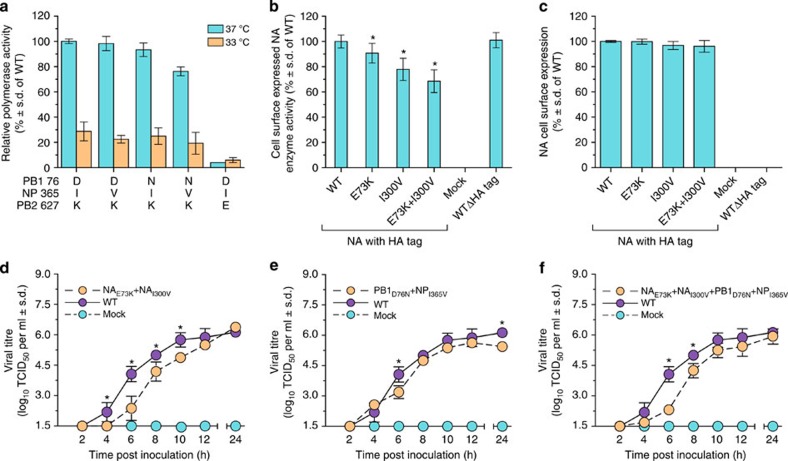
Figure 4. Effect of identified amino-acid substitutions in the NA, PB1 and NP on protein function and replication kinetics of recombinant A/Anhui/1/2013 (H7N9) influenza viruses in vitro.
(a) Effect of temperature on polymerase complex activity with the indicated amino-acid substitutions. (b) Effect of the indicated amino-acid substitutions on NA activity. (c) Cell surface expression of the NAs shown in panel b. (df) Replication kinetics of rg-A/Anhui/1/2013 (H7N9) influenza viruses with the indicated amino-acid substitutions in the NA, PB1 and NP genes in MDCK cells. Values are mean and s.d. from two independent experiments (n=4). *P<0.05 compared with WT virus by two-way analysis of variance.
Figure 5
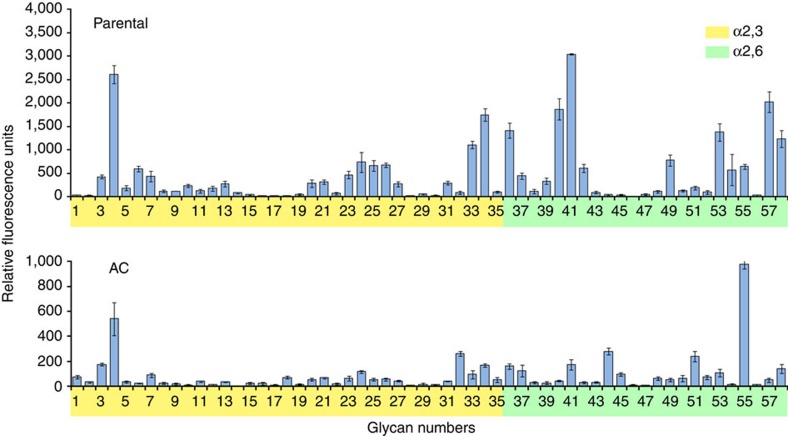
Figure 5. Receptor-binding preference of A/Anhui/1/2013 (H7N9) influenza virus.
Glycan microarray containing α2,3 and α2,6 sialosides was used to compare the receptor-binding affinity of parental and AC (isolated on day 8 post inoculation after aerosol transmission) A/Anhui/1/2013 (H7N9) influenza virus. Values are the means±s.d. of six replicate spots per glycan.

References

    1. Gao R. et al. Human infection with a novel avian-origin influenza A (H7N9) virus. New Engl. J. Med. 368, 1888–1897 (2013) . - PubMed
    1. WHO. Human infection with avian influenza A(H7N9) virus – update. WHO at http://www.who.int/csr/don/2014_05_28_h7n9/en/ (2014) . - PMC - PubMed
    1. Bao C. et al. Live-animal markets and influenza A (H7N9) virus infection. New Engl. J. Med. 368, 2337–2339 (2013) . - PubMed
    1. Chen Y. et al. Human infections with the emerging avian influenza A H7N9 virus from wet market poultry: clinical analysis and characterisation of viral genome. Lancet 381, 1916–1925 (2013) . - PMC - PubMed
    1. Shi J. et al. A detailed epidemiological and clinical description of 6 human cases of avian-origin influenza A (H7N9) virus infection in Shanghai. PloS ONE 8, e77651 (2013) . - PMC - PubMed

Publication types

MeSH terms