


Clinical management and humoral immune responses to rabies post-exposure prophylaxis among three patients who received solid organs from a donor with rabies
- PMID: 25851103
- PMCID: PMC4642444
- DOI: 10.1111/tid.12393
Clinical management and humoral immune responses to rabies post-exposure prophylaxis among three patients who received solid organs from a donor with rabies
Abstract
Background: The rabies virus causes a fatal encephalitis and can be transmitted through organ transplantation. In 2013, a man developed rabies 18 months after receiving a kidney from a donor with rabies, who was not known to have been infected when the organs were procured. Three additional persons who received organs from the same donor (liver, kidney, heart), all of whom were not vaccinated for rabies before transplantation, received rabies post-exposure prophylaxis (PEP) with rabies immune globulin and 5 doses of rabies vaccine as soon as the diagnosis of rabies was made in the donor (18 months after their transplant surgeries). We describe their clinical management.
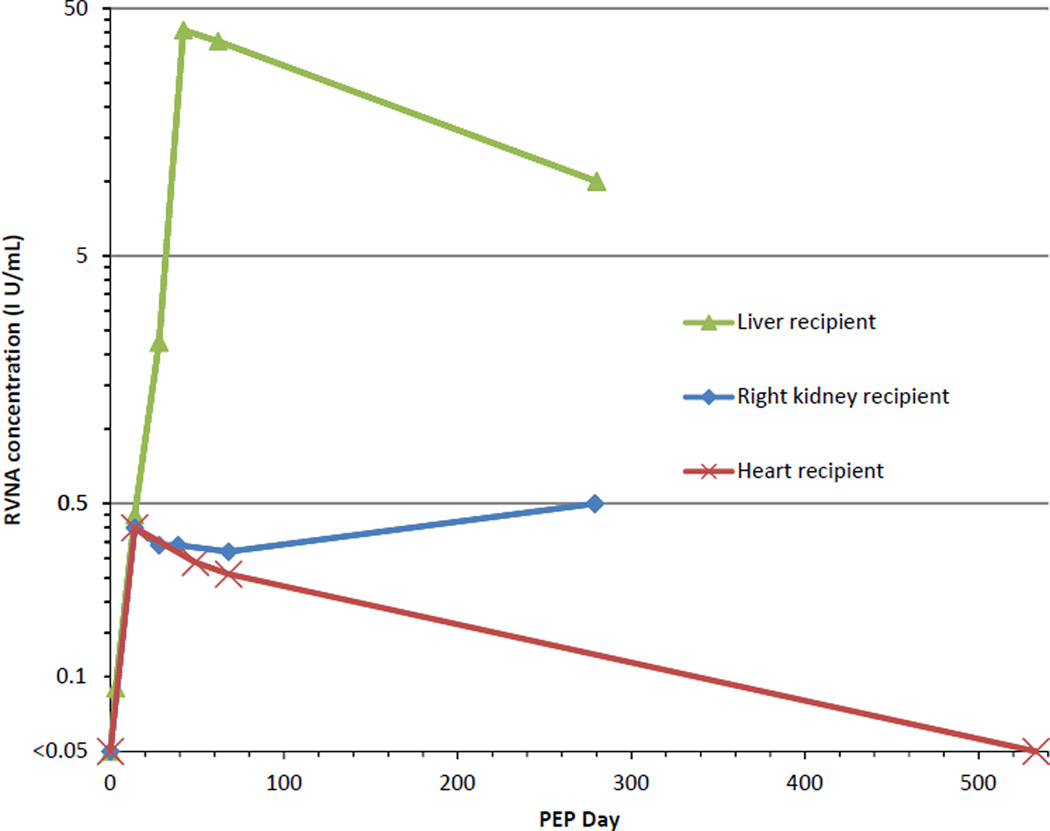
Methods: As the 3 recipients were all on immunosuppressive medications, post-vaccination serologic testing was performed using the rapid fluorescent focus inhibition test to measure rabies virus neutralizing antibodies (RVNAs). An acceptable antibody response to administration of rabies vaccine was defined as detection of RVNAs at a concentration ≥0.1 IU/mL from a serum specimen collected ≥7 days after the fifth vaccine dose.
Results: All 3 recipients demonstrated an acceptable antibody response despite their immunosuppressed states. More than 36 months have passed since their transplant surgeries, and all 3 recipients have no evidence of rabies.
Conclusions: The survival of 3 previously unvaccinated recipients of solid organs from a donor with rabies is unexpected. Although the precise factors that led to their survival remain unclear, our data suggest that PEP can possibly enhance transplant safety in settings in which donors are retrospectively diagnosed with rabies.
Keywords: post-exposure prophylaxis; rabies; solid organ transplantation.
© 2015 John Wiley & Sons A/S. Published by John Wiley & Sons Ltd.
Conflict of interest statement
Figures
References
-
- Manning SE, Rupprecht CE, Fishbein D, et al. Human rabies prevention–United States, 2008: recommendations of the Advisory Committee on Immunization Practices. MMWR Recomm Rep. 2008;57(RR-3):1–28. - PubMed
-
- Rupprecht CE, Briggs D, Brown CM, et al. Use of a reduced (4-dose) vaccine schedule for postexposure prophylaxis to prevent human rabies: recommendations of the advisory committee on immunization practices. MMWR Recomm Rep. 2010;59(RR-2):1–9. - PubMed
MeSH terms
Substances
Grants and funding
LinkOut - more resources
Full Text Sources
Other Literature Sources
Medical
Research Materials
Miscellaneous
