


Antibiotics for asymptomatic bacteriuria
- PMID: 25851268
- PMCID: PMC8407041
- DOI: 10.1002/14651858.CD009534.pub2
Antibiotics for asymptomatic bacteriuria
Abstract
Background: Asymptomatic bacteriuria is commonly detected in women aged up to 60 years, patients with diabetes, and the elderly. The benefit of antibiotic treatment for this condition is controversial.
Objectives: To assess the effectiveness and safety of antibiotics treatment for asymptomatic bacteriuria in adults. Specific objectives were to assess 1) the effectiveness of antibiotics for preventing development of symptomatic UTI, UTI-related complications, overall mortality, UTI-related mortality, and resolution of bacteriuria; 2) the development of resistance to antibiotic treatment by comparing resistance of grown bacteria in urine before and after therapy; and 3) the frequency of adverse events.
Search methods: We searched the Cochrane Renal Group's Specialised Register up to 24 February 2015 through contact with the Trials' Search Co-ordinator using search terms relevant to this review.
Selection criteria: Randomised controlled trials (RCTs) and quasi-RCTs comparing antibiotics to placebo or no treatment for asymptomatic bacteriuria in adults were included. The outcomes of interest were the development of symptomatic urinary tract infection (UTI), complications, death, any adverse event, development of antibiotic resistance, bacteriological cure, and decline in kidney function.
Data collection and analysis: Two authors independently extracted the data and assessed study quality. Statistical analyses were performed using the random effects model and the results expressed as risk ratios (RR) with 95% confidence intervals (CI).
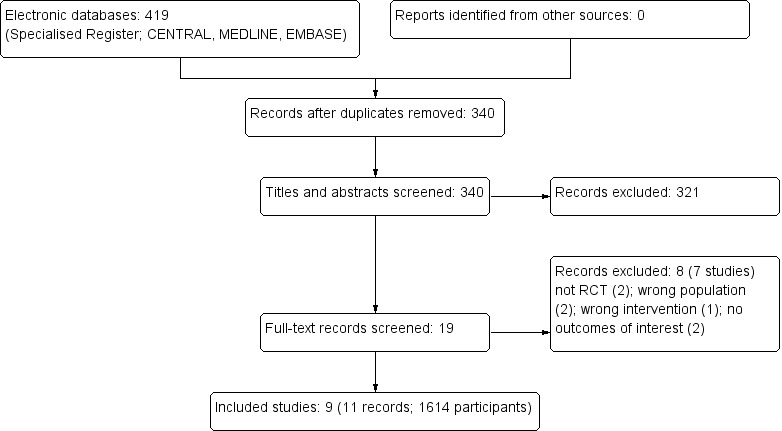
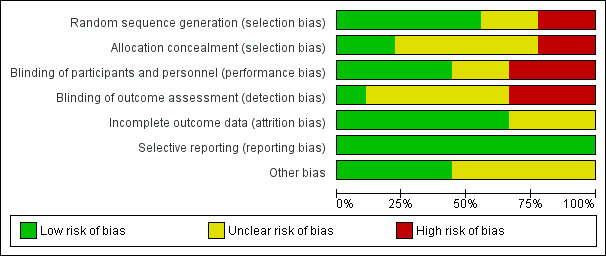
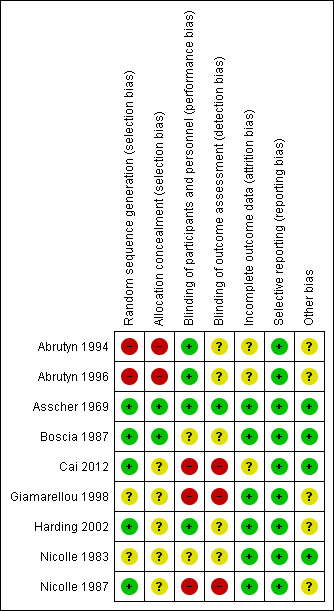
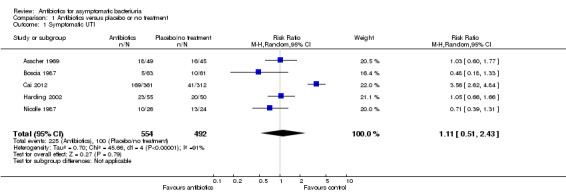
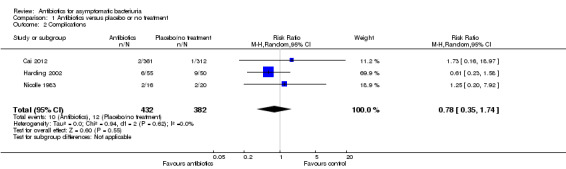
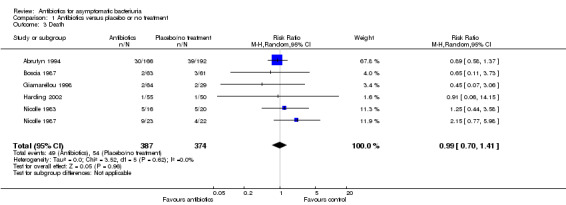
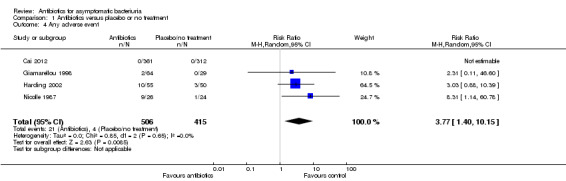
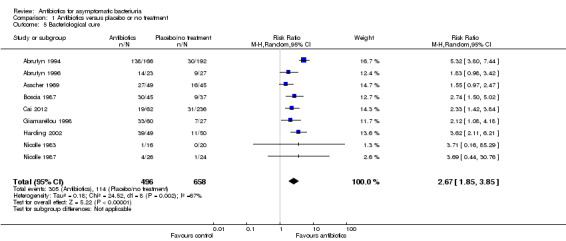
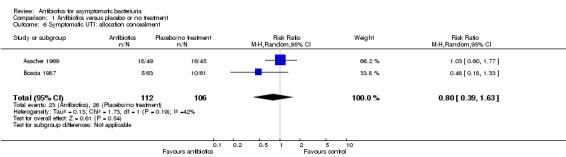
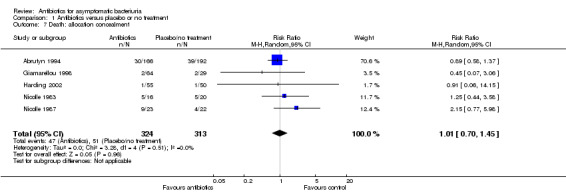
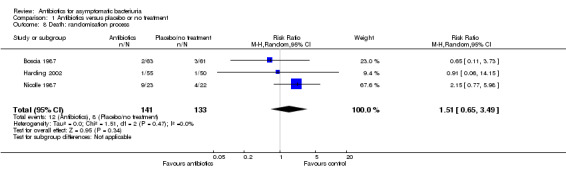
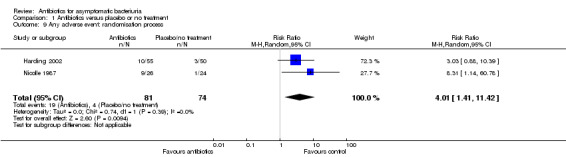
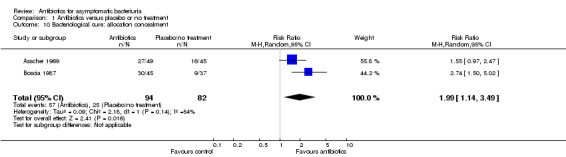
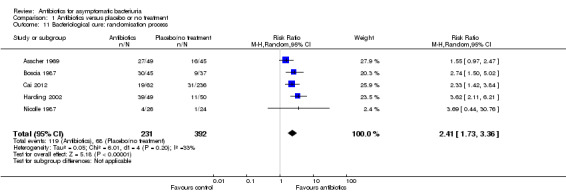
Main results: We included nine studies (1614 participants) in this review. Symptomatic UTI (RR 1.11, 95% CI 0.51 to 2.43), complications (RR 0.78, 95% CI 0. 35 to 1.74), and death (RR 0.99, 95% CI 0.70 to 1.41) were similar between the antibiotic and placebo or no treatment arms. Antibiotics were more effective for bacteriological cure (RR 2.32, 95% CI 1.11 to 4.83) but also more adverse events developed in this group (RR 3.77, 95% CI 1.40 to 10.15). No decline in the kidney function was observed across the studies; minimal data were available on the emergence of resistant strains after antimicrobial treatment.The included studies were of medium and high quality, used different treatments for different durations of treatment and follow-up, different populations, but this did not appear to influence the results of review.
Authors' conclusions: No differences were observed between antibiotics versus no treatment of asymptomatic bacteriuria for the development of symptomatic UTI, complications or death. Antibiotics were superior to no treatment for the bacteriological cure but with significantly more adverse events. There was no clinical benefit from treating asymptomatic bacteriuria in the studies included in this review.
Conflict of interest statement
None known.
Figures
Update of
References
References to studies included in this review
Abrutyn 1994 {published data only}
-
- Abrutyn E, Mossey J, Berlin JA, Boscia J, Levison M, Pitsakis P, et al. Does asymptomatic bacteriuria predict mortality and does antimicrobial treatment reduce mortality in elderly ambulatory women?. Annals of Internal Medicine 1994;120(10):827‐33. [MEDLINE: ] - PubMed
Abrutyn 1996 {published data only}
-
- Abrutyn E, Berlin J, Mossey J, Pitsakis P, Levison M, Kaye D. Does treatment of asymptomatic bacteriuria in older ambulatory women reduce subsequent symptoms of urinary tract infection?. Journal of the American Geriatrics Society 1996;44(3):293‐5. [MEDLINE: ] - PubMed
Asscher 1969 {published data only}
Boscia 1987 {published data only}
-
- Boscia JA, Kobasa WD, Knight RA, Abrutyn E, Levison ME, Kaye D. Therapy vs no therapy for bacteriuria in elderly ambulatory nonhospitalized women. JAMA 1987;257(8):1067‐71. [MEDLINE: ] - PubMed
Cai 2012 {published data only}
-
- Cai T, Mazzoli S, Mondaini N, Meacci F, Nesi G, D'Elia C, et al. The role of asymptomatic bacteriuria in young women with recurrent urinary tract infections: to treat or not to treat?. Clinical Infectious Diseases 2012;55(6):771‐7. [MEDLINE: ] - PubMed
-
- Cai T, Mazzoli S, Mondaini N, Meacci F, Nesi G, Luciani LG, et al. The role of asymptomatic bacteriuria in young women with recurrent urinary tract infections: To treat or not to treat [abstract]. European Urology, Supplements 2012;11(1):e188‐e188a. [EMBASE: 70863002] - PubMed
Giamarellou 1998 {published data only}
-
- Giamarellou H, Dontas AS, Zorbas P, Staszewska‐Pistoni M, Xirouchaki E, Petrikkos G. Asymptomatic bacteriuria in freely voiding elderly subjects. Long‐term continuous vs pulse treatment with ofloxacin. Clinical Drug Investigation 1998;15(3):187‐95. [EMBASE: 1998118841]
Harding 2002 {published data only}
-
- Harding GK, Zhanel GG, Nicolle LE, Cheang M, Manitoba Diabetes Urinary Tract Infection Study Group. Antimicrobial treatment in diabetic women with asymptomatic bacteriuria. New England Journal of Medicine 2002;347(20):1576‐83. [MEDLINE: ] - PubMed
Nicolle 1983 {published data only}
-
- Nicolle LE, Bjornson J, Harding GK, MacDonell JA. Bacteriuria in elderly institutionalized men. New England Journal of Medicine 1983;309(23):1420‐25. [MEDLINE: ] - PubMed
Nicolle 1987 {published data only}
-
- Nicolle LE, Mayhew WJ, Bryan L. Prospective randomized comparison of therapy and no therapy for asymptomatic bacteriuria in institutionalized elderly women. American Journal of Medicine 1987;83(1):27‐33. [MEDLINE: ] - PubMed
References to studies excluded from this review
Butler 1995 {published data only}
Dalal 2009 {published data only}
Freeman 1968 {published data only}
-
- Freeman RB, Bromer L, Brancato F, Cohen SI, Garfield CF, Griep RJ, et al. Prevention of recurrent bacteriuria with continuous chemotherapy. Annals of Internal Medicine 1968;69(4):655‐72. [MEDLINE: ] - PubMed
-
- Freeman RB, Smith WM, Richardson JA, Hennelly PJ, Thurm RH, Urner C, et al. Long‐term therapy for chronic bacteriuria in men. U.S. Public Health Service cooperative study. Annals of Internal Medicine 1975;83(2):133‐47. [MEDLINE: ] - PubMed
Giamarellou 2007 {published data only}
-
- Giamarellou H, Dontas AS, Petrikkos G, Gnardellis C, Zorbas P, Philippou P. Survival of elderly bacteriuric subjects following long‐term quinolone therapy. Journal of Chemotherapy 2007;19(2):185‐92. [MEDLINE: ] - PubMed
Harding 1973 {published data only}
-
- Harding GK, Ronald AR. Clinical experiences: genitourinary infections. A. Infections of the urinary tract. Efficacy of trimethoprim‐sulfamethoxazole in bacteriuria. Journal of Infectious Diseases 1973;128(Suppl):641‐6. [MEDLINE: ] - PubMed
Nicolle 2006 {published data only}
-
- Nicolle LE, Zhanel GG, Harding GK. Microbiological outcomes in women with diabetes and untreated asymptomatic bacteriuria. World Journal of Urology 2006;24(1):61‐5. [MEDLINE: ] - PubMed
Renneberg 1984 {published data only}
-
- Renneberg J, Paerregaard A. Single‐day treatment with trimethoprim for asymptomatic bacteriuria in the elderly patient. Journal of Urology 1984;132(5):934‐5. [MEDLINE: ] - PubMed
Additional references
Boscia 1986
-
- Boscia JA, Kobasa WD, Abrutyn E, Levison ME, Kaplan AM, Kaye D. Lack of association between bacteriuria and symptoms in the elderly. American Journal of Medicine 1986;81(6):979‐82. [MEDLINE: ] - PubMed
Colgan 2006
-
- Colgan R, Nicolle LE, McGlone A, Hooton TM. Asymptomatic bacteriuria in adults. American Family Physician 2006;74(6):985‐90. [MEDLINE: ] - PubMed
Dontas 1981
-
- Dontas AS, Kasviki‐Charvati P, Papanaylotou PC, Mareketos SG. Bacteriuria and survival in old age. New England Journal of Medicine 1981;304(16):939‐43. [MEDLINE: ] - PubMed
Evans 1982
-
- Evans DA, Kass EH, Hennekens CH, Rosner B, Miao L, Kendrick MI, et al. Bacteriuria and subsequent mortality in women. Lancet 1982;1(8264):156‐8. [MEDLINE: ] - PubMed
Geerlings 1999
-
- Geerlings SE, Brouwer EC, Gaastra W, Verhoel J, Hoepelman AI. Effect of glucose and pH on uropathogenic and non‐uropathogenic Escherichia coli: studies with urine from diabetic and non‐diabetic individuals. Journal of Medical Microbiology 1999;48(6):535‐9. [MEDLINE: ] - PubMed
Geerlings 2000
-
- Geerlings SE, Stolk RP, Camps MJ, Netten PM, Collet TJ, Hoepelman AI, et al. Risk factors for symptomatic urinary tract infection in women with diabetes. Diabetes Care 2000;23(12):1737‐41. [MEDLINE: ] - PubMed
Geerlings 2001
-
- Geerlings SE, Stolk RP, Camps MJ, Netten PM, Collet JT, Schneeberger PM, et al. Consequences of asymptomatic bacteriuria in women with diabetes mellitus. Archives of Internal Medicine 2001;161(11):1421‐7. [MEDLINE: ] - PubMed
Geerlings 2008
-
- Geerlings SE. Urinary tract infections in patients with diabetes mellitus: epidemiology, pathogenesis and treatment. International Journal of Antimicrobial Agents 2008;31 Suppl 1:S54‐7. [MEDLINE: ] - PubMed
Gross 2007
-
- Gross PA, Patel B. Reducing antibiotic overuse: a call for a national performance measure for not treating asymptomatic bacteriuria. Clinical Infectious Diseases 2007;45(10):1335‐7. [MEDLINE: ] - PubMed
Guinto 2010
Heinamaki 1986
-
- Heinamaki P, Haavisto M, Hakulinen T, Mattila K, Rajala S. Mortality in relation to urinary characteristics in the very aged. Gerontology 1986;32(3):167‐71. [MEDLINE: ] - PubMed
Higgins 2003
Higgins 2011
-
- Higgins JP, Green S (editors). Cochrane Handbook for Systematic Reviews of Interventions Version 5.1.0 [updated February 2011]. The Cochrane Collaboration, 2011. Available from www.cochrane‐handbook.org.
Holden 2004
-
- Holden NJ, Gally DL. Switches, cross‐talk and memory in Escherichia coli adherence. Journal of Medical Microbiology 2004;53(Pt 7):585‐93. [MEDLINE: ] - PubMed
Hooton 2000
-
- Hooton TM, Scholes D, Stapleton AE, Roberts PL, Winter C, Gupta K, et al. A prospective study of asymptomatic bacteriuria in sexually active young women. New England Journal of Medicine 2000;343(14):992‐7. [MEDLINE: ] - PubMed
Hull 1999
Klemm 2007
Lin 2008
-
- Lin K, Fajardo K, U.S. Preventive Services Task Force. Screening for asymptomatic bacteriuria in adults: evidence for the U.S. Preventive Services Task Force reaffirmation recommendation statement. Annals of Internal Medicine 2008;149(1):W20‐4. [MEDLINE: ] - PubMed
Marketos 1969
-
- Marketos SG, Papanayiotou PC, Dontas AS. Bacteriuria and non‐obstructive renovascular disease in old age. Journal of Gerontology 1969;24(1):33‐6. [MEDLINE: ] - PubMed
Mims 1990
-
- Mims AD, Norman DC, Yamamura RH, Yoshikawa TT. Clinically inapparent (asymptomatic) bacteriuria in ambulatory elderly men: epidemiological, clinical and microbiological findings. Journal of the American Geriatrics Society 1990;38(11):1209‐14. [MEDLINE: ] - PubMed
Nicolle 1987a
-
- Nicolle LE, Henderson E, Bjornson J, McIntyre M, Harding GK, MacDonell JA. The association of bacteriuria with resident characteristics and survival in elderly institutionalized men. Annals of Internal Medicine 1987;106(5):682‐6. [MEDLINE: ] - PubMed
Nicolle 1988
-
- Nicolle LE, Muir P, Harding GK, Norris M. Localization of urinary tract infection in elderly, institutionalized women with asymptomatic bacteriuria. Journal of Infectious Diseases 1988;157(1):65‐70. [MEDLINE: ] - PubMed
Nicolle 1997
-
- Nicolle LE. Asymptomatic bacteriuria in the elderly. Infectious Disease Clinics of North America 1997;11(3):647‐62. [MEDLINE: ] - PubMed
Nicolle 2005
-
- Nicolle LE, Bradley S, Colgan R, Rice JC, Schaeffer A, Hooton TM. Infectious Diseases Society of America guidelines for the diagnosis and treatment of asymptomatic bacteriuria in adults. Clinical Infectious Diseases 2005;40(5):643‐54. [MEDLINE: ] - PubMed
Nordenstam 1986
-
- Nordenstam GR, Brandberg CA, Oden AS, Svanborg Eden CM, Svanborg A. Bacteriuria and mortality in an elderly population. New England Journal of Medicine 1986;314(18):1152‐6. [MEDLINE: ] - PubMed
Reid 1984
-
- Reid G, Zorzotto ML, Bruce AW. Pathogenesis of urinary tract infection in the elderly: the role of bacterial adherence to uroepithelial cells. Current Microbiology 1984;11(2):67‐72. [EMBASE: 1985159608]
Ribera 2006
-
- Ribera MC, Pascual R, Orosco D, Perez Barba C, Pedrera V, Gil V. Incidence and risk factors associated with urinary tract infection in diabetic patients with and without asymptomatic bacteriuria. European Journal of Clinical Microbiology & Infectious Diseases 2006;25(6):389‐93. [MEDLINE: ] - PubMed
Sant 1987
-
- Sant GR. Urinary tract infection in the elderly. Seminars in Urology 1987;5(2):126‐33. [MEDLINE: ] - PubMed
SIGN 2012
-
- Scottish Intercollegiate Guidelines Network (SIGN). Management of suspected bacterial urinary tract infection in adults: a national clinical guideline. 2012. www.sign.ac.uk/pdf/sign88.pdf (accessed 12 March 2015).
Smaill 2007
Sourander 1972
-
- Sourander LB, Kasanen A. A 5‐year follow‐up of bacteriuria in the aged. Gerontologia Clinica 1972;14(5):274‐81. [MEDLINE: ] - PubMed
Vranes 2003
-
- Vranes J, Kruzic V, Sterk‐Kuzmanovic N, Schonwald S. Virulence characteristics of Escherichia coli strains causing asymptomatic bacteriuria. Infection 2003;31(4):216‐20. [MEDLINE: ] - PubMed
Widmer 2011
Wright 2000
-
- Wright SW, Wrenn KD, Haynes M, Haas DW. Prevalence and risk factors for multidrug resistant uropathogens in ED patients. American Journal of Emergency Medicine 2000;18(2):143‐6. [MEDLINE: ] - PubMed
Zdziarski 2008
Zhanel 1990
-
- Zhanel GG, Harding GK, Guay DR. Asymptomatic bacteriuria: which patients should be treated?. Archives of Internal Medicine 1990;150(7):1389‐96. [MEDLINE: ] - PubMed
Zhanel 1991
-
- Zhanel GG, Harding GK, Nicolle LE. Asymptomatic bacteriuria in patients with diabetes mellitus. Reviews of Infectious Diseases 1991;13(1):150‐4. [MEDLINE: ] - PubMed
Zhang 2003
-
- Zhang L, Foxman B. Molecular epidemiology of Escherichia coli mediated urinary tract infections. Frontiers in Bioscience 2003;8:e235‐44. [MEDLINE: ] - PubMed
References to other published versions of this review
LinkOut - more resources
Full Text Sources
