


Urea cycle disorders: a case report of a successful treatment with liver transplant and a literature review
- PMID: 25852294
- PMCID: PMC4385556
- DOI: 10.3748/wjg.v21.i13.4063
Urea cycle disorders: a case report of a successful treatment with liver transplant and a literature review
Abstract
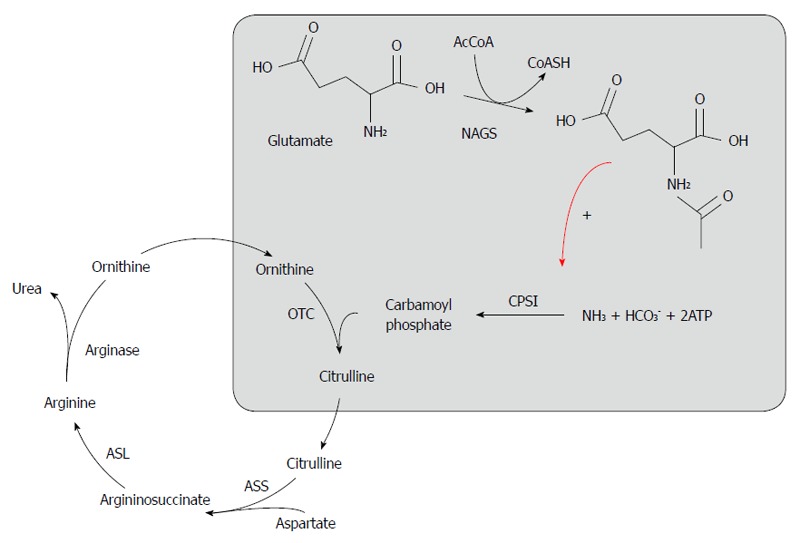
The urea cycle is the final pathway for nitrogen metabolism. Urea cycle disorders (UCDs) include a variety of genetic defects, which lead to inefficient urea synthesis. Elevated blood ammonium level is usually dominant in the clinical pattern and the primary manifestations affect the central nervous system. Herein, we report the case of a 17-year-old girl who was diagnosed with UCD at the age of 3. Despite a controlled diet, she was hospitalized several times for acute attacks with recurrent life risk. She came to our attention for a hyperammonemic episode. We proposed an orthotopic liver transplant (OLT) as a treatment; the patient and her family were in complete agreement. On February 28, 2007, she successfully received a transplant. Following the surgery, she has remained well, and she is currently leading a normal life. Usually for UCDs diet plays the primary therapeutic role, while OLT is often considered as a last resort. Our case report and the recent literature data on the quality of life and prognosis of traditionally treated patients vs OLT patients, support OLT as a primary intervention to prevent life-threatening acute episodes and chronic mental impairment.
Keywords: Diet; Hyperammonemia; Liver transplantation; Quality of life; Urea cycle disorders.
Figures
References
-
- Morioka D, Kasahara M, Takada Y, Shirouzu Y, Taira K, Sakamoto S, Uryuhara K, Egawa H, Shimada H, Tanaka K. Current role of liver transplantation for the treatment of urea cycle disorders: a review of the worldwide English literature and 13 cases at Kyoto University. Liver Transpl. 2005;11:1332–1342. - PubMed
-
- Bates TR, Lewis BD, Burnett JR, So K, Mitchell A, Delriviere L, Jeffrey GP. Late-onset carbamoyl phosphate synthetase 1 deficiency in an adult cured by liver transplantation. Liver Transpl. 2011;17:1481–1484. - PubMed
-
- Brusilow SW, Horwich AL. Urea enzymes. In: Scriver CR, Beaudet AL, Sly WS, Valle D, eds , et al., editors. The Molecular and Metabolic Bases of Inherited Disease. 8th ed. New York: McGraw-Hill; 2001. pp. 1909–1965.
-
- Braissant O. Current concepts in the pathogenesis of urea cycle disorders. Mol Genet Metab. 2010;100 Suppl 1:S3–S12. - PubMed
-
- Endo F, Matsuura T, Yanagita K, Matsuda I. Clinical manifestations of inborn errors of the urea cycle and related metabolic disorders during childhood. J Nutr. 2004;134:1605S–1609S; discussion 1630S-1632S, 1667S-1672S. - PubMed
Publication types
MeSH terms
LinkOut - more resources
Full Text Sources
Other Literature Sources
Medical
