Review
. 2015 Mar 24:6:134.
doi: 10.3389/fimmu.2015.00134. eCollection 2015.

Behçet's Disease: Do Natural Killer Cells Play a Significant Role?

Affiliations
Review

Behçet's Disease: Do Natural Killer Cells Play a Significant Role?

Harry Petrushkin et al. Front Immunol. .

Abstract

Behçet's disease (BD) is a complex inflammatory disease, of unknown etiology. While disease pathogenesis remains unclear, a strong relationship between BD and HLA-B*51 has been established over the last 30 years. A number of theories exist regarding the cause of BD; however, few are able to account for the increased rates of HLA-B*51 positive individuals, particularly around the Mediterranean basin and Middle-East where the prevalence is highest. This review outlines current immunogenetic data on BD and the immunoregulatory role natural killer cells may play. It also describes the interaction of the killer immunoglobulin-like receptor - KIR3DL1 with its ligand Bw4, which is found on HLA-B51. Finally, CD94/NKG2D, MICA, and ERAP are outlined with regard to their potential roles in BD.

Keywords: Behçet’s; Behçet’s disease; Behçet’s syndrome; HLA-B antigens; HLA-B*51; KIR; KIR3DL1; NK cells.


Figures
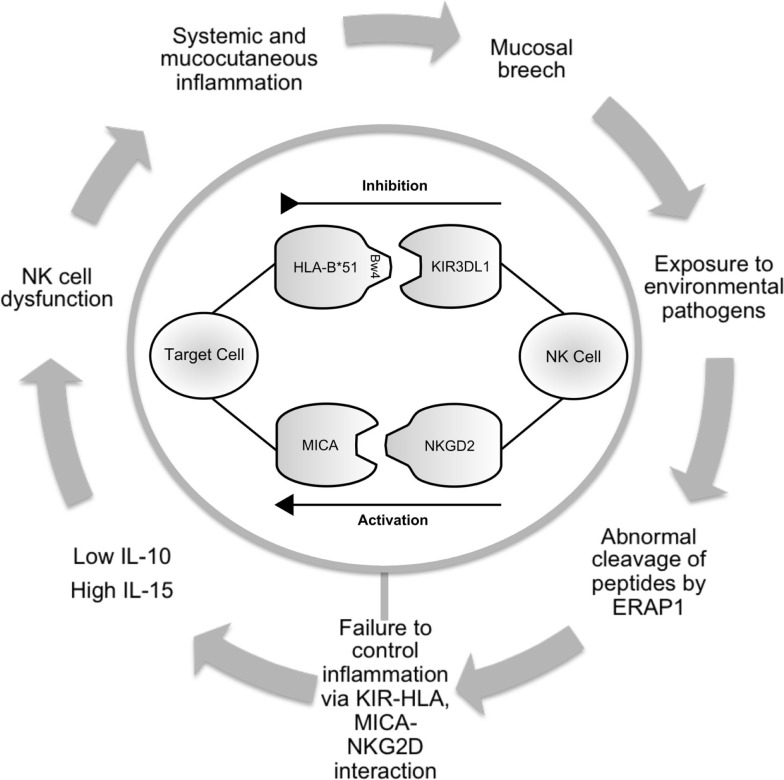
Figure 1
Figure 1
Schematic illustrating the potential role of NK cells in Behçet’s disease. Infection or inflammation at mucocutatneous surfaces may persist due to dysfunction of the innate immune response in predisposed individuals. ERAP1 may have a role in processing peptides that are presented by HLA-class-I molecules. KIR3DL1 inhibits cell-mediated cytotoxicity via interaction with HLA-B*51. This effect is balanced by activatory interactions via NKG2D and MICA. Production of cytokines including IL-10 and IL-15 contribute to abnormal NK cell function leading to prolonged inflammation and further episodes. NK cell, natural killer cell; ERAP, endoplasmic reticulum aminopeptidase 1; HLA, human leukocyte antigen; KIR, killer immunoglobulin-like receptor; MICA, MHC class-I polypeptide-related sequence A; NKG2D, natural killer group 2; receptor D; IL, interleukin.

References

    1. Sakane T, Takeno M, Suzuki N, Inaba G. Behcet’s disease. N Engl J Med (1999) 341:1284–9110.1056/NEJM199910213411707 - DOI - PubMed
    1. Verity DH, Marr JE, Ohno S, Wallace GR, Stanford MR. Behcet’s disease, the silk road and HLA-B51: historical and geographical perspectives. Tissue Antigens (1999) 54:213–20.10.1034/j.1399-0039.1999.540301.x - DOI - PubMed
    1. Azizlerli G, Kose AA, Sarica R, Gul A, Tutkun IT, Kulac M, et al. Prevalence of Behcet’s disease in Istanbul, Turkey. Int J Dermatol (2003) 42:803–6.10.1046/j.1365-4362.2003.01893.x - DOI - PubMed
    1. Caligiuri MA. Human natural killer cells. Blood (2008) 112:461–9.10.1182/blood-2007-09-077438 - DOI - PMC - PubMed
    1. Inngjerdingen M, Kveberg L, Naper C, Vaage JT. Natural killer cell subsets in man and rodents. Tissue Antigens (2011) 78:81–8.10.1111/j.1399-0039.2011.01714.x - DOI - PubMed
