. 2015 Feb 26:4:6.
doi: 10.1186/s40169-015-0048-3. eCollection 2015.

EMT and tumor metastasis

Affiliations

EMT and tumor metastasis

Sarah Heerboth et al. Clin Transl Med. .

Abstract

EMT and MET comprise the processes by which cells transit between epithelial and mesenchymal states, and they play integral roles in both normal development and cancer metastasis. This article reviews these processes and the molecular pathways that contribute to them. First, we compare embryogenesis and development with cancer metastasis. We then discuss the signaling pathways and the differential expression and down-regulation of receptors in both tumor cells and stromal cells, which play a role in EMT and metastasis. We further delve into the clinical implications of EMT and MET in several types of tumors, and lastly, we discuss the role of epigenetic events that regulate EMT/MET processes. We hypothesize that reversible epigenetic events regulate both EMT and MET, and thus, also regulate the development of different types of metastatic cancers.


Figures
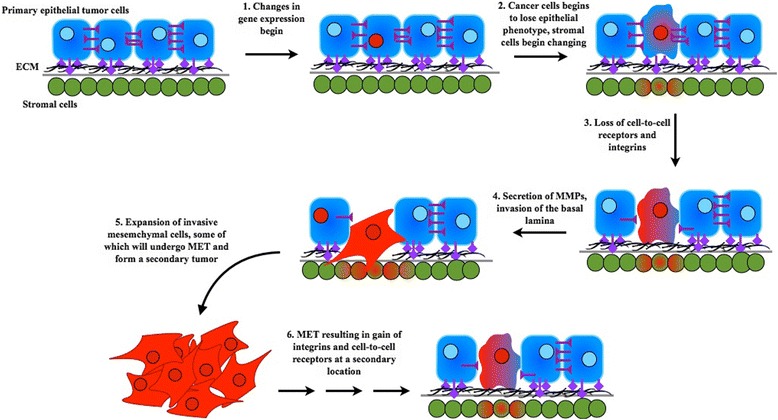
Figure 1
Figure 1
Changes that occur as a tumor cell undergoes EMT and then metastasizes at a secondary location. Epithelial tumor cells are shown in blue, and stromal cells are shown in green. As a tumor cell undergoes EMT, it begins to lose its epithelial phenotype as shown after step 2. Loss of cell-to-cell attachment receptors and integrins (shown in purple) also occurs and continues to step 3 and beyond. In addition, stromal cells near the cancer cell (which is undergoing EMT) are affected and begin undergoing changes (shown as a progression from green to red cells). Once a cancer cell has completely undergone EMT and travels to a new location, multiple steps (not explicitly shown) involving MET must occur for the metastatic cancer cell to anchor to the distant site and form a secondary tumor. The stromal cells at the new tumor location will also undergo change.

References

    1. Micalizzi D, Farabaugh S, Ford H. Epithelial-mesenchymal transition in cancer: parallels between normal development and tumor progression. J Mammary Gland Biol Neoplasia. 2010;15(2):117–34. doi: 10.1007/s10911-010-9178-9. - DOI - PMC - PubMed
    1. Byler S, Goldgar S, Heerboth S, Leary M, Housman G, Moulton K, et al. Genetic and epigenetic aspects of breast cancer progression and therapy. Anticancer Res. 2014;34(3):1071–7. - PubMed
    1. Nieto MA. Epithelial plasticity: a common theme in embryonic and cancer cells. Science. 2013;342(6159):1234850. doi: 10.1126/science.1234850. - DOI - PubMed
    1. Akalay I, Janji B, Hasmim M, Noman MZ, Thiery JP, Mami-Chouaib F, et al. EMT impairs breast carcinoma cell susceptibility to CTL-mediated lysis through autophagy induction. Autophagy. 2013;9(7):1104–6. doi: 10.4161/auto.24728. - DOI - PMC - PubMed
    1. Powell D, Blasky A, Britt S, Artinger K. Riding the crest of the wave: parallels between the neural crest and cancer in epithelial-to-mesenchymal transition and migration. Wiley Interdiscip Rev Syst Biol Med. 2013;5(4):511–22. doi: 10.1002/wsbm.1224. - DOI - PMC - PubMed