


Exploring Mediators of Physical Activity in Young Adult Cancer Survivors: Evidence from a Randomized Trial of a Facebook-Based Physical Activity Intervention
- PMID: 25852972
- PMCID: PMC4365511
- DOI: 10.1089/jayao.2014.0034
Exploring Mediators of Physical Activity in Young Adult Cancer Survivors: Evidence from a Randomized Trial of a Facebook-Based Physical Activity Intervention
Abstract
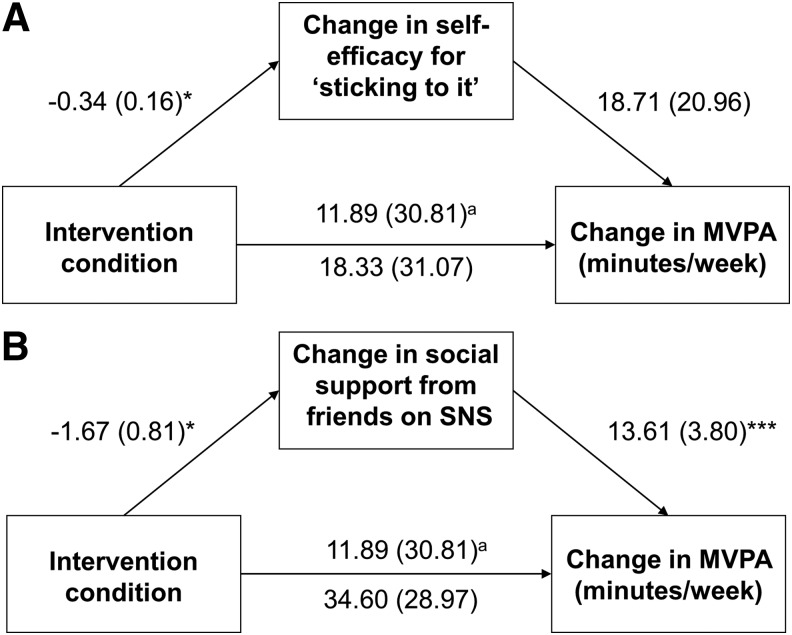
Purpose: This study examined the effects of a physical activity (PA) intervention for young adult cancer survivors on changes in self-efficacy, social support, and self-monitoring and determined whether changes in these social cognitive theory constructs mediated the relationship between the intervention and changes in PA.
Methods: A 12-week randomized trial compared a Facebook-based intervention (FITNET) aimed at increasing moderate-to-vigorous intensity PA to a Facebook-based self-help comparison group. Young adult cancer survivors (N=86, aged 21-39) were randomly assigned to one of the two groups. Self-report measures of PA and psychosocial variables were collected at baseline and after 12 weeks.
Results: The FITNET group reported lower self-efficacy for sticking to exercise (mean change=-0.38; 95% CI: -0.62 to -0.12; p=0.025) and social support from friends on social networking websites (mean change=-0.47; 95% CI: -1.45 to 0.65; p=0.039) relative to the self-help comparison group over time. Changes in social support from friends on social networking websites partially mediated the intervention effects on moderate-to-vigorous PA (mean indirect effect=-22.4; 95% CI: -62.0 to -2.8) in the unexpected direction. Across both groups, social support from friends and self-monitoring were positively associated with changes in moderate-to-vigorous PA.
Conclusion: The proposed mediators did not explain the positive effects of the FITNET intervention on mild PA. The lack of significant improvements in psychosocial constructs among FITNET participants may partly explain why the intervention did not increase moderate-to-vigorous PA relative to the self-help comparison group. Future PA interventions with young adult cancer survivors should examine targeting social support from friends and self-monitoring.
Keywords: Facebook; behavioral intervention; mediation; physical activity; psychosocial determinants; social networking website.
Figures
References
-
- World Cancer Research Fund, American Institute for Cancer Research. Food, nutrition, physical activity, and the prevention of cancer: a global perspective. Washington, DC: American Institute for Cancer Research; 2007
-
- Rock CL, Doyle C, Demark-Wahnefried W, et al. Nutrition and physical activity guidelines for cancer survivors. CA Cancer J Clin. 2012;62(4):242–4 - PubMed
-
- Schmitz KH, Holtzman J, Courneya KS, et al. Controlled physical activity trials in cancer survivors: a systematic review and meta-analysis. Cancer Epidemiol Biomarkers Prev. 2005;14(7):1588–95 - PubMed
-
- Physical Activity Guidelines Advisory Committee. Physical Activity Guidelines Advisory Committee report, 2008. Washington, DC: US Department of Health and Human Services; 2008. Accessed July3, 2014 from: www.health.gov/paguidelines/Report/Default.aspx
Publication types
MeSH terms
Grants and funding
LinkOut - more resources
Full Text Sources
Other Literature Sources
Medical
