


Evaluation of elastix-based propagated align algorithm for VOI- and voxel-based analysis of longitudinal (18)F-FDG PET/CT data from patients with non-small cell lung cancer (NSCLC)
- PMID: 25853021
- PMCID: PMC4385310
- DOI: 10.1186/s13550-015-0089-z
Evaluation of elastix-based propagated align algorithm for VOI- and voxel-based analysis of longitudinal (18)F-FDG PET/CT data from patients with non-small cell lung cancer (NSCLC)
Abstract
Background: Deformable image registration allows volume of interest (VOI)- and voxel-based analysis of longitudinal changes in fluorodeoxyglucose (FDG) tumor uptake in patients with non-small cell lung cancer (NSCLC). This study evaluates the performance of the elastix toolbox deformable image registration algorithm for VOI and voxel-wise assessment of longitudinal variations in FDG tumor uptake in NSCLC patients.
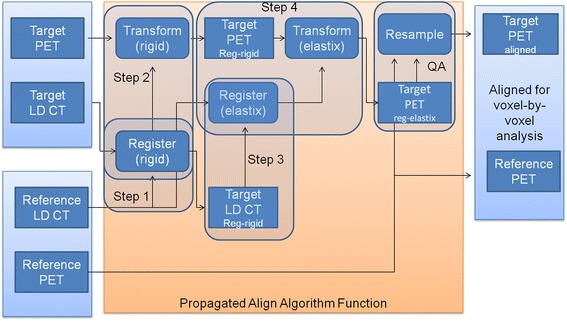
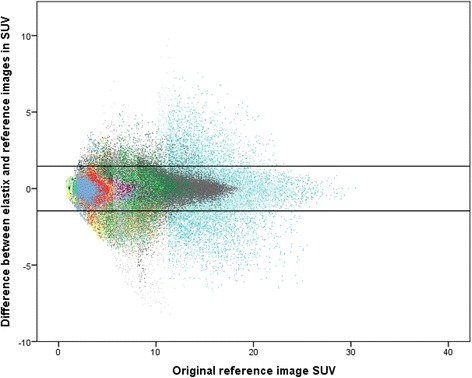
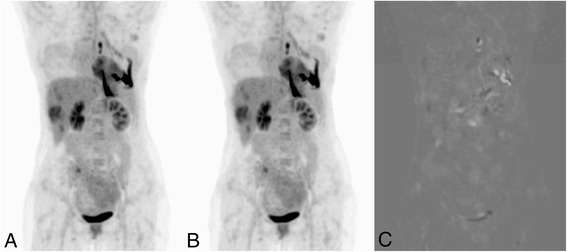
Methods: Evaluation of the elastix toolbox was performed using (18)F-FDG PET/CT at baseline and after 2 cycles of therapy (follow-up) data in advanced NSCLC patients. The elastix toolbox, an integrated part of the IMALYTICS workstation, was used to apply a CT-based non-linear image registration of follow-up PET/CT data using the baseline PET/CT data as reference. Lesion statistics were compared to assess the impact on therapy response assessment. Next, CT-based deformable image registration was performed anew on the deformed follow-up PET/CT data using the original follow-up PET/CT data as reference, yielding a realigned follow-up PET dataset. Performance was evaluated by determining the correlation coefficient between original and realigned follow-up PET datasets. The intra- and extra-thoracic tumors were automatically delineated on the original PET using a 41% of maximum standardized uptake value (SUVmax) adaptive threshold. Equivalence between reference and realigned images was tested (determining 95% range of the difference) and estimating the percentage of voxel values that fell within that range.
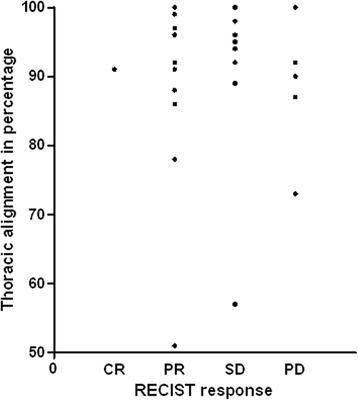
Results: Thirty-nine patients with 191 tumor lesions were included. In 37/39 and 12/39 patients, respectively, thoracic and non-thoracic lesions were evaluable for response assessment. Using the EORTC/SUVmax-based criteria, 5/37 patients had a discordant response of thoracic, and 2/12 a discordant response of non-thoracic lesions between the reference and the realigned image. FDG uptake values of corresponding tumor voxels in the original and realigned reference PET correlated well (R (2)=0.98). Using equivalence testing, 94% of all the voxel values fell within the 95% range of the difference between original and realigned reference PET.
Conclusions: The elastix toolbox impacts lesion statistics and therefore therapy response assessment in a clinically significant way. The elastix toolbox is therefore not applicable in its current form and/or standard settings for PET response evaluation. Further optimization and validation of this technique is necessary prior to clinical implementation.
Keywords: Elastix; Image deformation; NSCLC; PET/CT.
Figures

References
-
- Kobe C, Scheffler M, Holstein A, Zander T, Nogova L, Lammertsma AA, et al. Predictive value of early and late residual 18 F-fluorodeoxyglucose and 18 F-fluorothymidine uptake using different SUV measurements in patients with non-small-cell lung cancer treated with erlotinib. Eur J Nucl Med Mol Imaging. 2012;39:1117–27. doi: 10.1007/s00259-012-2118-8. - DOI - PubMed
-
- Tiseo M, Ippolito M, Scarlattei M, Spadaro P, Cosentino S, Latteri F, et al. Predictive and prognostic value of early response assessment using 18FDG-PET in advanced non-small cell lung cancer patients treated with erlotinib. Cancer Chemother Pharmacol. 2014;73:299–307. doi: 10.1007/s00280-013-2356-x. - DOI - PubMed
-
- Young H, Baum R, Cremerius U, Herholz K, Hoekstra O, Lammertsma AA, et al. Measurement of clinical and subclinical tumour response using [18 F]-fluorodeoxyglucose and positron emission tomography: review and 1999 EORTC recommendations. European Organization for Research and Treatment of Cancer (EORTC) PET Study Group. Eur J Cancer. 1999;35:1773–82. doi: 10.1016/S0959-8049(99)00229-4. - DOI - PubMed
LinkOut - more resources
Full Text Sources
Other Literature Sources
