. 2015 May;74(5):442-52.
doi: 10.1097/NEN.0000000000000188.

CDKN2A loss is associated with shortened overall survival in lower-grade (World Health Organization Grades II-III) astrocytomas

Affiliations

CDKN2A loss is associated with shortened overall survival in lower-grade (World Health Organization Grades II-III) astrocytomas

Gerald F Reis et al. J Neuropathol Exp Neurol. 2015 May.

Abstract

Lower-grade (World Health Organization Grades II and III) gliomas vary widely in clinical behavior and are classified as astrocytic, oligodendroglial, or mixed. Anaplasia depends greatly on mitotic activity, with CDKN2A loss considered as the most common mechanism for cell cycle dysregulation. We investigated whether loss of the CDKN2A gene is associated with overall survival across pathologically and genetically defined glioma subtypes. After adjustment for IDH mutation, sex, and age, CDKN2A deletion was strongly associated with poorer overall survival in astrocytomas but not in oligodendrogliomas or oligoastrocytomas. Molecular classification of astrocytomas by IDH mutation, TP53 mutation, and /or ATRX loss of expression revealed that CDKN2A loss in IDH/TP53 mutated tumors was strongly associated with worse overall survival. CDKN2A loss in IDH mutated tumors with ATRX loss was only weakly associated with worse overall survival. These findings suggest that CDKN2A testing may provide further clinical aid in lower-grade glioma substratification beyond IDH mutation and 1p19q codeletion status, particularly in IDH/TP53 mutated astrocytomas.


Figures
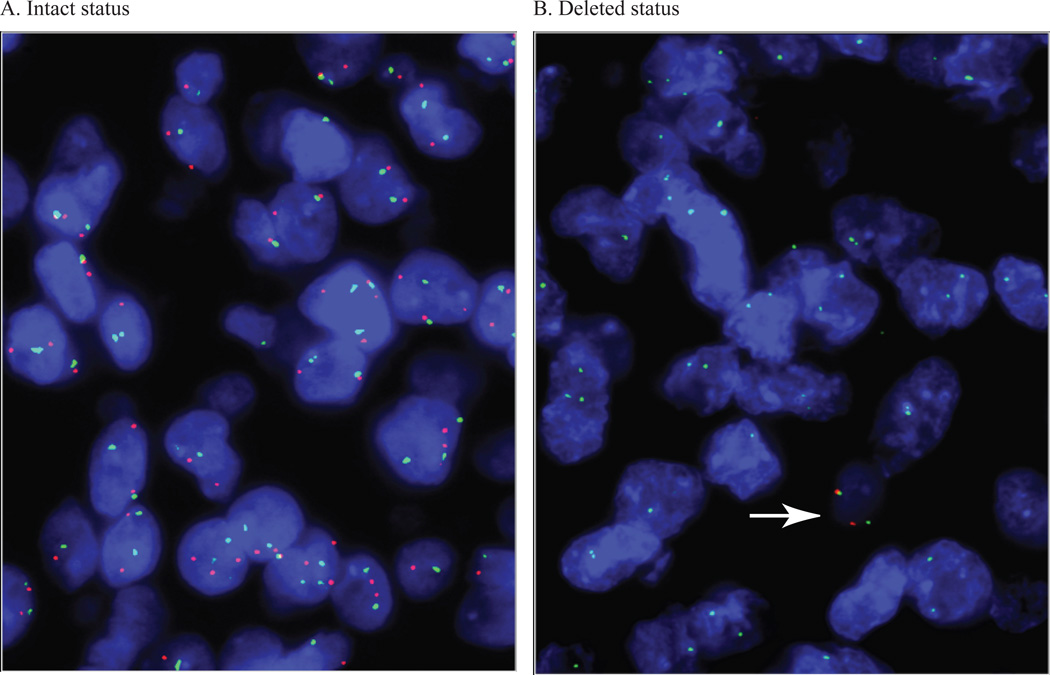
Figure 1
Figure 1. Fluorescence in situ hybridization for CDKN2A
(A, B) Results of fluorescence in situ hybridization demonstrating intact (A: CEP9/CDKN2A ratio near one) and deleted (B) CDKN2A status. In the latter case, a non-neoplastic cell containing 2 green CEP9 signals and 2 red CDKN2A signals is seen (white arrow), whereas all the tumor cells have only CEP9 signals.
Figure 2
Figure 2
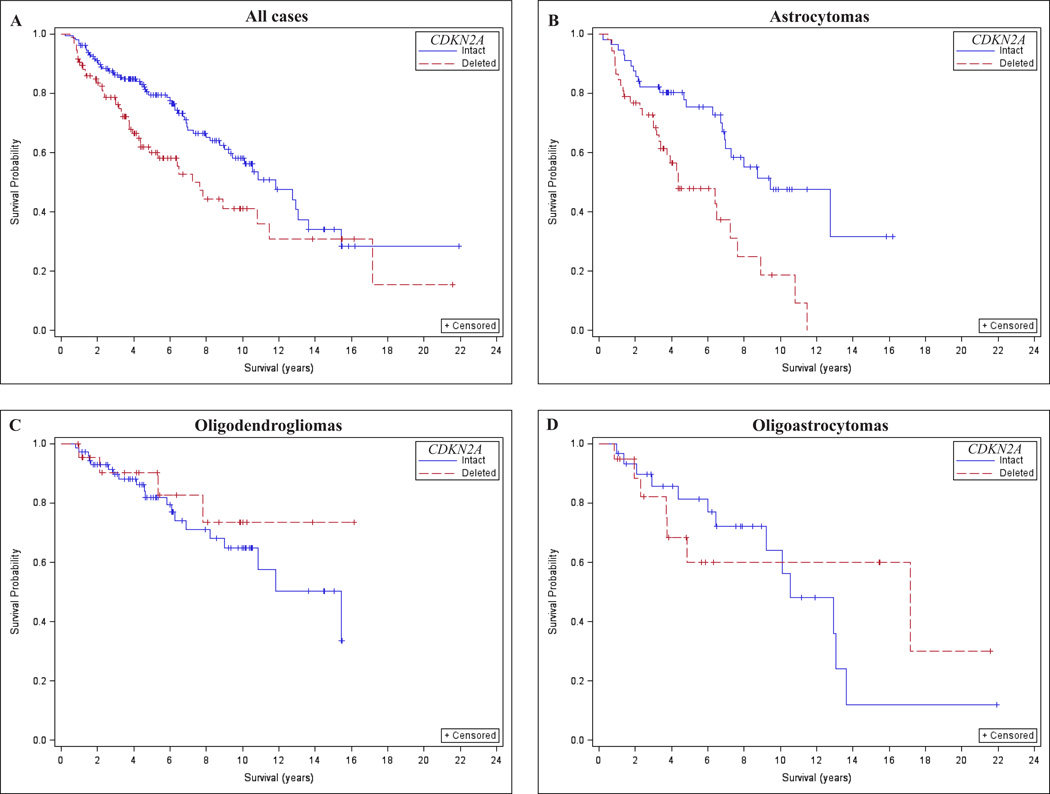
Effect of CDKN2A loss on overall survival of histologically classified lower grade (World Health Organization II-III) gliomas. (A–D) CDKN2A loss was associated with worse overall survival in lower grade gliomas not stratified by histology (A) and in astrocytomas (B), but not in oligodendrogliomas (C) or oligoastrocytomas (D).
Figure 3
Figure 3
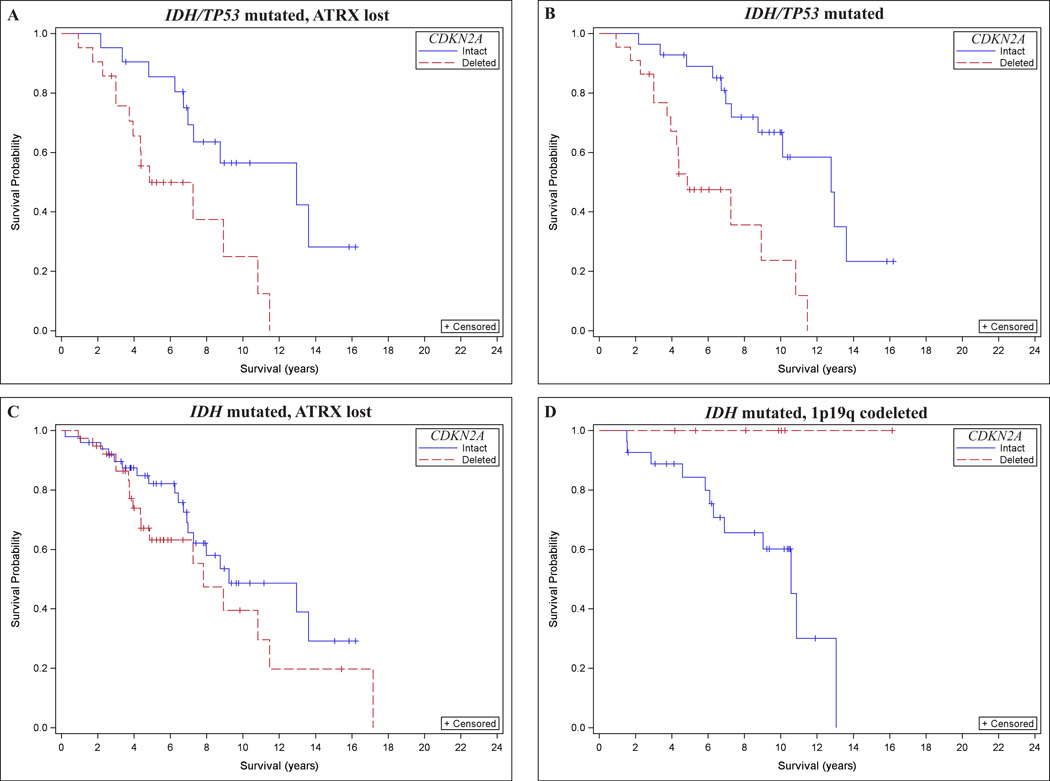
Effect of CDKN2A loss on overall survival in subsets of molecularly defined astrocytomas and oligodendrogliomas. (A–C) CDKN2A loss by fluorescence in situ hybridization (FISH) was associated with worse overall survival in IDH/TP53 mutated tumors with ATRX loss (IDH/TP53/ATRX group) (A) and IDH/TP53 mutated tumors (IDH/TP53 group) (B) but not in IDH mutated tumors with ATRX loss (IDH/ATRX group) (C). (D) Patients with molecularly defined oligodendrogliomas in the CDKN2A deleted group appeared to have improved survival; however, the statistical significance of the association between CDKN2A loss and overall survival could not be accurately assessed because none of the subjects in the CDKN2A deleted group died during the follow-up period.
Figure 4
Figure 4
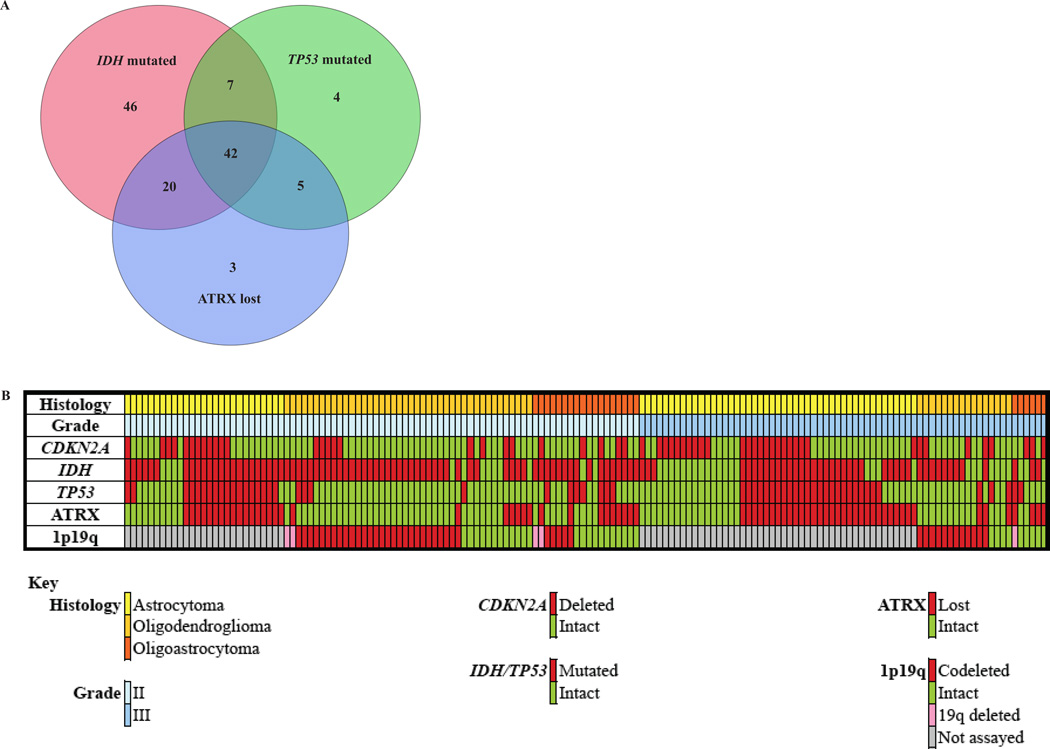
Overlap between IDH/TP53 and IDH/ATRX groups. (A) The astrocytoma groups defined by IDH/TP53 mutation (IDH/TP53 group) or IDH mutated tumors with ATRX loss (IDH/ATRX group) showed partial overlap such that among 115 IDH mutated cases with known status for CDKN2A IDH TP53, and ATRX, 42 cases (36.5%) showed ATRX loss and TP53 mutation, 7 cases (6.1%) were TP53 mutated and ATRX intact; 20 cases (17.4%) were ATRX intact and TP53 wild type. (B) OncoPrint of molecular parameters grouped by histology and grade.

References

    1. Dolecek TA, Propp JM, Stroup NE, et al. CBTRUS statistical report: primary brain and central nervous system tumors diagnosed in the United States in 2005–2009. Neuro Oncol. 2012;(14) Suppl 5:v1–v49. - PMC - PubMed
    1. Louis DN, Cavenee WK, Ohgaki H, et al. WHO classification of tumours of the central nervous system. Lyon. 2007 - PMC - PubMed
    1. Louis DN, Perry A, Burger P, et al. International Society of Neuropathology-Haarlem Consensus Guidelines for Nervous System Tumor Classification and Grading. Brain Pathol. 2014;24:429–435. - PMC - PubMed
    1. Bourne TD, Schiff D. Update on molecular findings, management and outcome in low-grade gliomas. Nat Rev Neurol. 2010;6:695–701. - PubMed
    1. Parsons DW, Jones S, Zhang X, et al. An integrated genomic analysis of human glioblastoma multiforme. Science. 2008;321:1807–1812. - PMC - PubMed

Publication types

Substances