Effects of red-cell storage duration on patients undergoing cardiac surgery
- PMID: 25853746
- PMCID: PMC5442442
- DOI: 10.1056/NEJMoa1414219
Effects of red-cell storage duration on patients undergoing cardiac surgery
Abstract
Background: Some observational studies have reported that transfusion of red-cell units that have been stored for more than 2 to 3 weeks is associated with serious, even fatal, adverse events. Patients undergoing cardiac surgery may be especially vulnerable to the adverse effects of transfusion.
Methods: We conducted a randomized trial at multiple sites from 2010 to 2014. Participants 12 years of age or older who were undergoing complex cardiac surgery and were likely to undergo transfusion of red cells were randomly assigned to receive leukocyte-reduced red cells stored for 10 days or less (shorter-term storage group) or for 21 days or more (longer-term storage group) for all intraoperative and postoperative transfusions. The primary outcome was the change in Multiple Organ Dysfunction Score (MODS; range, 0 to 24, with higher scores indicating more severe organ dysfunction) from the preoperative score to the highest composite score through day 7 or the time of death or discharge.
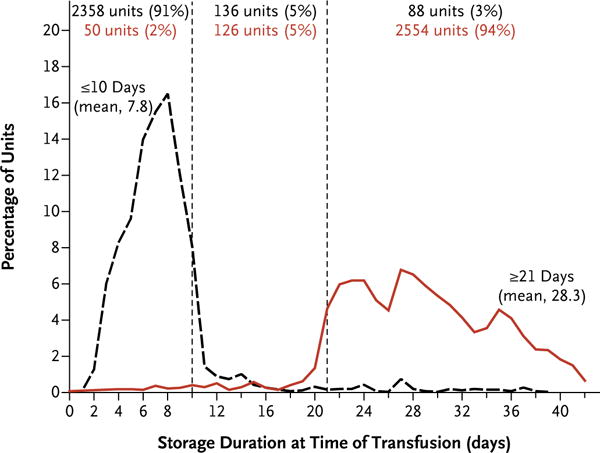
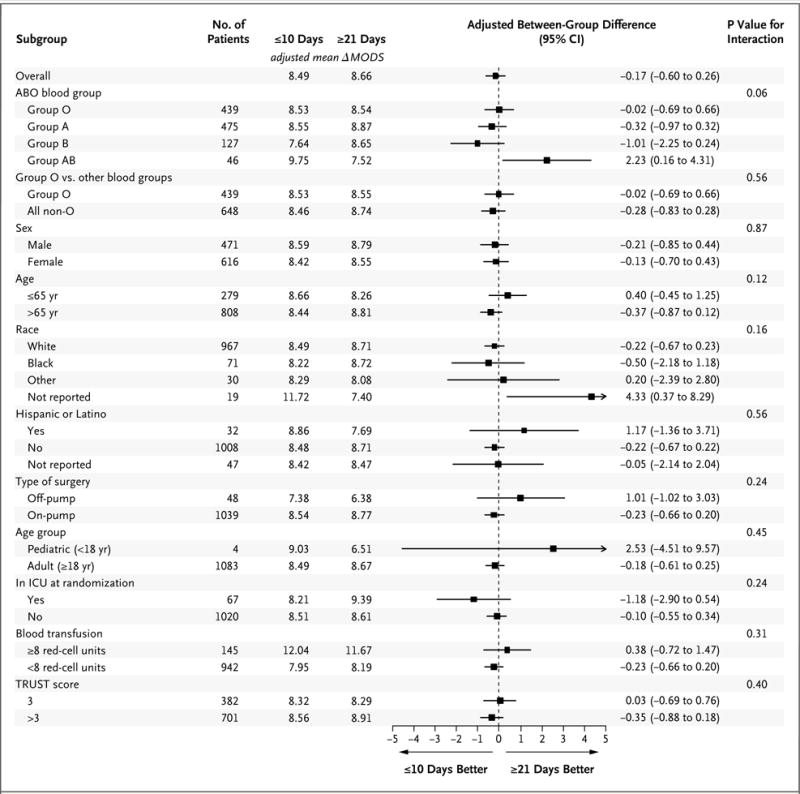
Results: The median storage time of red-cell units provided to the 1098 participants who received red-cell transfusion was 7 days in the shorter-term storage group and 28 days in the longer-term storage group. The mean change in MODS was an increase of 8.5 and 8.7 points, respectively (95% confidence interval for the difference, -0.6 to 0.3; P=0.44). The 7-day mortality was 2.8% in the shorter-term storage group and 2.0% in the longer-term storage group (P=0.43); 28-day mortality was 4.4% and 5.3%, respectively (P=0.57). Adverse events did not differ significantly between groups except that hyperbilirubinemia was more common in the longer-term storage group.
Conclusions: The duration of red-cell storage was not associated with significant differences in the change in MODS. We did not find that the transfusion of red cells stored for 10 days or less was superior to the transfusion of red cells stored for 21 days or more among patients 12 years of age or older who were undergoing complex cardiac surgery. (Funded by the National Heart, Lung, and Blood Institute; RECESS ClinicalTrials.gov number, NCT00991341.).
Figures
Comment in
-
More on the Age of Transfused Red Cells.N Engl J Med. 2015 Jul 16;373(3):283-4. doi: 10.1056/NEJMc1505699. N Engl J Med. 2015. PMID: 26176390 No abstract available.
-
More on the Age of Transfused Red Cells.N Engl J Med. 2015 Jul 16;373(3):283. doi: 10.1056/NEJMc1505699. N Engl J Med. 2015. PMID: 26176391 No abstract available.
References
Publication types
MeSH terms
Associated data
Grants and funding
LinkOut - more resources
Full Text Sources
Other Literature Sources
Medical