


Implementation of 5S management method for lean healthcare at a health center in Senegal: a qualitative study of staff perception
- PMID: 25854781
- PMCID: PMC4390558
- DOI: 10.3402/gha.v8.27256
Implementation of 5S management method for lean healthcare at a health center in Senegal: a qualitative study of staff perception
Abstract
Background: 5S is a lean method for workplace organization; it is an abbreviation representing five Japanese words that can be translated as sort, set in order, shine, standardize, and sustain. The 5S management method has been recognized recently as a potential solution for improving the quality of government healthcare services in low- and middle-income countries.
Objective: To assess how the 5S management method creates changes in the workplace and in the process and outcomes of healthcare services, and how it can be applicable in a resource-poor setting, based on data from a pilot intervention of the 5S program implemented in a health facility in Senegal.
Design: In this qualitative study, we interviewed 21 health center staff members 1 year after the pilot intervention. We asked them about their views on the changes brought on by the 5S program in their workplace, daily routines, and services provided. We then transcribed interview records and organized the narrative information by emerging themes using thematic analysis in the coding process.
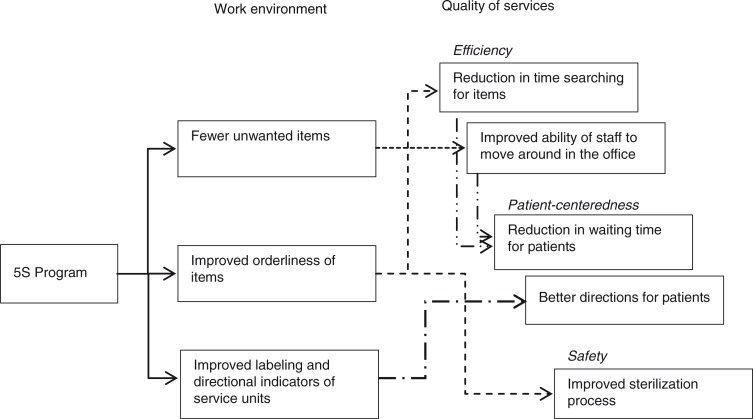
Results: Study participants indicated that, despite resource constraints and other demotivating factors present at the health center, the 5S program created changes in the work environment, including fewer unwanted items, improved orderliness, and improved labeling and directional indicators of service units. These efforts engendered changes in the quality of services (e.g. making services more efficient, patient-centered, and safe), and in the attitude and behavior of staff and patients.
Conclusions: The pilot intervention of the 5S management method was perceived to have improved the quality of healthcare services and staff motivation in a resource-poor healthcare facility with a disorderly work environment in Senegal. Quantitative and qualitative research based on a larger-scale intervention would be needed to elaborate and validate these findings and to identify the cost-effectiveness of such intervention in low- and middle-income countries.
Keywords: 5S; healthcare; intervention programs; lean; qualitative study; quality improvement; work environment.
Figures
References
-
- Gapp R, Fisher R, Kobayashi K. Implementing 5S within a Japanese context: an integrated management system. Manage Decis. 2008;46:565–79.
-
- Hirano H. 5S for operators: 5 pillars of the visual workplace. Portland, OR: Productivity Press; 1996.
-
- Hirano H. JIT implementation manual - The complete guide to just-in-time manufacturing: Volume 2 - Waste and the 5S's. Boca Raton: CRC Press; 2009.
-
- Ho SK, Cicmil S, Fung CK. The Japanese 5-S practice and TQM training. Train Qual. 1995;3:19–24.
-
- Womak J, Jones D, Roos D. The machine that changed the world. New York, NY: Rawson Associates; 1990.
Publication types
MeSH terms
LinkOut - more resources
Full Text Sources
Other Literature Sources
Medical
