


Vitreal delivery of AAV vectored Cnga3 restores cone function in CNGA3-/-/Nrl-/- mice, an all-cone model of CNGA3 achromatopsia
- PMID: 25855802
- PMCID: PMC4459390
- DOI: 10.1093/hmg/ddv114
Vitreal delivery of AAV vectored Cnga3 restores cone function in CNGA3-/-/Nrl-/- mice, an all-cone model of CNGA3 achromatopsia
Abstract
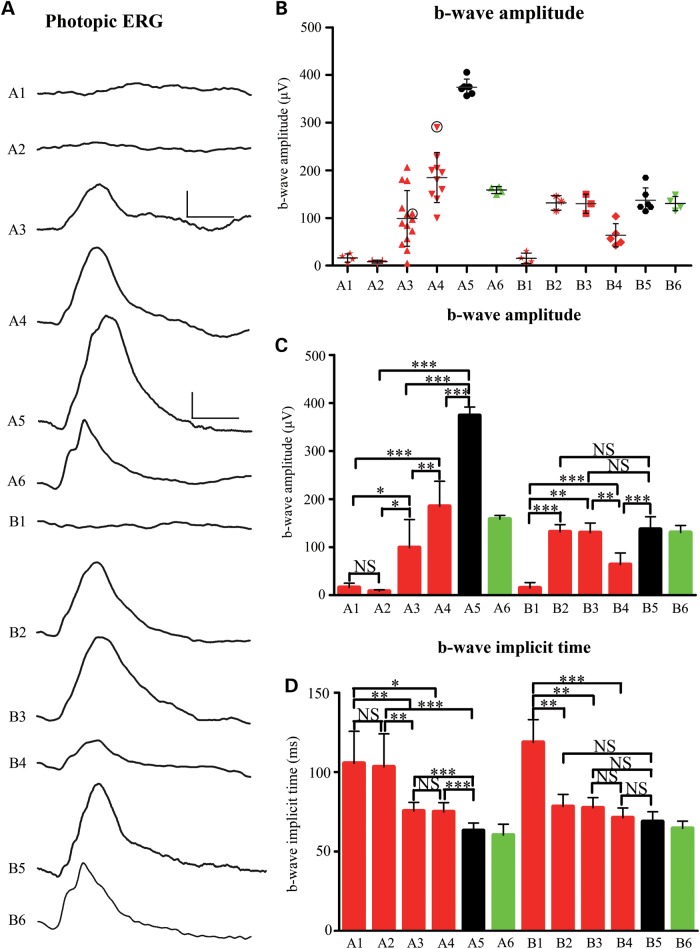
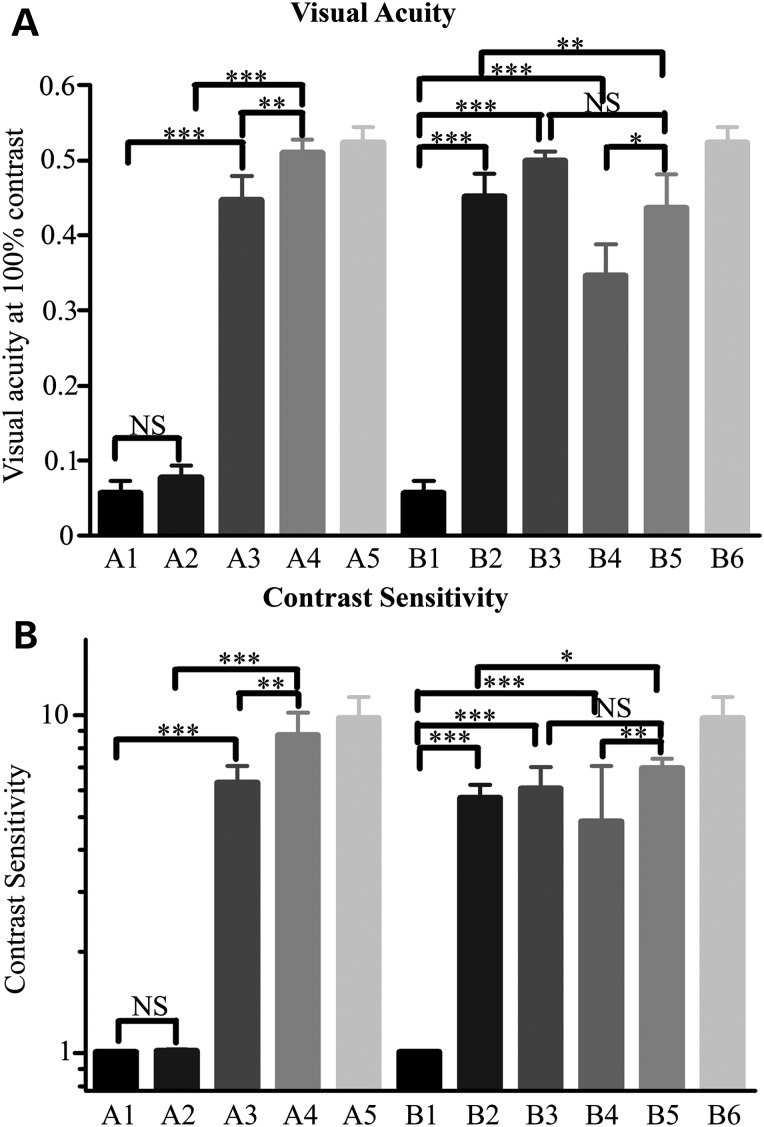
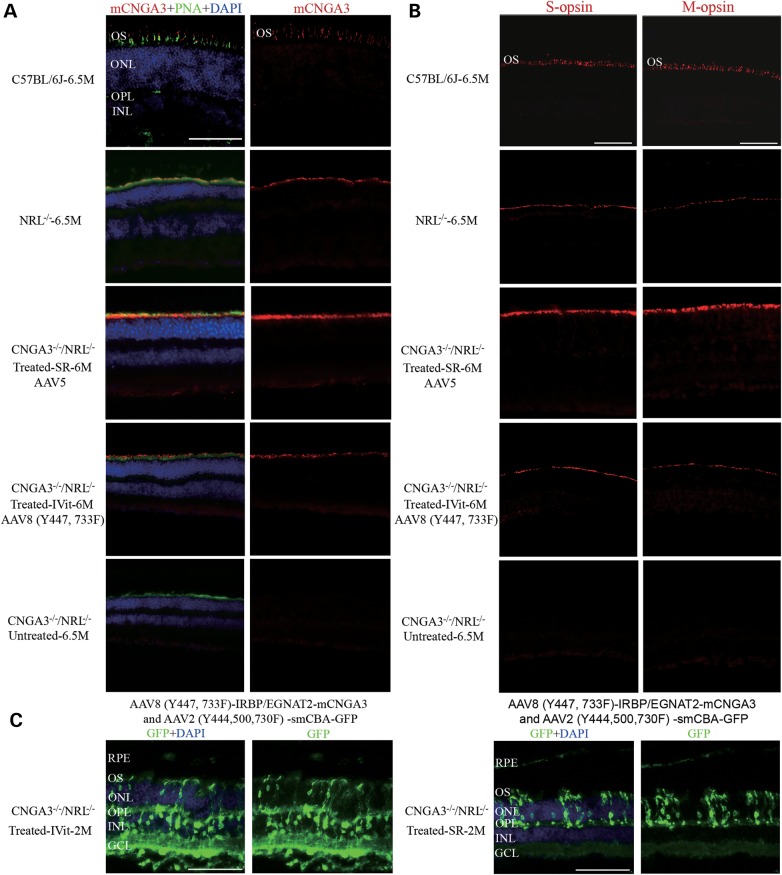
The CNGA3(-/-)/Nrl(-/-) mouse is a cone-dominant model with Cnga3 channel deficiency, which partially mimics the all cone foveal structure of human achromatopsia 2 with CNGA3 mutations. Although subretinal (SR) AAV vector administration can transfect retinal cells efficiently, the injection-induced retinal detachment can cause retinal damage, particularly when SR vector bleb includes the fovea. We therefore explored whether cone function-structure could be rescued in CNGA3(-/-)/Nrl(-/-) mice by intravitreal (IVit) delivery of tyrosine to phenylalanine (Y-F) capsid mutant AAV8. We find that AAV-mediated CNGA3 expression can restore cone function and rescue structure following IVit delivery of AAV8 (Y447, 733F) vector. Rescue was assessed by restoration of the cone-mediated electroretinogram (ERG), optomotor responses, and cone opsin immunohistochemistry. Demonstration of gene therapy in a cone-dominant mouse model by IVit delivery provides a potential alternative vector delivery mode for safely transducing foveal cones in achromatopsia patients and in other human retinal diseases affecting foveal function.
© The Author 2015. Published by Oxford University Press. All rights reserved. For Permissions, please email: journals.permissions@oup.com.
Figures
References
-
- Kohl S., Varsanyi B., Antunes G.A., Baumann B., Hoyng C.B., Jagle H., Rosenberg T., Kellner U., Lorenz B., Salati R., et al. (2005) CNGB3 mutations account for 50% of all cases with autosomal recessive achromatopsia. Eur. J. Hum. Genet., 13, 302–308. - PubMed
-
- Kaupp U.B., Seifert R. (2002) Cyclic nucleotide-gated ion channels. Physiol. Rev., 82, 769–824. - PubMed
-
- Zelinger L., Greenberg A., Kohl S., Banin E., Sharon D. (2010) An ancient autosomal haplotype bearing a rare achromatopsia-causing founder mutation is shared among Arab Muslims and Oriental Jews. Hum. Genet., 128, 261–267. - PubMed
-
- Dai X.F., Pang J.J. (2012) [Progress on study of achromatopsia and targeted gene therapy]. Zhonghua Yan Ke Za Zhi, 48, 755–758. - PubMed
Publication types
MeSH terms
Substances
Grants and funding
LinkOut - more resources
Full Text Sources
Other Literature Sources
Medical
Molecular Biology Databases
Research Materials
