Community-centered responses to Ebola in urban Liberia: the view from below
- PMID: 25856072
- PMCID: PMC4391876
- DOI: 10.1371/journal.pntd.0003706
Community-centered responses to Ebola in urban Liberia: the view from below
Erratum in
-
Correction: Community-centered responses to Ebola in urban Liberia: the view from below.PLoS Negl Trop Dis. 2015 May 7;9(5):e0003767. doi: 10.1371/journal.pntd.0003767. eCollection 2015 May. PLoS Negl Trop Dis. 2015. PMID: 25951327 Free PMC article. No abstract available.
Abstract
Background: The West African Ebola epidemic has demonstrated that the existing range of medical and epidemiological responses to emerging disease outbreaks is insufficient, especially in post-conflict contexts with exceedingly poor healthcare infrastructures. In this context, community-based responses have proven vital for containing Ebola virus disease (EVD) and shifting the epidemic curve. Despite a surge in interest in local innovations that effectively contained the epidemic, the mechanisms for community-based response remain unclear. This study provides baseline information on community-based epidemic control priorities and identifies innovative local strategies for containing EVD in Liberia.
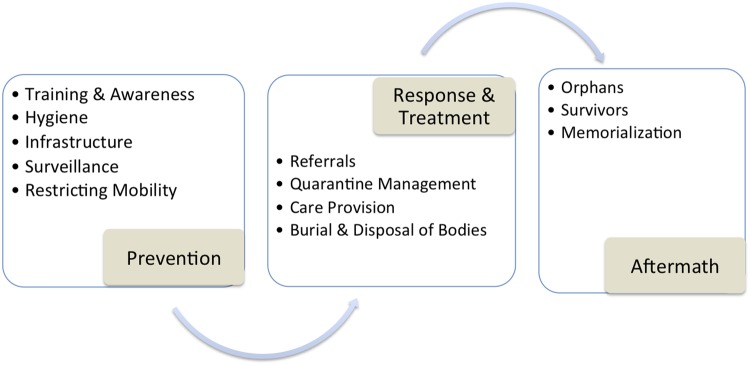
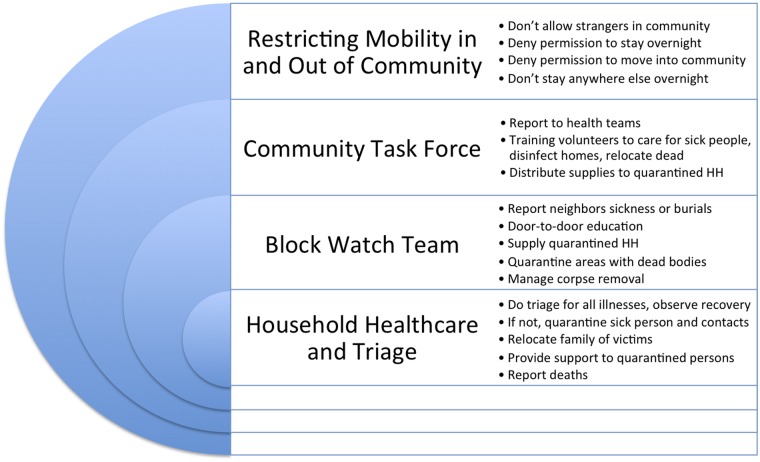
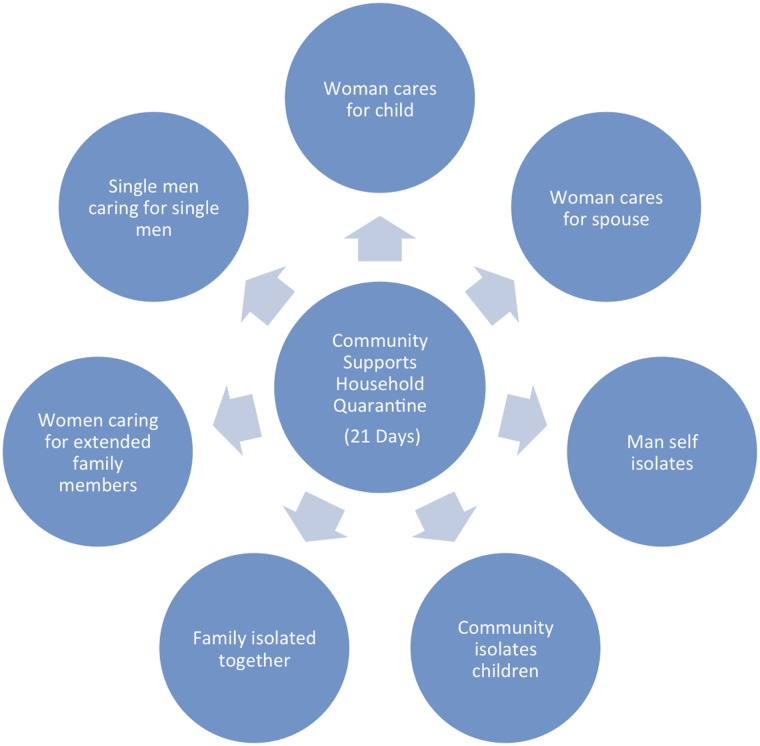
Methodology/principal findings: This study was conducted in September 2014 in 15 communities in Monrovia and Montserrado County, Liberia--one of the epicenters of the Ebola outbreak. Findings from 15 focus group discussions with 386 community leaders identified strategies being undertaken and recommendations for what a community-based response to Ebola should look like under then-existing conditions. Data were collected on the following topics: prevention, surveillance, care-giving, community-based treatment and support, networks and hotlines, response teams, Ebola treatment units (ETUs) and hospitals, the management of corpses, quarantine and isolation, orphans, memorialization, and the need for community-based training and education. Findings have been presented as community-based strategies and recommendations for (1) prevention, (2) treatment and response, and (3) community sequelae and recovery. Several models for community-based management of the current Ebola outbreak were proposed. Additional findings indicate positive attitudes towards early Ebola survivors, and the need for community-based psychosocial support.
Conclusions/significance: Local communities' strategies and recommendations give insight into how urban Liberian communities contained the EVD outbreak while navigating the systemic failures of the initial state and international response. Communities in urban Liberia adapted to the epidemic using multiple coping strategies. In the absence of health, infrastructural and material supports, local people engaged in self-reliance in order to contain the epidemic at the micro-social level. These innovations were regarded as necessary, but as less desirable than a well-supported health-systems based response; and were seen as involving considerable individual, social, and public health costs, including heightened vulnerability to infection.
Conflict of interest statement
The authors have declared that no competing interests exist.
Figures

References
-
- WHO. Ebola Response Roadmap Situation Report. 21 January 2015. Geneva: Switzerland.
Publication types
MeSH terms
LinkOut - more resources
Full Text Sources
Other Literature Sources
Medical