


Dexamethasone as adjuvant to bupivacaine prolongs the duration of thermal antinociception and prevents bupivacaine-induced rebound hyperalgesia via regional mechanism in a mouse sciatic nerve block model
- PMID: 25856078
- PMCID: PMC4391940
- DOI: 10.1371/journal.pone.0123459
Dexamethasone as adjuvant to bupivacaine prolongs the duration of thermal antinociception and prevents bupivacaine-induced rebound hyperalgesia via regional mechanism in a mouse sciatic nerve block model
Abstract
Background: Dexamethasone has been studied as an effective adjuvant to prolong the analgesia duration of local anesthetics in peripheral nerve block. However, the route of action for dexamethasone and its potential neurotoxicity are still unclear.
Methods: A mouse sciatic nerve block model was used. The sciatic nerve was injected with 60ul of combinations of various medications, including dexamethasone and/or bupivacaine. Neurobehavioral changes were observed for 2 days prior to injection, and then continuously for up to 7 days after injection. In addition, the sciatic nerves were harvested at either 2 days or 7 days after injection. Toluidine blue dyeing and immunohistochemistry test were performed to study the short-term and long-term histopathological changes of the sciatic nerves. There were six study groups: normal saline control, bupivacaine (10mg/kg) only, dexamethasone (0.5mg/kg) only, bupivacaine (10mg/kg) combined with low-dose (0.14mg/kg) dexamethasone, bupivacaine (10mg/kg) combined with high-dose (0.5mg/kg) dexamethasone, and bupivacaine (10mg/kg) combined with intramuscular dexamethasone (0.5mg/kg).
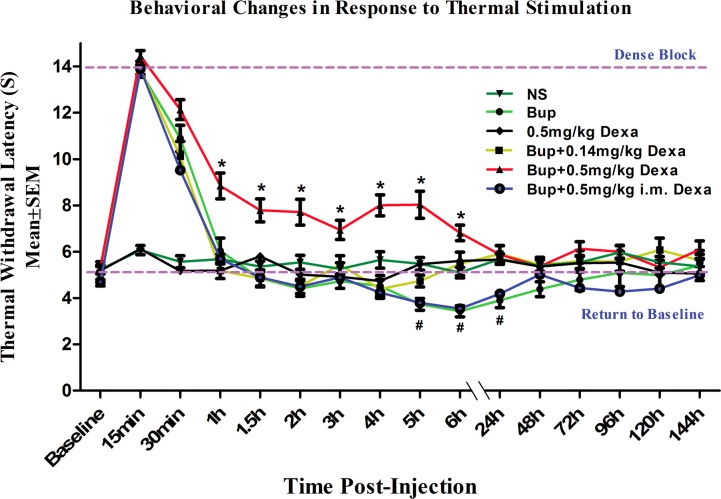
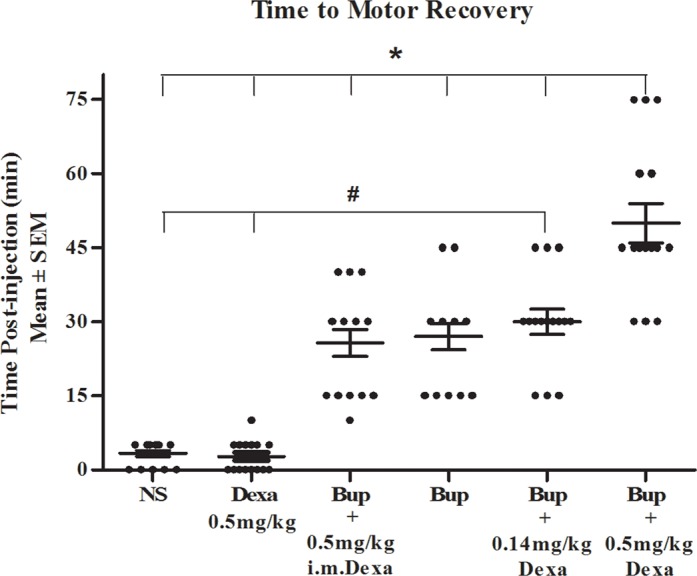
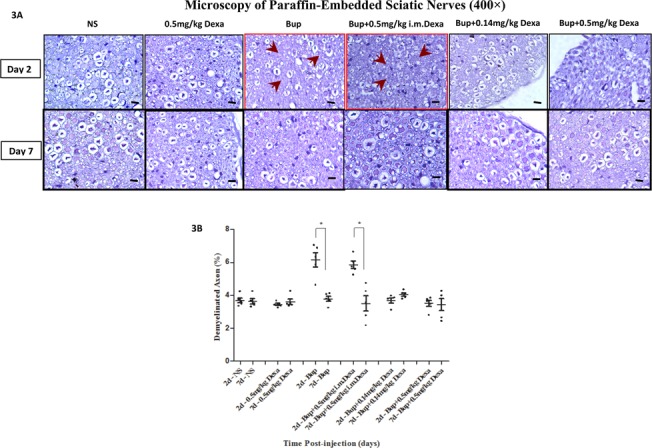
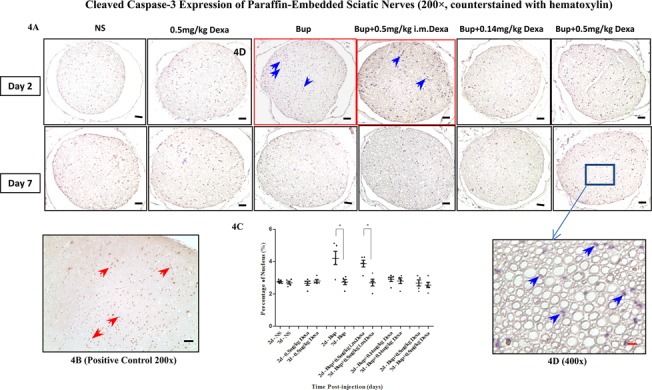
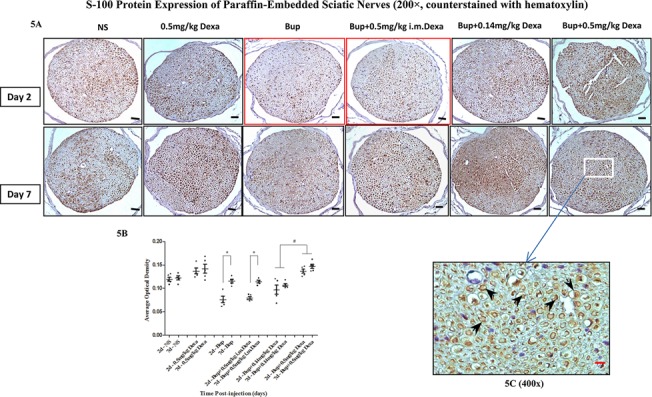
Results: High-dose perineural dexamethasone, but not systemic dexamethasone, combined with bupivacaine prolonged the duration of both sensory and motor block of mouse sciatic nerve. There was no significant difference on the onset time of the sciatic nerve block. There was "rebound hyperalgesia" to thermal stimulus after the resolution of plain bupivacaine sciatic nerve block. Interestingly, both low and high dose perineural dexamethasone prevented bupivacaine-induced hyperalgesia. There was an early phase of axon degeneration and Schwann cell response as represented by S-100 expression as well as the percentage of demyelinated axon and nucleus in the plain bupivacaine group compared with the bupivacaine plus dexamethasone groups on post-injection day 2, which resolved on post-injection day 7. Furthermore, we demonstrated that perineural dexamethasone, but not systemic dexamethasone, could prevent axon degeneration and demyelination. There was no significant caspase-dependent apoptosis process in the mouse sciatic nerve among all study groups during our study period.
Conclusions: Perineural, not systemic, dexamethasone added to a clinical concentration of bupivacaine may not only prolong the duration of sensory and motor blockade of sciatic nerve, but also prevent the bupivacaine-induced reversible neurotoxicity and short-term "rebound hyperalgesia" after the resolution of nerve block.
Conflict of interest statement
Figures
References
-
- Long TR, Wass CT, Burkle CM (2002) Perioperative interscalene blockade: an overview of its history and current clinical use. Journal of clinical anesthesia 14: 546–556. - PubMed
-
- Bulka CM, Shotwell MS, Gupta RK, Sandberg WS, Ehrenfeld JM (2014) Regional Anesthesia, Time to Hospital Discharge, and In-Hospital Mortality: A Propensity Score Matched Analysis. Regional anesthesia and pain medicine. - PubMed
-
- Merritt CK, Mariano ER, Kaye AD, Lissauer J, Mancuso K, Prabhakar A, et al. (2014) Peripheral nerve catheters and local anesthetic infiltration in perioperative analgesia. Best practice & research Clinical anaesthesiology 28: 41–57. - PubMed
-
- Bailard NS, Ortiz J, Flores RA (2014) Additives to local anesthetics for peripheral nerve blocks: Evidence, limitations, and recommendations. American journal of health-system pharmacy: AJHP: official journal of the American Society of Health-System Pharmacists 71: 373–385. 10.2146/ajhp130336 - DOI - PubMed
-
- Parrington SJ, O'Donnell D, Chan VW, Brown-Shreves D, Subramanyam R, Qu M, et al. (2010) Dexamethasone added to mepivacaine prolongs the duration of analgesia after supraclavicular brachial plexus blockade. Regional anesthesia and pain medicine 35: 422–426. 10.1097/AAP.0b013e3181e85eb9 - DOI - PubMed
MeSH terms
Substances
LinkOut - more resources
Full Text Sources
Other Literature Sources
Medical
