. 2015 Apr 8;12(4):3915-25.
doi: 10.3390/ijerph120403915.

Evaluation of E-cigarette liquid vapor and mainstream cigarette smoke after direct exposure of primary human bronchial epithelial cells

Affiliations

Evaluation of E-cigarette liquid vapor and mainstream cigarette smoke after direct exposure of primary human bronchial epithelial cells

Stefanie Scheffler et al. Int J Environ Res Public Health. .

Abstract

E-cigarettes are emerging products, often described as "reduced-risk" nicotine products or alternatives to combustible cigarettes. Many smokers switch to e-cigarettes to quit or significantly reduce smoking. However, no regulations for e-cigarettes are currently into force, so that the quality and safety of e-liquids is not necessarily guaranteed. We exposed primary human bronchial epithelial cells of two different donors to vapor of e-cigarette liquid with or without nicotine, vapor of the carrier substances propylene glycol and glycerol as well as to mainstream smoke of K3R4F research cigarettes. The exposure was done in a CULTEX® RFS compact module, allowing the exposure of the cells at the air-liquid interface. 24 h post-exposure, cell viability and oxidative stress levels in the cells were analyzed. We found toxicological effects of e-cigarette vapor and the pure carrier substances, whereas the nicotine concentration did not have an effect on the cell viability. The viability of mainstream smoke cigarette exposed cells was 4.5-8 times lower and the oxidative stress levels 4.5-5 times higher than those of e-cigarette vapor exposed cells, depending on the donor. Our experimental setup delivered reproducible data and thus provides the opportunity for routine testing of e-cigarette liquids to ensure safety and quality for the user.


Figures
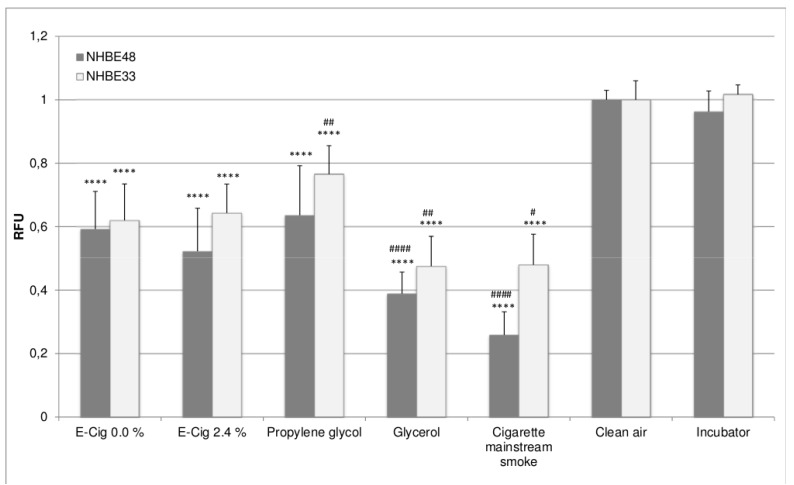
Figure 1
Figure 1
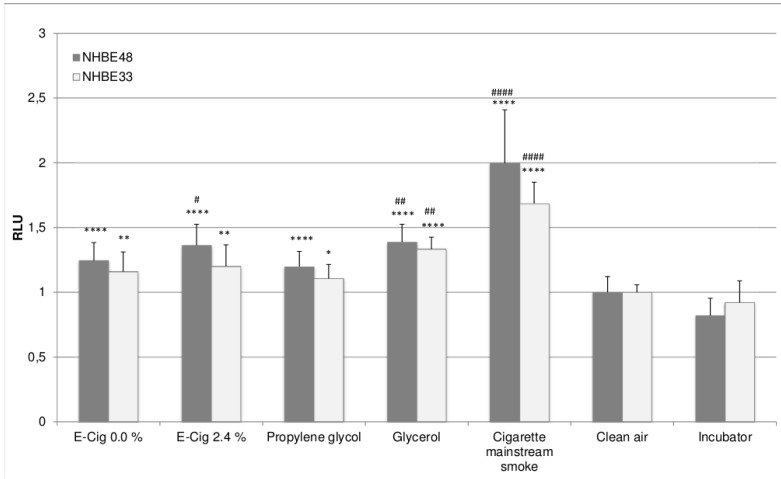
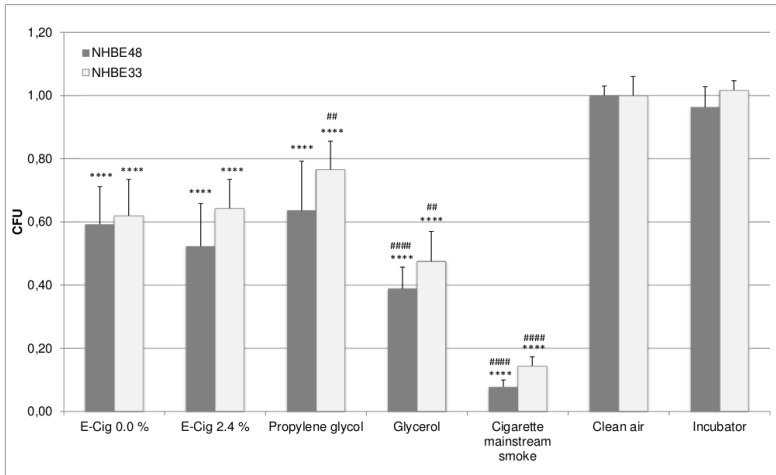
Cell viability of NHBE cells after exposure. The results are given as mean of five (NHBE48) and three (NHBE33) independent experiments with three samples each + standard deviation. The asterisks indicate the statistical significance compared to clean air exposed cells, the hash marks compared to cells exposed to e-cigarette vapor with 0% nicotine. The relevance of the significance is explained in Section 2.5.
Figure 2
Figure 2
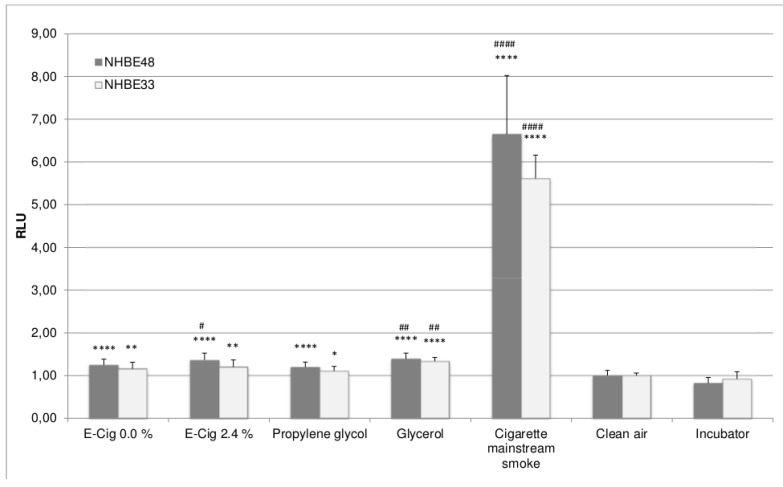
Oxidative stress levels in NHBE cells after exposure. The results are given as mean of five (NHBE48) and three (NHBE33) independent experiments with three samples each + standard deviation. The asterisks indicate the statistical significance compared to clean air exposed cells, the hash marks compared to cells exposed to e-cigarette vapor with 0% nicotine. The relevance of the significance is explained in Section 2.5.
Figure 3
Figure 3
Puff-adjusted values for cell viability of NHBE cells after exposure. The results are given as mean of five (NHBE48) and three (NHBE33) independent experiments with three samples each + standard deviation. The asterisks indicate the statistical significance compared to clean air exposed cells, the hash marks compared to cells exposed to e-cigarette vapor with 0% nicotine. The relevance of the significance is explained in Section 2.5.
Figure 4
Figure 4
Puff-adjusted values for oxidative stress levels in NHBE cells after exposure. The results are given as mean of five (NHBE48) and three (NHBE33) independent experiments with three samples each + standard deviation. The asterisks indicate the statistical significance compared to clean air exposed cells, the hash marks compared to cells exposed to e-cigarette vapor with 0% nicotine. The relevance of the significance is explained in Section 2.5.

References

    1. Zhu S.H., Sun J.Y., Bonnevie E., Cummins S.E., Gamst A., Yin L., Lee M. Four hundred and sixty brands of e-cigarettes and counting: Implications for product regulation. Tob. Control. 2014;23:iii3–iii9. doi: 10.1136/tobaccocontrol-2014-051670. - DOI - PMC - PubMed
    1. Polosa R., Caponnetto P., Morjaria J.B., Papale G., Campagna D., Russo C. Effect of an electronic nicotine delivery device (e-Cigarette) on smoking reduction and cessation: A prospective 6-month pilot study. BMC Public Health. 2011;11 doi: 10.1186/1471-2458-11-786. - DOI - PMC - PubMed
    1. Polosa R., Morjaria J., Caponnetto P., Campagna D., Russo C., Alamo A., Amaradio M., Fisichella A. Effectiveness and tolerability of electronic cigarette in real-life: A 24-month prospective observational study. Int. Emerg. Med. 2014;9:537–546. doi: 10.1007/s11739-013-0977-z. - DOI - PubMed
    1. KU Leuven E-Cigarettes Significantly Reduce Tobacco Cravings. [(assessed on 27 February 2015)]. Available online: http://www.kuleuven.be/english/news/e-cigarettes-significantly-reduce-to....
    1. Westenberger B.J. Evaluation of E-Cigarettes. [(assessed on 27 February 2015)]; Available online: http://www.fda.gov/downloads/drugs/scienceresearch/ucm173250.pdf.

MeSH terms

LinkOut - more resources