


Changing knowledge, attitudes, and behaviors regarding cervical cancer screening: The effects of an educational intervention in rural Kenya
- PMID: 25858634
- PMCID: PMC4437717
- DOI: 10.1016/j.pec.2015.03.017
Changing knowledge, attitudes, and behaviors regarding cervical cancer screening: The effects of an educational intervention in rural Kenya
Abstract
Objective: Cervical cancer screening uptake may be influenced by inadequate knowledge in resource-limited settings. This randomized trial evaluated a health talk's impact on cervical cancer knowledge, attitudes, and screening rates in rural Kenya.
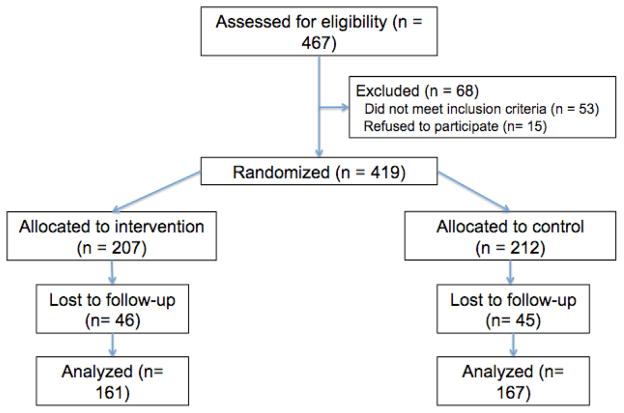
Methods: 419 women attending government clinics were randomized to an intervention (N=207) or control (N=212) group. The intervention was a brief health talk on cervical cancer. Participants completed surveys at enrollment (all), immediately after the talk (intervention arm), and at three-months follow-up (all). The primary outcomes were the change in knowledge scores and the final screening rates at three-months follow-up. Secondary outcomes were changes in awareness about cervical cancer screening, perception of personal cervical cancer risk, cervical cancer and HIV stigma, and screening acceptability.
Results: Mean Knowledge Scores increased by 26.4% (8.7 points increased to 11.0 points) in the intervention arm compared to only 17.6% (8.5 points increased to 10.0 points) in the control arm (p<0.01). Screening uptake was moderate in both the intervention (58.9%; N=122) and control (60.9%; N=129) arms, with no difference between the groups (p=0.60).
Conclusion: A brief health talk increased cervical cancer knowledge, although it did not increase screening over simply informing women about free screening.
Practical implications: Screening programs can increase patient understanding with just a brief educational intervention.
Keywords: Behavior; Cervical cancer screening; Health education; Knowledge; Risk perception; Sub-Saharan Africa.
Copyright © 2015 Elsevier Ireland Ltd. All rights reserved.
Conflict of interest statement
The authors have no conflicts of interest.
References
-
- Jemal A, Bray F, Center MM, Ferlay J, Ward E, Forman D. Global cancer statistics. CA Cancer J Clin. 2011 Mar-Apr;61(2):69–90. - PubMed
-
- Louie KS, de Sanjose S, Mayaud P. Epidemiology and prevention of human papillomavirus and cervical cancer in sub-Saharan Africa: a comprehensive review. Trop Med Int Health. 2009 Oct;14(10):1287–1302. - PubMed
-
- Francis SA, Nelson J, Liverpool J, Soogun S, Mofammere N, Thorpe RJ., Jr Examining attitudes and knowledge about HPV and cervical cancer risk among female clinic attendees in Johannesburg, South Africa. Vaccine. 2010 Nov 23;28(50):8026–8032. - PubMed
-
- Hoque M, Hoque E, Kader SB. Evaluation of cervical cancer screening program at a rural community of South Africa. East African journal of public health. 2008 Aug;5(2):111–116. - PubMed
-
- McFarland DM. Cervical cancer and Pap smear screening in Botswana: knowledge and perceptions. Int Nurs Rev. 2003 Sep;50(3):167–175. - PubMed
Publication types
MeSH terms
Grants and funding
LinkOut - more resources
Full Text Sources
Other Literature Sources
Medical
