Review
. 2015 Mar 25:6:41.
doi: 10.3389/fpsyt.2015.00041. eCollection 2015.

Role of the endogenous cannabinoid system in nicotine addiction: novel insights

Affiliations
Review

Role of the endogenous cannabinoid system in nicotine addiction: novel insights

Islam Hany Gamaleddin et al. Front Psychiatry. .

Abstract

Several lines of evidence have shown that the endogenous cannabinoids are implicated in several neuropsychiatric diseases. Notably, preclinical and human clinical studies have shown a pivotal role of the cannabinoid system in nicotine addiction. The CB1 receptor inverse agonist/antagonist rimonabant (also known as SR141716) was effective to decrease nicotine-taking and nicotine-seeking in rodents, as well as the elevation of dopamine induced by nicotine in brain reward area. Rimonabant has been shown to improve the ability of smokers to quit smoking in randomized clinical trials. However, rimonabant was removed from the market due to increased risk of psychiatric side-effects observed in humans. Recently, other components of the endogenous cannabinoid system have been explored. Here, we present the recent advances on the understanding of the role of the different components of the cannabinoid system on nicotine's effects. Those recent findings suggest possible alternative ways of modulating the cannabinoid system that could have implication for nicotine dependence treatment.

Keywords: addiction; cannabinoid system; endogenous cannabinoids; nicotine.


Figures
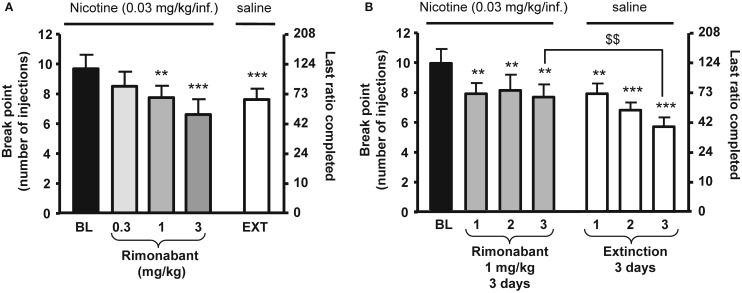
Figure 1
Figure 1
Effects of rimonabant on motivation for nicotine in rats. In (A), rimonabant [0.3–3 mg/kg, IP 60 min pre-treatment time (PTT)] dose-dependently reduced nicotine (0.03 mg/kg/injection) self-administration under a progressive-ratio schedule. Data are expressed as means (±SEM) of the number of injections (break-point, left y-axis) and of the last ratio completed (in number of lever presses, right y-axis) during baseline (BL) conditions, rimonabant pre-treatment, and vehicle pre-treatment and substitution of nicotine with saline (EXT). N = 8. **p < 0.01; ***p < 0.001 vs. baseline (BL), Dunnett’s test after significant ANOVA for repeated measures. In (B), effects of rimonabant (1 mg/kg, IP 60 min PTT) on nicotine self-administration under a progressive-ratio schedule during three consecutive sessions. Data are expressed as means (±SEM) of the number of injections (break-point, left y-axis) and of the last ratio completed (in number of lever presses, right y-axis) during baseline (BL) conditions, during three consecutive sessions with rimonabant pre-treatment (1 mg/kg) and during three consecutive sessions with vehicle pre-treatment and substitution of nicotine with saline. N = 9. **p < 0.01; ***p < 0.001 vs. baseline; $$p < 0.01 vs. vehicle extinction group, Student Newman–Keuls multiple comparison test after significant ANOVA for repeated measures. The figure and its caption have been reproduced with permission from Ref. (81).
Figure 2
Figure 2
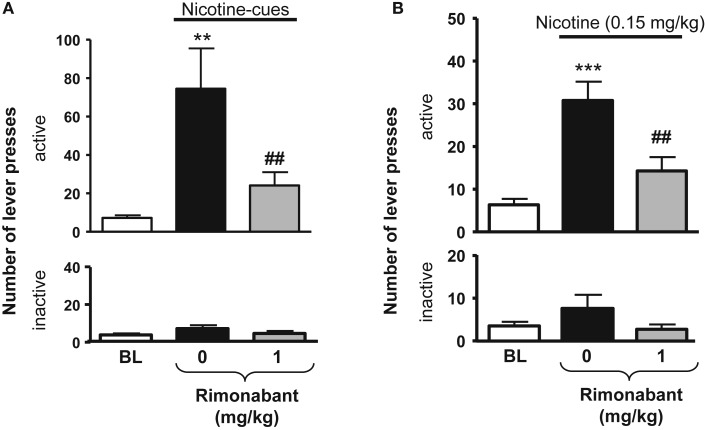
Effects of rimonabant on nicotine-seeking in rats. In (A), effects of rimonabant [0.1 mg/kg, IP 60 min pre-treatment time (PTT)] on the active (top) and the inactive (below) levers responses during cue-induced reinstatement of nicotine-seeking. **p < 0.01 vs. baseline; ##p < 0.01 vs. vehicle pre-treatment. In (B), effects of rimonabant (1 mg/kg, IP 70 min, PTT) on the active (top) and the inactive (below) levers responses during a nicotine-induced (0.15 mg/kg, SC, 10 min) reinstatement of nicotine-seeking. ***p < 0.001 vs. baseline; ##p < 0.001 vs. vehicle pre-treatment. The figure and its caption have been reproduced with permission from Ref. (81).
Figure 3
Figure 3
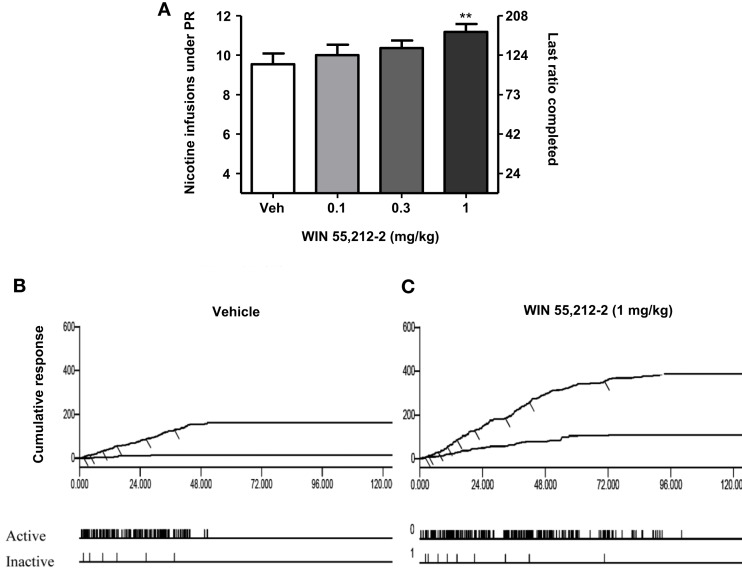
Effects of the stimulation of cannabinoid receptors on motivation for nicotine. In (A), effects of pre-treatment with WIN 55,212-2 [0.1–1 mg/kg, IP 15 min pre-treatment time (PTT)] on nicotine (0.03 mg/kg/infusion) self-administration under a progressive-ratio schedule. Data are expressed as means (±SEM) of the number of infusions obtained during the 4-h sessions. **p < 0.01 vs. vehicle pre-treatment (Dunnett’s test after significant ANOVA for repeated measures N = 9). In (B,C), individual representative cumulative responses on the active and inactive levers during nicotine self-administration under progressive-ratio schedule in rats pre-treated with vehicle (B) or 1 mg/kg WIN 55,212-2 (C). Each short upward mark on the cumulative lever-press records indicates one nicotine infusion. Break-point values are indicated and the pattern of response across time on active and inactive levers is provided below. The figure and its caption have been reproduced with permission from Ref. (89).
Figure 4
Figure 4
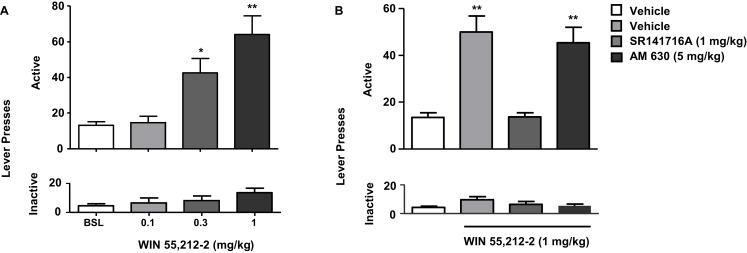
Effects of the stimulation of cannabinoid receptors on nicotine-seeking. In (A), rats trained to self-administer nicotine underwent an extinction phase after which they were pre-treated with WIN 55,212-2 [0.1–1 mg/kg, IP 15 min pre-treatment time (PTT)]. Figure shows responses on the active lever (top) and inactive lever (bottom). WIN 55,212-2 (0.3 and 1 mg/kg) significantly reinstated nicotine-seeking, assessed by the number of responses on the active lever (*p < 0.05 and *p < 0.001). No significant changes in responding on the inactive lever were observed. In (B), pre-treatment with the CB1 antagonist rimonabant (SR141716A) (1 mg/kg, IP), but not with the CB2 antagonist AM630 (5 mg/kg, IP) reversed reinstatement of nicotine-seeking induced by WIN 55,212-2. The figure and its caption have been reproduced with permission from Ref. (89).
Figure 5
Figure 5
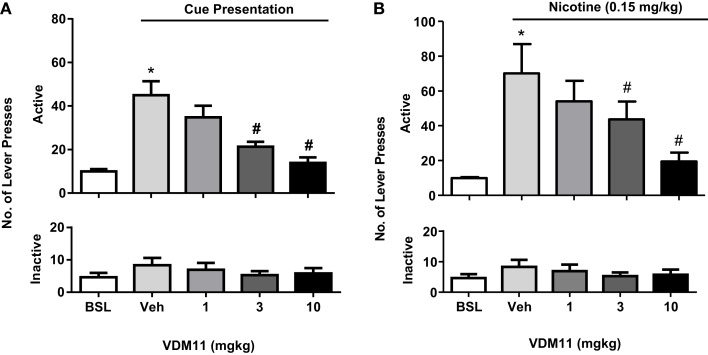
Effects of VDM11 on cue and nicotine priming reinstatement of nicotine-seeking behavior. In (A), a significant reinstatement of nicotine- seeking behavior was produced by presentation of nicotine-associated cues in non-treated animals (*p < 0.01). Pre-treatment with VDM11 [3 and 10 mg/kg, IP 30 min pre-treatment time (PTT)] significantly reduced cue-induced reinstatement of nicotine-seeking behavior (#p < 0.05). In (B), a significant reinstatement of nicotine-seeking was also produced by pre-treatment with nicotine (0.15 mg/kg) (*p < 0.01). VDM11 (3 and 10 mg/kg, IP 30 min PTT) significantly reduced the reinstatement of nicotine-seeking behavior induced by a priming injection of 0.15 mg/kg nicotine administered 10 min before the session (#p < 0.05). Data are expressed as means (±SEM) of the number of active lever presses during extinction (BSL) vehicle pre-treatment (visual cues). The figure and its caption have been reproduced with permission from Ref. (116).

References

    1. WHO. WHO Report on the Global Tobacco Epidemic 2013. (2013).
    1. Wilkie GI, Hutson PH, Stephens MW, Whiting P, Wonnacott S. Hippocampal nicotinic autoreceptors modulate acetylcholine release. Biochem Soc Trans (1993) 21:429–31. - PubMed
    1. Clarke PB, Reuben M. Release of [3H]-noradrenaline from rat hippocampal synaptosomes by nicotine: mediation by different nicotinic receptor subtypes from striatal [3H]-dopamine release. Br J Pharmacol (1996) 117:595–606.10.1111/j.1476-5381.1996.tb15232.x - DOI - PMC - PubMed
    1. Pontieri FE, Tanda G, Orzi F, Di Chiara G. Effects of nicotine on the nucleus accumbens and similarity to those of addictive drugs. Nature (1996) 382:255–7.10.1038/382255a0 - DOI - PubMed
    1. Yang X, Criswell HE, Breese GR. Nicotine-induced inhibition in medial septum involves activation of presynaptic nicotinic cholinergic receptors on gamma-aminobutyric acid-containing neurons. J Pharmacol Exp Ther (1996) 276:482–9. - PubMed

LinkOut - more resources