


doi: 10.1021/jacs.5b02150.
Epub 2015 Apr 20.
Discovery of a Small-Molecule Probe for V-ATPase Function
Affiliations
- PMID: 25860544
- PMCID: PMC4416280
- DOI: 10.1021/jacs.5b02150
Item in Clipboard
Discovery of a Small-Molecule Probe for V-ATPase Function
J Am Chem Soc.
.
Abstract
Lysosomes perform a critical cellular function as a site of degradation for diverse cargoes including proteins, organelles, and pathogens delivered through distinct pathways, and defects in lysosomal function have been implicated in a number of diseases. Recent studies have elucidated roles for the lysosome in the regulation of protein synthesis, metabolism, membrane integrity, and other processes involved in homeostasis. Complex small-molecule natural products have greatly contributed to the investigation of lysosomal function in cellular physiology. Here we report the discovery of a novel, small-molecule modulator of lysosomal acidification derived from diversity-oriented synthesis through high-content screening.
Figures
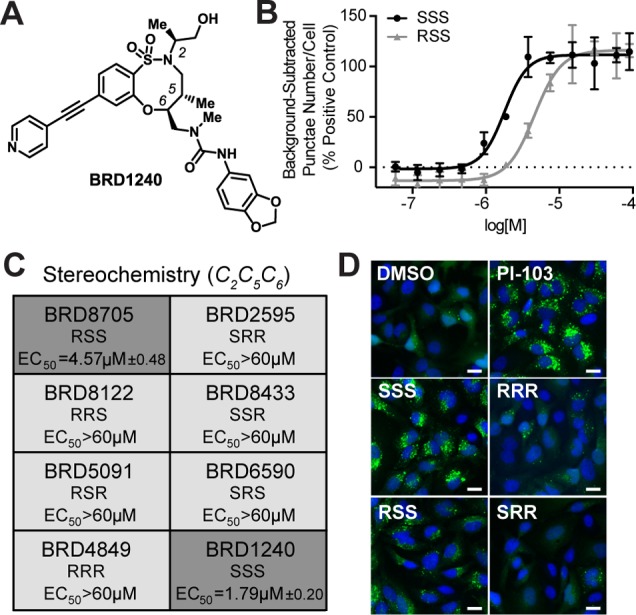
BRD1240 increases the GFP-LC3 punctae number, and this
activity
is dependent on stereochemistry. (A) Chemical structure of BRD1240.
(B) Dose–response curves of BRD1240 (SSS) and BRD8705 (RSS)
in the GFP-LC3 punctae formation assay. The positive control for increased
punctae number is PI-103, a dual PI3K/mTOR inhibitor. Values are presented
as the average ± SD of three independent experiments, each run
in duplicate. (C) Dose–response data (EC50) for
all stereoisomers in the GFP-LC3 punctae formation assay. Values are
presented as average ± SEM. (D) Representative images from the
GFP-LC3 punctae formation assay following treatment with DMSO; PI-103
(5 μM); BRD1240 and its enantiomer, BRD4849 (RRR); and BRD8705
(RSS) and its enantiomer, BRD2595 (SRR) (all 20 μM). Blue (Hoechst
33342), green (eGFP). Scalar bars represent 10 μm.
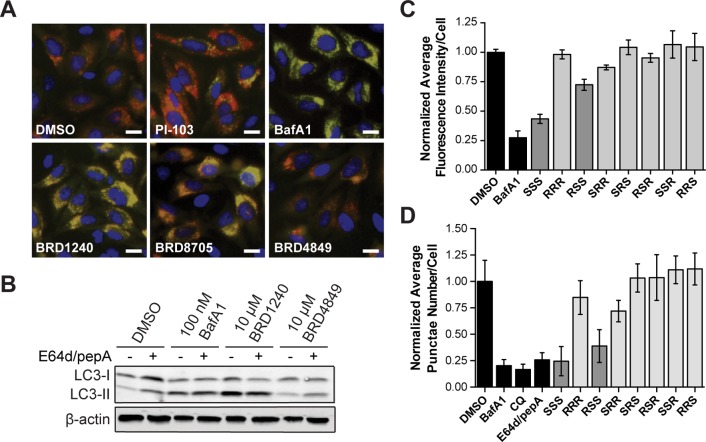
BRD1240 blocks
the later stages of autophagy. (A) Representative
images from the mCherry-eGFP-LC3 assay following treatment with DMSO,
PI-103 (5 μM), BafA1 (100 nM), BRD1240 (10 μM), BRD8705
(10 μM), and BRD4849 (10 μM). Blue (Hoechst 33342), red
(mCherry), green (eGFP). Scalar bars represent 10 μm. (B) Western
blot for LC3-I to LC3-II shift in HeLa cells treated with BafA1, BRD1240,
and BRD4849 ± 10 μg/mL E64d/pepA. (C) Normalized average
fluorescence intensity of punctae per cell for BafA1 (100 nM), BRD1240
(SSS) (10 μM), and all seven stereoisomers (10 μM) in
HeLa cells in the LysoTracker displacement assay. (D) Normalized average
punctae number per cell for BafA1 (200 nM), chloroquine (CQ) (50 μM),
E64d/pepA (10 μg/mL), BRD1240 (20 μM), and all seven stereoisomers
(20 μM) in HeLa cells in the DQ-BSA assay. In parts C and D
data are presented as the average ± SD of three independent experiments,
each run in duplicate.
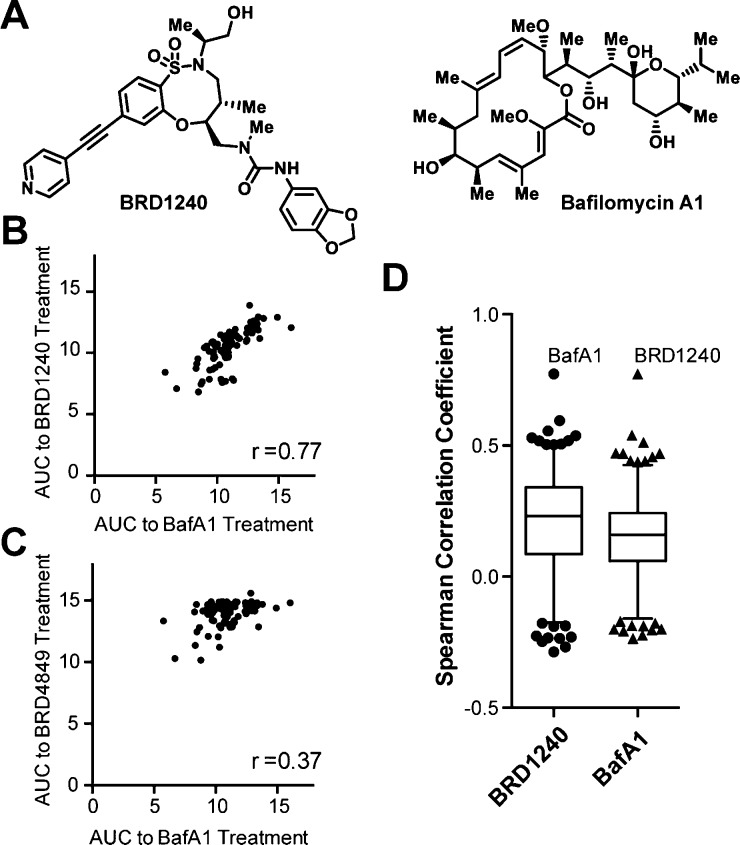
Comparison of 481 compounds
in 83 cancer cell lines reveals a significant
correlation between BRD1240, but not inactive stereoisomer BRD4849,
and bafilomycin A1, a potent V-ATPase inhibitor. (A) Chemical structures
of BRD1240 and BafA1. (B, C) Scatter plots presenting the area under
the curve (AUC) for each cell line in response to compound treatments. r values indicate the Spearman correlation coefficient calculated
on the basis of each data plot. (D) Box and whisker plot showing the
Spearman correlation coefficient between sensitivities of BRD1240
or BafA1 and the other 480 compounds tested in 83 cancer cell lines.
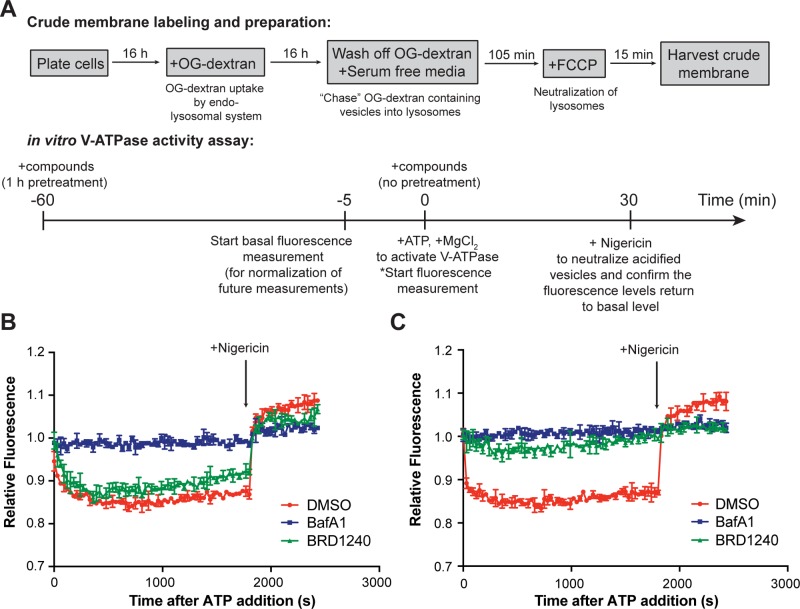
BafA1 and BRD1240 deacidify
lysosomes in an in vitro V-ATPase activity assay.
(A) Scheme of the assay protocol. (B) Performances
of DMSO, BafA1 (100 nM), and BRD1240 (10 μM) in the in vitro V-ATPase assay over 30 min after ATP addition and
after introduction of 10 μg/mL nigericin when no pretreatment
was applied. Higher relative fluorescence values are indicative of
higher pH. (C) Performances of these compounds in the assay when 1
h pretreatment was applied. In parts B and C, representative results
from three independent experiments are shown. Values are presented
as the average ± SD of two technical replicates.
References
-
- Eskelinen E.-L.; Tanaka Y.; Saftig P. Trends Cell Biol. 2003, 13, 137. - PubMed
Publication types
MeSH terms
Substances
Grants and funding
LinkOut - more resources
Full Text Sources
Other Literature Sources
