


Melanocortins contribute to sequential differentiation and enucleation of human erythroblasts via melanocortin receptors 1, 2 and 5
- PMID: 25860801
- PMCID: PMC4393082
- DOI: 10.1371/journal.pone.0123232
Melanocortins contribute to sequential differentiation and enucleation of human erythroblasts via melanocortin receptors 1, 2 and 5
Abstract
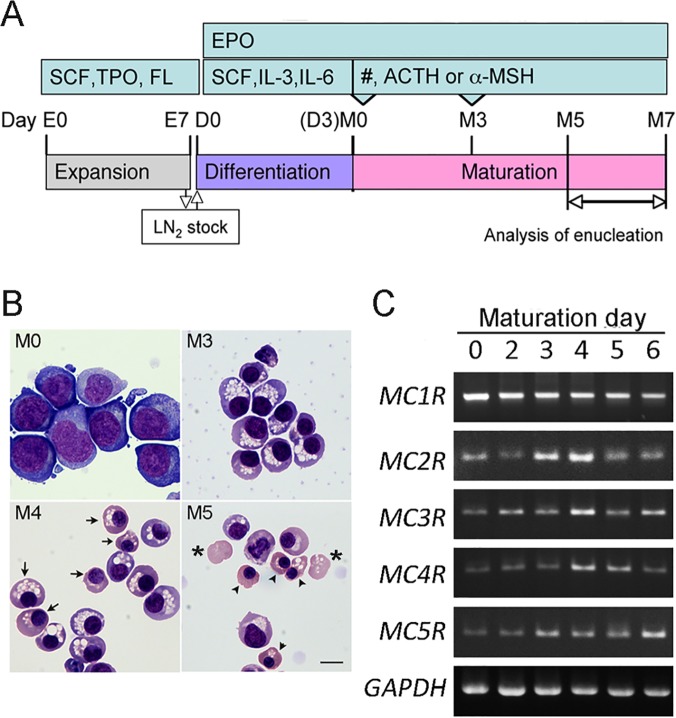
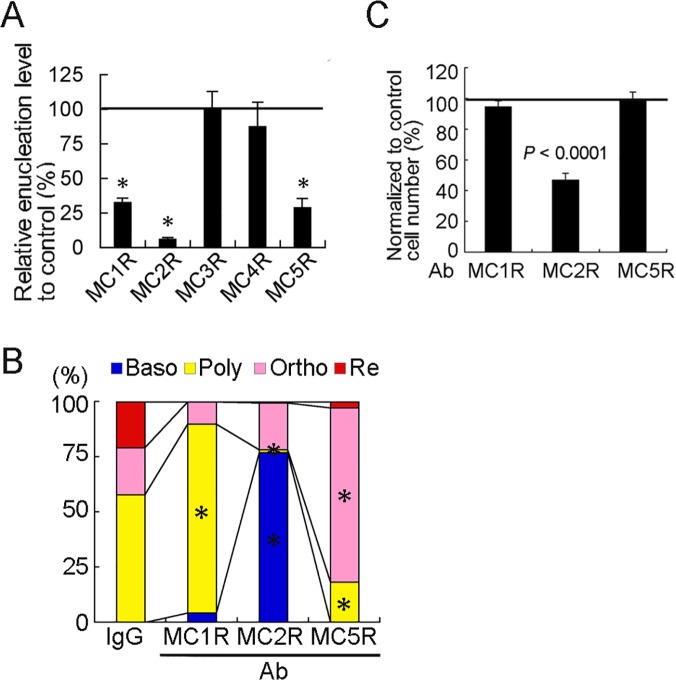
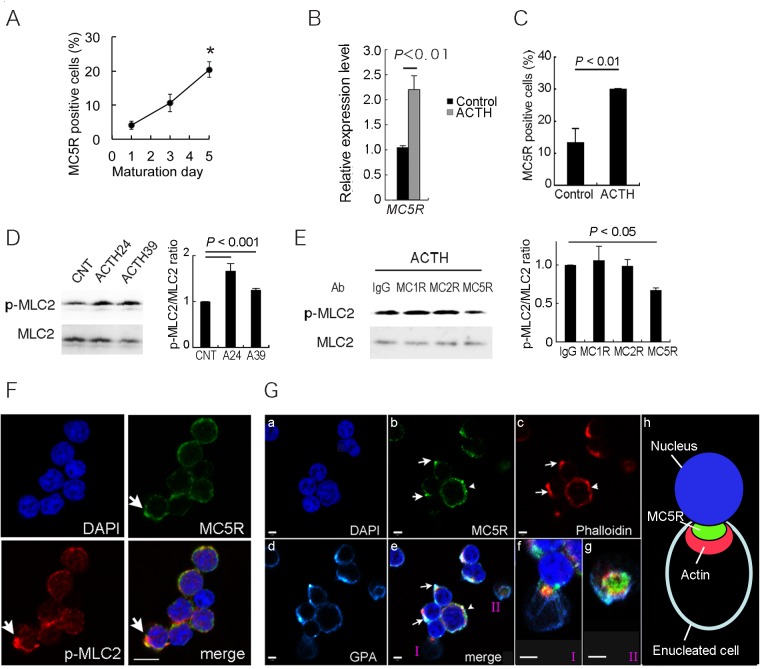
In this study, we showed that adrenocorticotropic hormone (ACTH) promoted erythroblast differentiation and increased the enucleation ratio of erythroblasts. Because ACTH was contained in hematopoietic medium as contamination, the ratio decreased by the addition of anti-ACTH antibody (Ab). Addition of neutralizing Abs (nAbs) for melanocortin receptors (MCRs) caused erythroblast accumulation at specific stages, i.e., the addition of anti-MC2R nAb led to erythroblast accumulation at the basophilic stage (baso-E), the addition of anti-MC1R nAb caused accumulation at the polychromatic stage (poly-E), and the addition of anti-MC5R nAb caused accumulation at the orthochromatic stage (ortho-E). During erythroblast differentiation, ERK, STAT5, and AKT were consecutively phosphorylated by erythropoietin (EPO). ERK, STAT5, and AKT phosphorylation was inhibited by blocking MC2R, MC1R, and MC5R, respectively. Finally, the phosphorylation of myosin light chain 2, which is essential for the formation of contractile actomyosin rings, was inhibited by anti-MC5R nAb. Taken together, our study suggests that MC2R and MC1R signals are consecutively required for the regulation of EPO signal transduction in erythroblast differentiation, and that MC5R signal transduction is required to induce enucleation. Thus, melanocortin induces proliferation and differentiation at baso-E, and polarization and formation of an actomyosin contractile ring at ortho-E are required for enucleation.
Conflict of interest statement
Figures



References
-
- Giarratana MC, Kobari L, Lapillonne H, Chalmers D, Kiger L, Cynober T, et al. Ex vivo generation of fully mature human red blood cells from hematopoietic stem cells. Nat Biotechnol. 2005; 23: 69–74. - PubMed
-
- Miharada K, Hiroyama T, Sudo K, Nagasawa T, Nakamura Y. Efficient enucleation of erythroblasts differentiated in vitro from hematopoietic stem and progenitor cells. Nat Biotechnol. 2006; 24: 1255–1256. - PubMed
-
- McNiece IK, Langley KE, Zsebo KM. Recombinant human stem cell factor synergises with GM-CSF, G-CSF, IL-3 and epo to stimulate human progenitor cells of the myeloid and erythroid lineages. Exp Hematol. 1991; 19: 226–231. - PubMed
-
- Neildez-Nguyen TM, Wajcman H, Marden MC, Bensidhoum M, Moncollin V, Giarrantana MC, et al. (2002) Human erythroid cells produced ex vivo at large scale differentiate into red blood cells in vivo. Nat Biotechnol. 2002; 20: 467–472. - PubMed
-
- Chen C, Sytkowski AJ. Erythropoietin regulation of Raf-1 and MEK: evidence for a Ras-independent mechanism. Blood. 2004; 104: 73–80. - PubMed
Publication types
MeSH terms
Substances
LinkOut - more resources
Full Text Sources
Other Literature Sources
Research Materials
Miscellaneous
