Case Reports
. 2015 Mar;14(Suppl 1):323-30.
doi: 10.1007/s12663-013-0539-y. Epub 2013 May 28.

Traumatic globe luxation associated with orbital fracture in a child: a case report and literature review

Affiliations
Case Reports

Traumatic globe luxation associated with orbital fracture in a child: a case report and literature review

Márcio Bruno Figueiredo Amaral et al. J Maxillofac Oral Surg. 2015 Mar.

Abstract

Orbital fracture associated with traumatic globe luxation is rare, as it generally requires trauma with high energy for this to occur. The present case report focused on a child who had been hit by a motorcycle, leading to a globe luxation of the left eye and fractures of the superolateral orbital walls. The patient presented initial cosmetic and psychological benefits from the repositioning of the intact globe and the reduction of the orbital fractures. However, a subsequent evisceration of the globe was required due to persistent proptosis and pain. An ocular prosthesis was also implanted, thus recovering the patient's aesthetics. Thirty-four well-documented cases of traumatic globe luxation could be found in the English literature since 1970. The mean age of patients presenting traumatic globe luxation was 29.5 years. The male gender proved to be more prevalent, with traffic collisions representing the most common accident etiology. Direct orbital trauma with fractures of medial and floor walls displacing the globe into the maxillary sinus represented the most common injury mechanism (38.2 %), followed by an elongated object entering the orbit (26.5 %). Optical nerve avulsion is the most serious complication seen in association with traumatic globe luxation, with the repositioning of the initial globe, with no enucleation or evisceration, representing the main form of management.

Keywords: Facial injuries; Globe luxation; Orbital trauma.


Figures

Fig. 1
Fig. 1
Clinical features of patient with traumatic globe luxation. A Left proptotic globe with eyelids closed behind it and extensive eyebrow laceration. B Fractures in left orbital rim and lateral wall. C Fixation of the orbital fracture with 1.5 mm titanium bone plate and screws. D Lacerations repaired and temporary tarsorrhaphy performed after initial globe repositioning
Fig. 2
Fig. 2
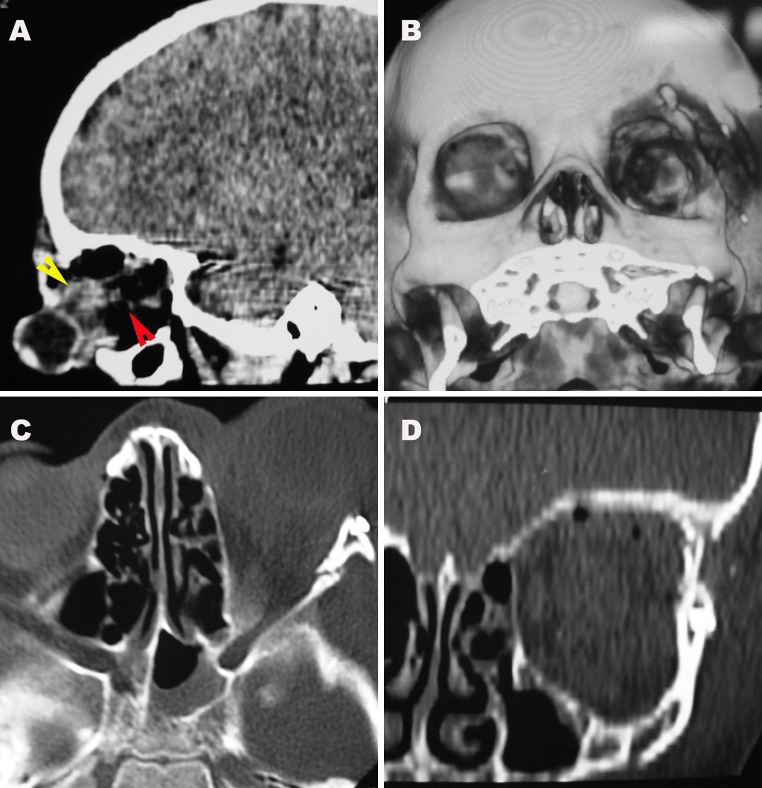
Computed tomography (CT) shows the traumatic globe luxation. A CT shows proptosis of the left globe, intraconal retrobulbar hematoma (yellow head arrow), and stretching of the optic nerve, suggesting optic nerve avulsion (head arrow red). B 3D CT shows fractures in the lateral and superior walls with medial dislocation into the left orbit, reducing the orbital volume. C Axial CT shows that the reduction of the lateral wall of the left orbit reestablished the orbital volume. D Coronal CT shows the orbital volume after bone fixation
Fig. 3
Fig. 3
Clinical features of the patient after initial postoperative follow-up. A Ocular aspects of the patient after one month of postoperative follow-up, with slight proptosis in the left eye, no visual acuity, and no light perception. B Restricted ocular moments in the left eye and orbital contours reestablished. C Globe evisceration of the left eye after three months of postoperative follow-up, due to pain and poor aesthetic results. D Ocular prosthesis inserted to recover the patient’s cosmetic appearance after 12 months of follow-up

References

    1. Lelli GJ, Jr, Demirci H, Frueh BR. Avulsion of the optic nerve with luxation of the eye after motor vehicle accident. Ophthal Plast Reconstr Surg. 2007;23:158–160. doi: 10.1097/IOP.0b013e31803045b4. - DOI - PubMed
    1. Bajaj MS, Pushker N, Nainiwal SK, Balasubramanya R. Traumatic luxation of the globe with optic nerve avulsion. Clin Exp Ophthalmol. 2003;31:362–363. doi: 10.1046/j.1442-9071.2003.00672.x. - DOI - PubMed
    1. Bajaj MS, Kedar S, Sethi A, Gupta V. Traumatic globe luxation with optic nerve transection. Orbit. 2000;19:165–170. doi: 10.1076/orbi.19.3.165.2661. - DOI - PubMed
    1. Alp B, Yanyali A, Elibol O, Talu H, Karabas L. A case of traumatic globe luxation. Eur J Emerg Med. 2001;8:331–332. doi: 10.1097/00063110-200112000-00016. - DOI - PubMed
    1. Arkin MS, Rubin PA, Bilyk JR, Buchbinder B. Anterior chiasmal optic nerve avulsion. Am J Neuroradiol. 1996;17:1777–1781. - PMC - PubMed

Publication types

LinkOut - more resources