Review
. 2015:2015:246012.
doi: 10.1155/2015/246012. Epub 2015 Mar 16.

Alternative antimicrobial approach: nano-antimicrobial materials

Affiliations
Review

Alternative antimicrobial approach: nano-antimicrobial materials

Nurit Beyth et al. Evid Based Complement Alternat Med. 2015.

Abstract

Despite numerous existing potent antibiotics and other antimicrobial means, bacterial infections are still a major cause of morbidity and mortality. Moreover, the need to develop additional bactericidal means has significantly increased due to the growing concern regarding multidrug-resistant bacterial strains and biofilm associated infections. Consequently, attention has been especially devoted to new and emerging nanoparticle-based materials in the field of antimicrobial chemotherapy. The present review discusses the activities of nanoparticles as an antimicrobial means, their mode of action, nanoparticle effect on drug-resistant bacteria, and the risks attendant on their use as antibacterial agents. Factors contributing to nanoparticle performance in the clinical setting, their unique properties, and mechanism of action as antibacterial agents are discussed in detail.


Figures
Scheme 1
Scheme 1
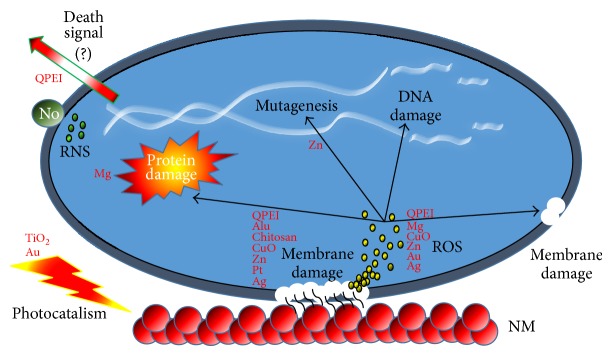
NM antibacterial mode of action. General schematic depicting the common modes of action of NM. Most known antibacterial NM interact electrostatically with the bacterial membrane causing membrane disruption. Frequently, free radicals (ROS yellow spots) are produced due to the NM-membrane interactions. These radicals may instigate secondary membrane damage, hinder protein function, cause DNA destruction, and result in excess radical production. Other antibacterial NM are photoactivated (photocatalism). Nitric oxide (NO) NM are involved with RNS (green spots). Polycationic NM (QPEI) have a unique feature as they seem to induce signal secretion that may promote programmed cell death.
Scheme 2
Scheme 2
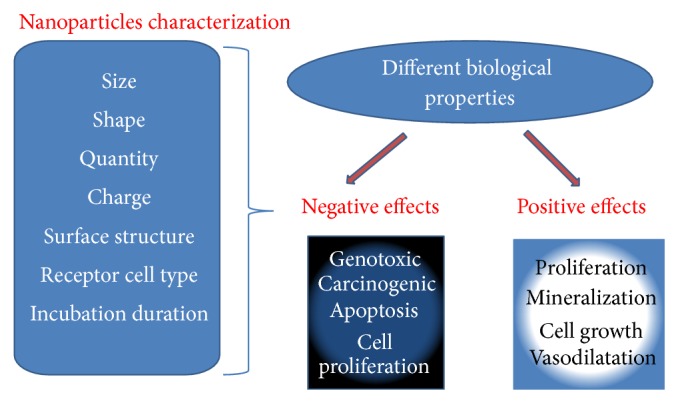
NM biocompatibility from in vitro studies. The biological activity of different organic and inorganic NM varies from negative to positive effects in different systems of in vitro cell lines. This activity depends on various factors such as size, electrical charge, quantity exposed, shape, and surface structure of NM.
Scheme 3
Scheme 3
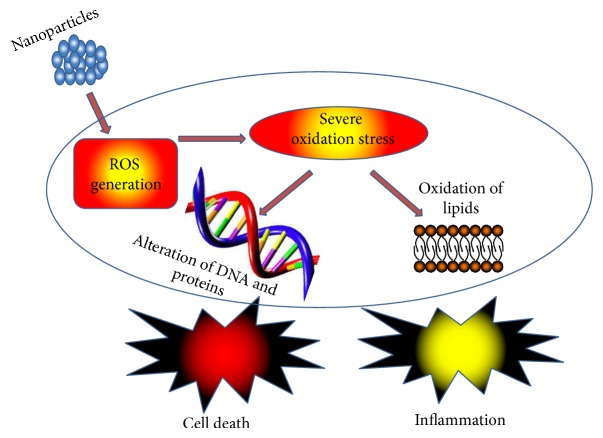
Toxicological mechanisms of NM to eukaryotic cells. Nanoparticles induce ROS generation in eukaryotic cells; these radicals cause severe oxidation stress in the cells, affecting membrane lipids and altering the structure of DNA and proteins. This excess radical production induces an inflammatory process that could lead to cell death.

References

    1. Davey M. E., O'Toole G. A. Microbial biofilms: from ecology to molecular genetics. Microbiology and Molecular Biology Reviews. 2000;64(4):847–867. doi: 10.1128/mmbr.64.4.847-867.2000. - DOI - PMC - PubMed
    1. Hall-Stoodley L., Costerton J. W., Stoodley P. Bacterial biofilms: from the natural environment to infectious diseases. Nature Reviews Microbiology. 2004;2(2):95–108. doi: 10.1038/nrmicro821. - DOI - PubMed
    1. Watnick P., Kolter R. Biofilm, city of microbes. Journal of Bacteriology. 2000;182(10):2675–2679. doi: 10.1128/JB.182.10.2675-2679.2000. - DOI - PMC - PubMed
    1. Donlan R. M. Role of biofilms antimicrobial resistance. ASAIO Journal. 2000;46(6):S47–S52. doi: 10.1097/00002480-200011000-00037. - DOI - PubMed
    1. Seil J. T., Webster T. J. Antimicrobial applications of nanotechnology: methods and literature. International Journal of Nanomedicine. 2012;7:2767–2781. doi: 10.2147/ijn.s24805. - DOI - PMC - PubMed

LinkOut - more resources