. 2015 Mar 17;7(1):28.
doi: 10.1186/s13148-015-0067-3. eCollection 2015.

Multiplex bisulfite PCR resequencing of clinical FFPE DNA

Affiliations

Multiplex bisulfite PCR resequencing of clinical FFPE DNA

Darren Korbie et al. Clin Epigenetics. .

Abstract

Background: The clinical utility of DNA methylation as a predictive or prognostic biomarker requires scalable resequencing protocols for bisulfite-converted DNA. Key features of any validation method should be adaptability for low- or high-throughput needs and high reproducibility, and should only require minimal amounts of precious clinical sample as input material. Critically, this method should also deliver robust results when working with bisulfite-converted DNA extracted from formalin-fixed, paraffin-embedded (FFPE) blocks.

Results: We report here for the first time on comparison studies between the Fluidigm Access Array system and multiplex assays for multiplex bisulfite PCR resequencing. The requirement of the Fluidigm Access Array system for high template amounts and its sensitivity to variations in template quality rendered it unsuitable for bisulfite PCR applications utilizing FFPE DNA. In response to this limitation, we established a multiplex bisulfite PCR assay capable of delivering robust methylation data using minimal amounts of FFPE clinical DNA. To evaluate the parameters and reproducibility of this assay, 57 amplicons were used to prepare sequencing libraries in triplicate for 13 FFPE tumour samples, as well as a series of 5 methylated controls (0%, 25%, 50%, 75%, and 100%). Analysis of this data demonstrated that this multiplex assay had high reproducibility (mean standard deviation of 1.4% for methylation values), was low cost, required low sample input (50 ng of DNA or less), and could be scaled for both low- and high-throughput needs. Notably, ExoSAP-IT (exonuclease I) treatment to remove residual primers in bisulfite resequencing libraries appeared to degrade the library and generate a high-molecular weight smear which may impact on the degree of methylation assessed.

Conclusions: Multiplex bisulfite PCR assays represent a convenient and scalable method for validation and screening of methylated DNA regions from archival FFPE DNA. Moreover, the library construction process detailed here can be rapidly optimized and implemented with a minimal amount of work, can be performed using the standard equipment found in any molecular biology laboratory, and can be easily adapted for use on both genomic DNA and bisulfite DNA applications. However, in preparing bisulfite libraries for sequencing, the use of ExoSAP-IT is not recommended due to potential off-target nuclease effects which may impact downstream methylation analysis.

Keywords: Bisulfite PCR; DNA methylation; FFPE DNA; Fluidigm Access Array; Multiplex PCR.


Figures
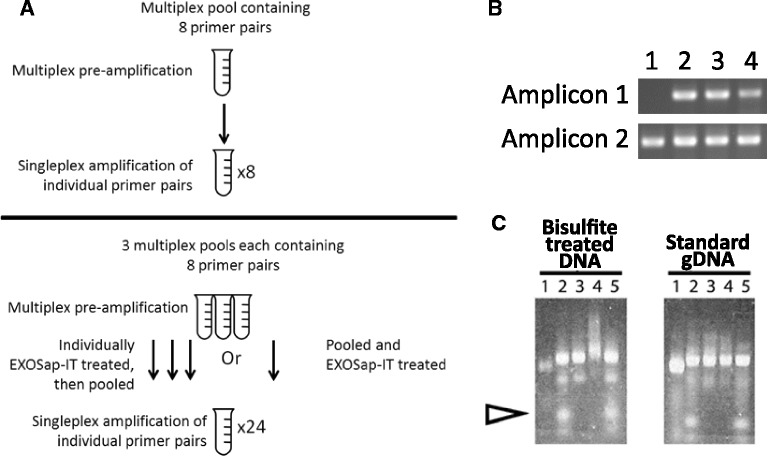
Figure 1
Figure 1
Pre-amplification multiplex results for bisulfite DNA samples. (A) A flow diagram outlining the different conditions examined with respect to multiplexability, pooling, and exonuclease treatment. (B) The results of different conditions after 15 cycles of multiplex pre-amplification. Forty-eight primer pairs were assessed for the multiplexability in a pre-amplification reaction. All samples had the same amount of input DNA. Lane 1: A positive control involving singleplex PCR reaction of an individual primer pair, with the same DNA template amount as used in the pre-amplification. Lane 2: Eight-plex pre-amplification reaction and ExoSAP-IT treatment of individual pre-amp reactions, followed by pooling and singleplex amplification (as illustrated in the upper panel of A). Lane 3: Results of three different 8-plex reactions pooled together first then ExoSAP-IT treatment of the combined pool, for a total of 24 amplicons in the ExoSAP-IT treatment, followed by singleplex amplification of a primer pair (as illustrated in the lower panel of A). Lane 4: Twenty-four-plex pre-amplification results. (C) The effect of ExoSAP-IT treatment on bisulfite libraries, as compared to gDNA amplicons. The arrow indicates where primers migrate on the gel. Lane 1: Pool of 48 amplicons prior to barcoding PCR. Lane 2: Sample library after barcoding PCR. Primers are visible at the bottom of the lane. Lane 3: Sample library after ExoSAP-IT treatment at 37°C. Lane 4: Sample library after ExoSAP-IT treatment at 37°C, followed by heat inactivation of the ExoSAP-IT at 80°C. Note the higher molecular weight smear in the methylation library, which is not observed with gDNA amplicons. Lane 5: Sample library cycled at 37°C, followed by 80°C heat denaturation step, but with no ExoSAP-IT.
Figure 2
Figure 2
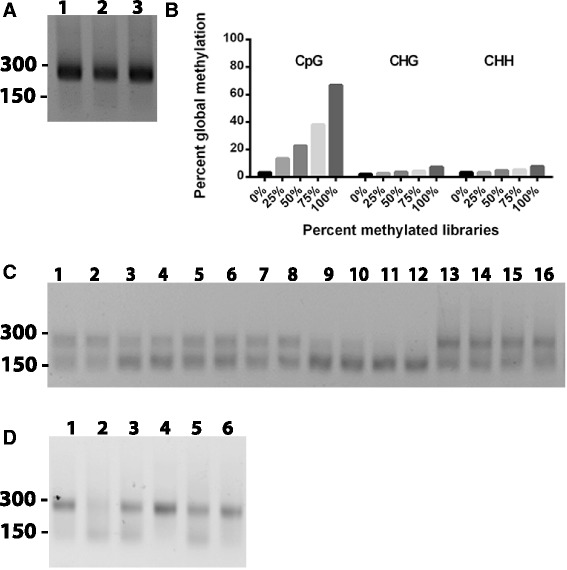
Bisulfite libraries prepared using the Fluidigm Access Array system. (A) Low-throughput libraries prepared manually were observed to produce strong dominant bands of the expected size with minimal visible dimer product, when visualized by agarose gel. Size in base pairs is indicated to the left (B) Sequencing results for the percent global methylation of the control libraries prepared manually. (C) Preliminary results with the Fluidigm Access Array platform resulted in weakly amplifying sequencing libraries with prominent dimer products. (D) After extensive optimization to identify the critical parameters, pre-amplification under ideal conditions still gave variable library performance using the Access Array system, with minor differences in pre-amplification primer concentration or the number of cycles of pre-amplification leading to failed libraries (that is, lane 1 vs lane 2). Lane 1, 200 nM primer, 15 cycles pre-amplification, GoTaq Flexi buffer; lane 2, 50 nM primer, 15 cycles pre-amplification, GoTaq Flexi buffer; lane 3, 200 nM primer, 15 cycles pre-amplification, Roche HF buffer; lane 4, 200 nM primer, 20 cycles pre-amplification, GoTaq Flexi buffer; lane 5, 50 nM primer, 20 cycles pre-amplification, GoTaq Flexi buffer; lane 6, 200 nM primer, 20 cycles pre-amplification, Roche HF buffer.
Figure 3
Figure 3
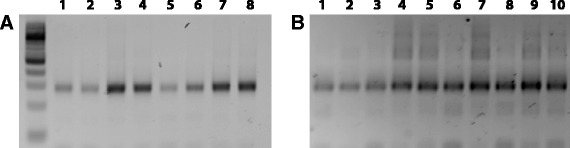
Representative libraries prepared using the custom bisulfite PCR multiplex assay. After optimizing primer concentration for the individual primer pairs as well as the overall pools, barcoding of the final libraries demonstrated that the assay performed well on both high-quality white blood cell DNA (A) and degraded clinical FFPE samples (B). In comparison, even substantially degraded FFPE DNA which completely failed in Fluidigm Access Array (lanes 8 to 10 in Figure 2C) performed well with this multiplex assay (panel B lanes 1 to 3).
Figure 4
Figure 4
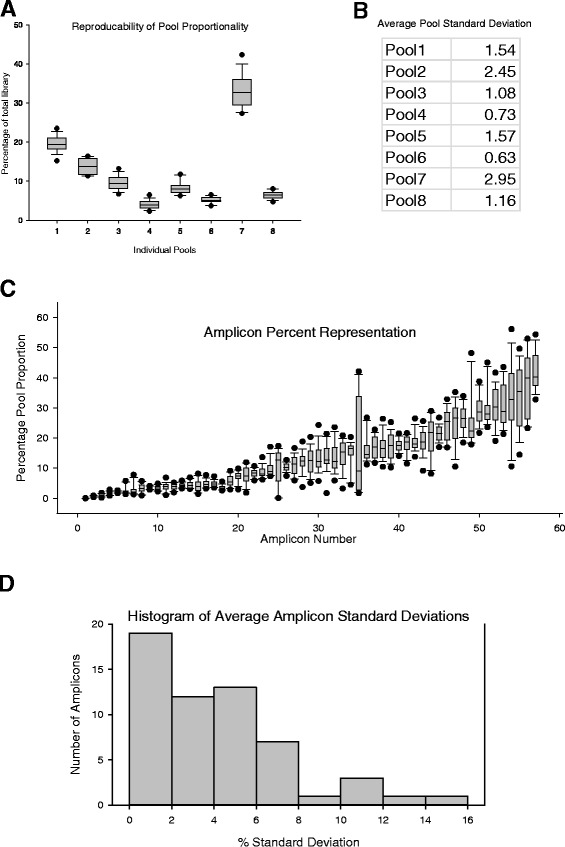
Sequencing results. Sequencing results for libraries prepared in triplicate for 13 FFPE tumour samples, as well as a series of 5 methylated controls (0%, 25%, 50%, 75%, and 100%) using the custom bisulfite PCR multiplex assay. (A) The proportions of each pool across 54 libraries, determined as a total amount of each library. Y-axis: Percentage of total library = Total number of reads for a pool ÷ Total number of reads for the library. Although pool 7 was observed to dominate all libraries, the proportion of each pool across 54 samples was maintained at consistent levels. Whiskers: 10th to 90th percentiles; black circles: 5th and 95th percentiles. (B) The average standard deviation in 8-plex pool proportions observed across all libraries. Average pool standard deviation = (The sum of all standard deviations for a single pool ÷ The total number of entries, that is, the mean value). Across 13 FFPE samples amplified in triplicate, pool proportionality was maintained within similar values across all samples and libraries. (C) The proportion of each amplicon in each of the libraries, calculated as a percentage of its original 8-plex pool. Percentage pool proportion = Total number of reads for an amplicon ÷ Total number of reads for its pool. Whiskers: 10th to 90th percentiles; black circles: 5th and 95th percentiles. (D) Histogram showing the distribution of the average standard deviations for all 57 amplicons in the assay. Across 13 FFPE samples amplified in triplicate, the proportion of each of the 56 amplicons was maintained at consistent levels. Average standard deviation = The sum of all standard deviation values for a single amplicon (as a percentage of its original 8-plex pool as outlined in C) ÷ The total number of entries.
Figure 5
Figure 5
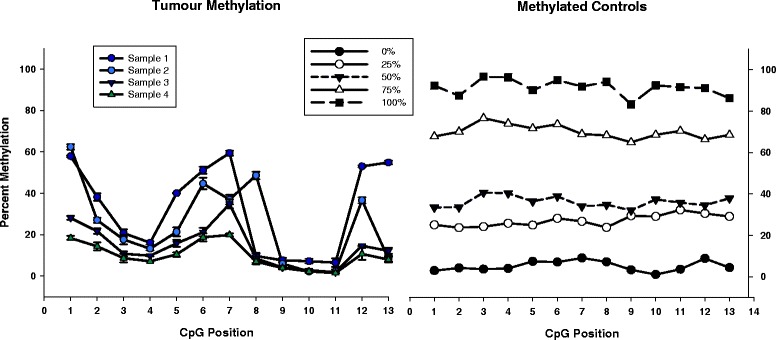
Representative methylation results. Representative data of 4 out of the 13 clinical FFPE samples assayed are shown. FFPE breast tumour samples were assayed in triplicate, along with a set of methylation controls (0%, 25%, 50%, 75%, and 100% methylation controls). Whereas the methylation values for the control samples were observed to be maintained at consistent levels across the region of interest, the breast cancer samples were observed to give unique patterns of methylation.

References

    1. Jones PA. Functions of DNA methylation: islands, start sites, gene bodies and beyond. Nat Rev Genet. 2012;13(7):484–92. doi: 10.1038/nrg3230. - DOI - PubMed
    1. Holliday R, Pugh JE. DNA modification mechanisms and gene activity during development. Science. 1975;187(4173):226–32. doi: 10.1126/science.1111098. - DOI - PubMed
    1. Riggs AD. X inactivation, differentiation, and DNA methylation. Cytogenet Cell Genet. 1975;14(1):9–25. doi: 10.1159/000130315. - DOI - PubMed
    1. Wutz A. Gene silencing in X-chromosome inactivation: advances in understanding facultative heterochromatin formation. Nat Rev Genet. 2011;12(8):542–53. doi: 10.1038/nrg3035. - DOI - PubMed
    1. Cedar H, Bergman Y. Programming of DNA methylation patterns. Annu Rev Biochem. 2012;81:97–117. doi: 10.1146/annurev-biochem-052610-091920. - DOI - PubMed