Review
. 2015 Apr 8:4:662.
doi: 10.1038/bonekey.2015.29. eCollection 2015.

Assessment of bone vascularization and its role in bone remodeling

Affiliations
Review

Assessment of bone vascularization and its role in bone remodeling

Marie-Hélène Lafage-Proust et al. Bonekey Rep. .

Abstract

Bone is a composite organ that fulfils several interconnected functions, which may conflict with each other in pathological conditions. Bone vascularization is at the interface between these functions. The roles of bone vascularization are better documented in bone development, growth and modeling than in bone remodeling. However, every bone remodeling unit is associated with a capillary in both cortical and trabecular envelopes. Here we summarize the most recent data on vessel involvement in bone remodeling, and we present the characteristics of bone vascularization. Finally, we describe the various techniques used for bone vessel imaging and quantitative assessment, including histology, immunohistochemistry, microtomography and intravital microscopy. Studying the role of vascularization in adult bone should provide benefits for the understanding and treatment of metabolic bone diseases.


Conflict of interest statement

The authors declare no conflict of interest.

Figures
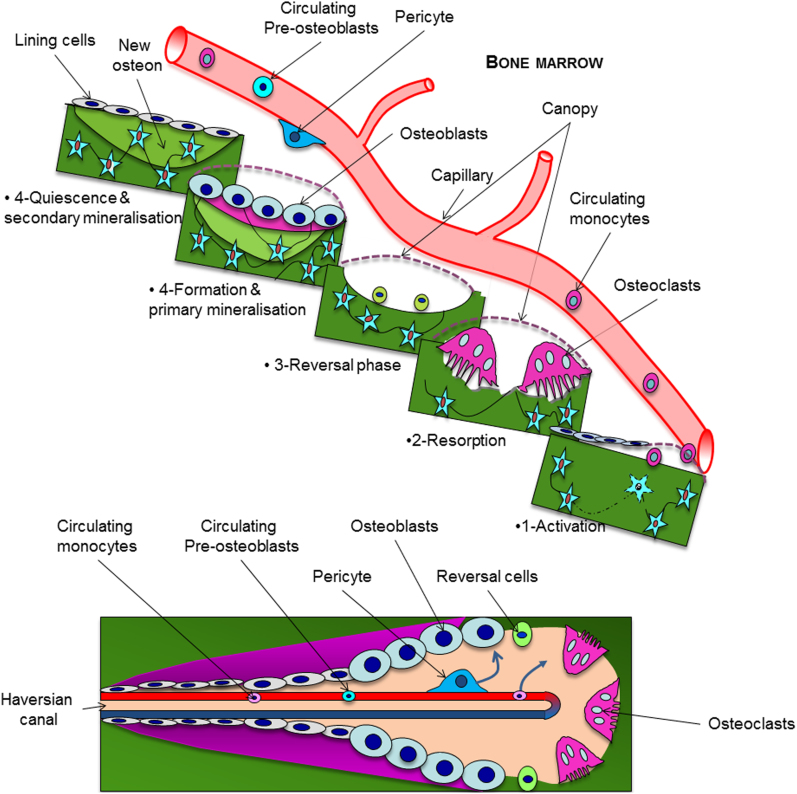
Figure 1
Figure 1
Illustration of spatial and functional relationships between blood capillary and the bone remodeling compartment in trabecular (top) and cortical envelopes (bottom). Circulating osteoclast precursors home to the bone surface through the vessel wall and the canopy where the bone remodeling unit is about to take place. The vessel also feeds the bone remodeling compartment with osteoblast progenitors via pericytes borne by the vascular wall or via circulating cells.
Figure 2
Figure 2
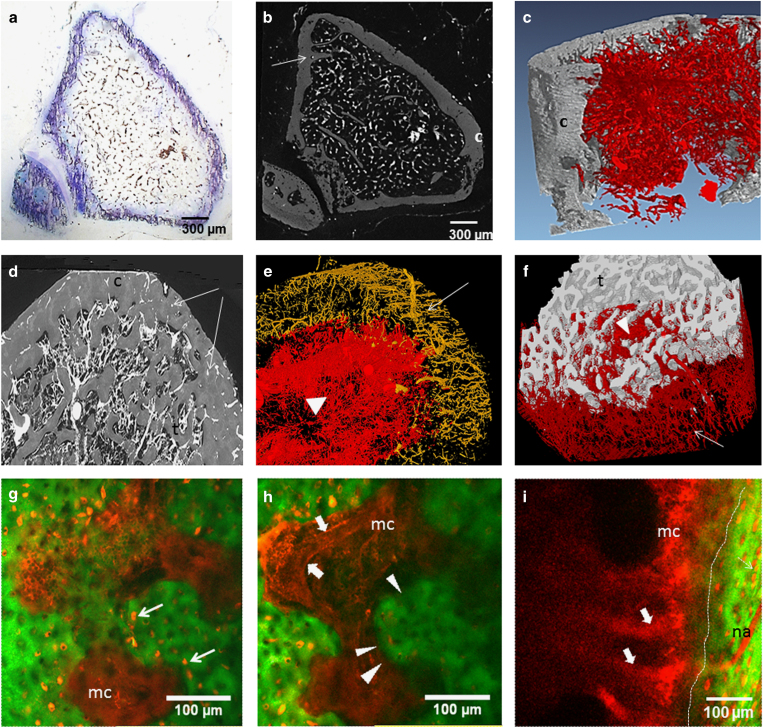
(af) Imaging of barium-infused vessels in tibia of mice (ac) and rats (df). Arrows: cortical vessels, arrow head: trabecular vascular network. t, trabecular bone; c, cortical bone. (a) Horizontal toluidine blue-stained 5-μm-thick section of barium-infused mouse tibia upper metaphysis. (b) Micro-CT image (3-μm resolution, Nanotom, GE Inspection Technology, Boston, MA, USA) of the same tibia section illustrated in a. (c) 3D rendering of synchrotron radiation microtomography (SR-CT) of the vascular network in mouse tibia upper metaphysis (1.5-μm resolution). (d) Seventy-μm-thick stack of SR-CT images of rat upper tibia metaphysis. (e) 3D rendering of SR-CT imaging of cortical (yellow) and trabecular vascular network (red) in tibia diaphysis after segmentation and removal of the bone component. (f) 3D rendering of SR-CT imaging of cortical and trabecular vascular network (red) after segmentation and removal of the cortical bone component. (gi) Intravital microscopy of Rhodamine B dextran-infused vessels in mouse calvaria (g, h) and tibia metaphysis (i). Performed on anesthetized mouse after incision of the skin and slight grinding of the cortical bone (tibia), 10 min after IV injection in the tail vein of Rhodamine B dextran with the Two-photon confocal microscope TCS-SP2, Leica Microsystems. (d, e) Two z-images of the same field separated by 50 μm, d being more superficial than e. Green: second-harmonic generation signals derived from bone collagen. Thin arrows: Rhodamine-filled osteocyte lacunae, thick arrows: Rhodamine–dextran-filled capillary (note the red blood cells inside the vessel), arrow heads and dotted line: endocortical surface. mc, marrow cavity; na, nutrient artery in tibia; 3D, three-dimensional; IV, intravenous.

References

    1. Maes C. Role and regulation of vascularization processes in endochondral bones. Calcif Tissue Int 2013;92:307–323. - PubMed
    1. Boerckel JD, Uhrig BA, Willett NJ, Huebsch N, Guldberg RE. Mechanical regulation of vascular growth and tissue regeneration in vivo. Proc Natl Acad Sci USA 2011;108:674–680. - PMC - PubMed
    1. Street J, Bao M, de Guzman L, Bunting S, Peale FV Jr, Ferrara N et al.. Vascular endothelial growth factor stimulates bone repair by promoting angiogenesis and bone turnover. Proc Natl Acad Sci USA 2002;23:9656–9661. - PMC - PubMed
    1. Harris GM, Rutledge K, Cheng Q, Blanchette J, Jabbarzadeh E. Strategies to direct angiogenesis within scaffolds for bone tissue engineering. Curr Pharm Des 2013;19:3456–3465. - PubMed
    1. Schneider P, Voide R, Stampanoni M, Donahue LR, Müller R. The importance of the intracortical canal network for murine bone mechanics. Bone 2013;53:120–128. - PubMed

LinkOut - more resources