. 2015 Jun;14(6):578-87.
doi: 10.1128/EC.00002-15. Epub 2015 Apr 10.

Overlapping Functions between SWR1 Deletion and H3K56 Acetylation in Candida albicans

Affiliations

Overlapping Functions between SWR1 Deletion and H3K56 Acetylation in Candida albicans

Zhiyun Guan et al. Eukaryot Cell. 2015 Jun.

Abstract

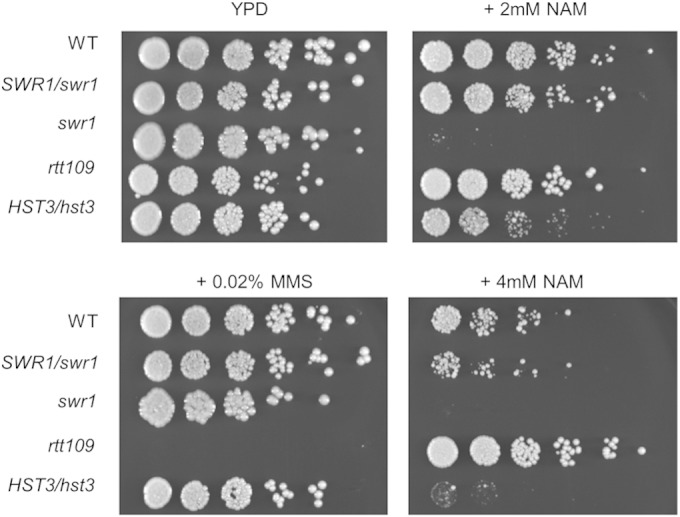
Nucleosome destabilization by histone variants and modifications has been implicated in the epigenetic regulation of gene expression, with the histone variant H2A.Z and acetylation of H3K56 (H3K56ac) being two examples. Here we find that deletion of SWR1, the major subunit of the SWR1 complex depositing H2A.Z into chromatin in exchange for H2A, promotes epigenetic white-opaque switching in Candida albicans. We demonstrate through nucleosome mapping that SWR1 is required for proper nucleosome positioning on the promoter of WOR1, the master regulator of switching, and that its effects differ in white and opaque cells. Furthermore, we find that H2A.Z is enriched adjacent to nucleosome-free regions at the WOR1 promoter in white cells, suggesting a role in the stabilization of a repressive chromatin state. Deletion of YNG2, a subunit of the NuA4 H4 histone acetyltransferase (HAT) that targets SWR1 activity through histone acetylation, produces a switching phenotype similar to that of swr1, and both may act downstream of the GlcNAc signaling pathway. We further uncovered a genetic interaction between swr1 and elevated H3K56ac with the discovery that the swr1 deletion mutant is highly sensitive to nicotinamide. Our results suggest that the interaction of H2A.Z and H3K56ac regulates epigenetic switching at the nucleosome level, as well as having global effects.


Figures

FIG 1
FIG 1
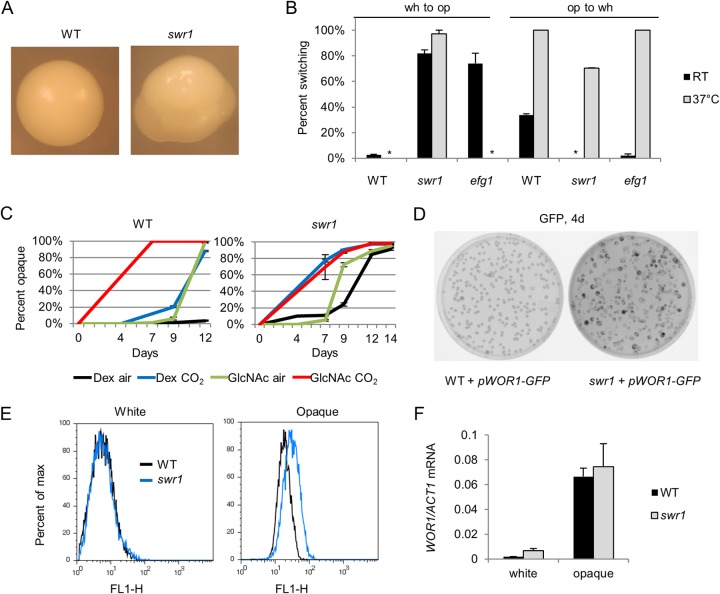
Deletion of SWR1 leads to elevated white-opaque switching and opaque stability. (A) Single colonies of white WT (JYC1) and swr1 (HLY4233) cells after 7 days of growth at room temperature (25°C) on YPD. The swr1 colony displays multiple opaque sectors typical of the strain. (B) Spontaneous white-to-opaque and opaque-to-white switching rates of the WT, swr1, and efg1 (HLY3600) strains at RT (25°C) and at 37°C after 7 days of growth on SCD medium. The P value is <0.01 for swr1 opaque cells at 37°C compared to the wild type, and the P value is <0.005 for all others comparisons to the wild type, based on two-tailed Student's t test. * indicates that 0% switching occurred. (C) Percentage of spontaneous switching to opaque from white cells of the WT and swr1 strains after 7 days of growth at RT on Lee's medium with 1.25% dextrose (Dex) or 1.25% GlcNAc as the carbon source, in air or 5% CO2. (D) Fluorescence image of colonies of the WT carrying pWOR1-GFP (HLY3555) and the swr1 mutant carrying pWOR1-GFP (HLY4234) after 4 days of growth on SCD medium at RT. Opaque colonies and sectors, expressing more GFP, appear darker. (E) FACS profiles of GFP fluorescence in a population of 10,000 white or opaque cells of the WT carrying pWOR1-GFP (HLY3555) and the swr1 mutant carrying pWOR1-GFP (HLY4234). Cells were from a log-phase liquid culture at RT. (F) Levels of WOR1 mRNA transcript as assayed by RT-qPCR in white and opaque cells of the WT (JYC1) or the swr1 (HLY4233) deletion mutant. RNA was collected from log-phase cell cultures in YPD at room temperature. Transcript levels were normalized to ACT1 levels. All experiments were performed in triplicate.
FIG 2
FIG 2
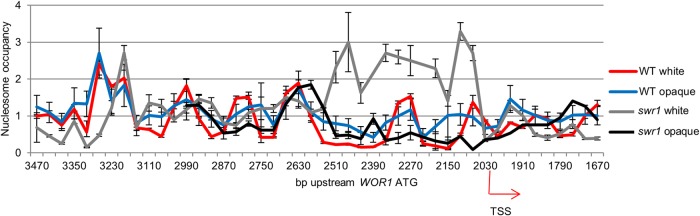
Nucleosome map of the WOR1 promoter shows white-opaque differences in the wild type and altered nucleosome positioning and occupancy in the swr1 mutant. Nucleosomal DNA was isolated from the WT strain carrying HTA3-HA (HLY4238) or the swr1 mutant carrying HTA3-HA (HLY4236) after removal of non-nucleosome-bound DNA with micrococcal nuclease digestion. Mapping was performed by qPCR using primers amplifying 100-bp regions along the WOR1 promoter. The error was calculated from the standard deviation of CT values from triplicate experiments. TSS, transcriptional start site.
FIG 3
FIG 3
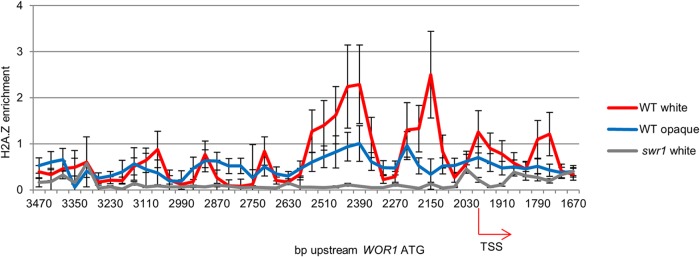
Differential enrichment of H2A.Z at the WOR1 promoter in white and opaque cells. Chromatin immunoprecipitation of HA-tagged H2A.Z was performed on nucleosomal DNA isolated from white and opaque cells of the WT strain carrying HTA3-HA and from white cells of the swr1 strain carrying HTA3-HA. qPCR was performed by using primers used to map the WOR1 promoter. Results were normalized to the total nucleosome level. TSS, transcriptional start site.
FIG 4
FIG 4
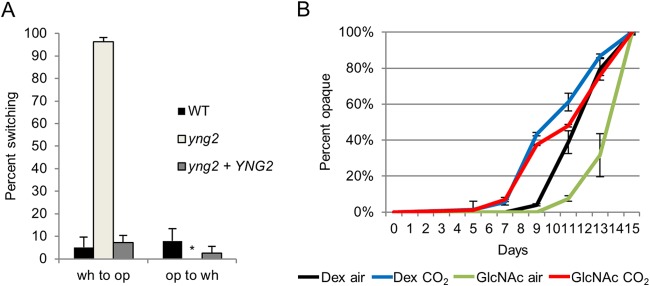
White-opaque switching of the yng2 mutant is elevated and shows synergy with CO2. (A) Spontaneous white-to-opaque and opaque-to-white switching rates of the yng2 strain (HLY3883) and the yng2+YNG2 complemented strain (HLY3886) compared to the WT after 14 days at room temperature on SCD medium. The P value is <0.005 for the yng2 and yng2+YNG2 strains compared to the WT. * indicates that 0% switching occurred. (B) Percentage of spontaneous switching of white yng2 cells to opaque after 7 days of growth on Lee's medium with 1.25% dextrose or 1.25% GlcNAc as the carbon source, in air or 5% CO2, at RT.
FIG 5
FIG 5
The swr1 mutant displays high sensitivity to nicotinamide but not to methyl methanesulfonate. Show are data from spot assays of the WT, SWR1/swr1 (HLY4235), swr1 (HLY4233), HST3/hst3 (HLY3993), and rtt109 (HLY3997) strains on YPD, YPD plus 2% MMS, or YPD plus 2 mM or 4 mM NAM. Fivefold serial dilutions from cultures with an OD600 of 0.1 were made on agar medium plates and incubated for 3 days at 30°C prior to imaging.

References

    1. Henikoff S. 2008. Nucleosome destabilization in the epigenetic regulation of gene expression. Nat Rev Genet 9:15–26. doi: 10.1038/nrg2206. - DOI - PubMed
    1. Zentner GE, Henikoff S. 2013. Regulation of nucleosome dynamics by histone modifications. Nat Struct Mol Biol 20:259–266. doi: 10.1038/nsmb.2470. - DOI - PubMed
    1. Masumoto H, Hawke D, Kobayashi R, Verreault A. 2005. A role for cell-cycle-regulated histone H3 lysine 56 acetylation in the DNA damage response. Nature 436:294–298. doi: 10.1038/nature03714. - DOI - PubMed
    1. Li Q, Zhou H, Wurtele H, Davies B, Horazdovsky B, Verreault A, Zhang Z. 2008. Acetylation of histone H3 lysine 56 regulates replication-coupled nucleosome assembly. Cell 134:244–255. doi: 10.1016/j.cell.2008.06.018. - DOI - PMC - PubMed
    1. Chen CC, Carson JJ, Feser J, Tamburini B, Zabaronick S, Linger J, Tyler JK. 2008. Acetylated lysine 56 on histone H3 drives chromatin assembly after repair and signals for the completion of repair. Cell 134:231–243. doi: 10.1016/j.cell.2008.06.035. - DOI - PMC - PubMed

Publication types

MeSH terms