


Elevating the Horizon: Emerging Molecular and Genomic Targets in the Treatment of Advanced Urothelial Carcinoma
- PMID: 25862322
- PMCID: PMC4561017
- DOI: 10.1016/j.clgc.2015.02.009
Elevating the Horizon: Emerging Molecular and Genomic Targets in the Treatment of Advanced Urothelial Carcinoma
Abstract
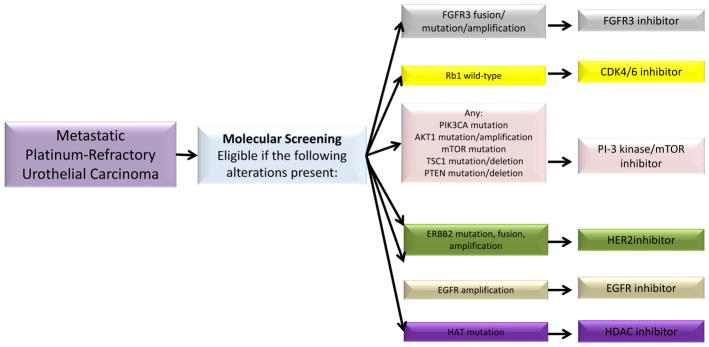
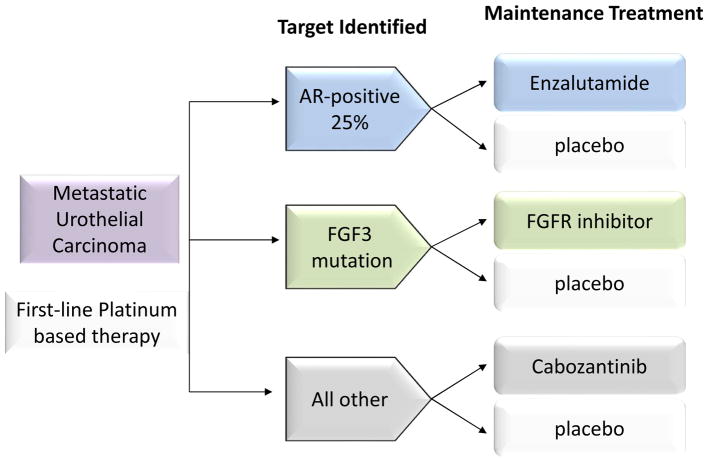
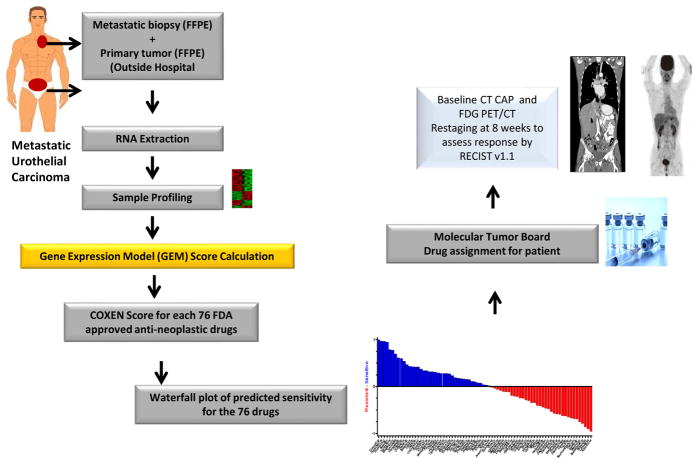
Despite recent advances in the identification of genomic alterations that lead to urothelial oncogenesis in vitro, patients with advanced urothelial carcinomas continue to have poor clinical outcomes. In the present review, we focus on targeted therapies that have yielded the most promising results alone or combined with traditional chemotherapy, including the antiangiogenesis agent bevacizumab, the human epidermal growth factor receptor 2 antibody trastuzumab, and the tyrosine kinase inhibitor cabozantinib. We also describe ongoing and developing clinical trials that use innovative approaches, including dose-dense scheduling of singular chemotherapy combinations, prospective screening of tumor tissues for mutational targets and biomarkers to predict chemosensitivity before the determination of the therapeutic regimen, and novel agents that target proteins in the immune checkpoint regulation pathway (programmed cell death protein 1 [PD-1] and anti-PD-ligand 1) that have shown significant potential in preclinical models and early clinical trials. New agents and targeted therapies, alone or combined with traditional chemotherapy, will only be validated through accrual to developing clinical trials that aim to translate these therapies into individualized treatments and improved survival rates in urothelial carcinoma.
Keywords: Bladder cancer; Clinical trials; Immune checkpoints; Novel agents; Targeted therapy.
Published by Elsevier Inc.
Figures
References
-
- von der Maase H, Sengelov L, Roberts JT, et al. Long-term survival results of a randomized trial comparing gemcitabine plus cisplatin, with methotrexate, vinblastine, doxorubicin, plus cisplatin in patients with bladder cancer. J Clin Oncol. 2005;23:4602–8. - PubMed
-
- von der Maase H, Hansen SW, Roberts JT, et al. Gemcitabine and cisplatin versus methotrexate, vinblastine, doxorubicin, and cisplatin in advanced or metastatic bladder cancer: results of a large, randomized, multinational, multicenter, phase III study. J Clin Oncol. 2000;18:3068–77. - PubMed
-
- Dreicer R. Second-line chemotherapy for advanced urothelial cancer: because we should or because we can? J Clin Oncol. 2009;27:4444–5. - PubMed
-
- Cognetti F, Ruggeri EM, Felici A, et al. Adjuvant chemotherapy with cisplatin and gemcitabine versus chemotherapy at relapse in patients with muscle-invasive bladder cancer submitted to radical cystectomy: an Italian, multicenter, randomized phase III trial. Ann Oncol. 2012;23:695–700. - PubMed
Publication types
MeSH terms
Substances
Grants and funding
LinkOut - more resources
Full Text Sources
Other Literature Sources
Research Materials
