


Persistent or Recurrent Anemia Is Associated With Severe and Disabling Inflammatory Bowel Disease
- PMID: 25862987
- PMCID: PMC4702483
- DOI: 10.1016/j.cgh.2015.03.029
Persistent or Recurrent Anemia Is Associated With Severe and Disabling Inflammatory Bowel Disease
Abstract
Background & aims: Anemia is a common manifestation of inflammatory bowel disease (IBD) that can greatly affect patients' quality of life. We performed a prospective study of a large cohort of patients with IBD to determine if patterns of anemia over time are associated with aggressive or disabling disease.
Methods: We performed a longitudinal analysis of demographic, clinical, laboratory, and treatment data from a registry of patients with IBD at the University of Pittsburgh Medical Center from 2009 through 2013. Patients with a complete follow-up evaluation (at least 1 annual visit with laboratory results) were included. Anemia was defined by World Health Organization criteria. Disease activity scores (the Harvey-Bradshaw Index or the ulcerative colitis activity index) and quality-of-life scores (based on the short IBD questionnaire) were determined at each visit; laboratory data, including levels of C-reactive protein and erythrocyte sedimentation rates, as well as patterns of IBD-related health care use, were analyzed.
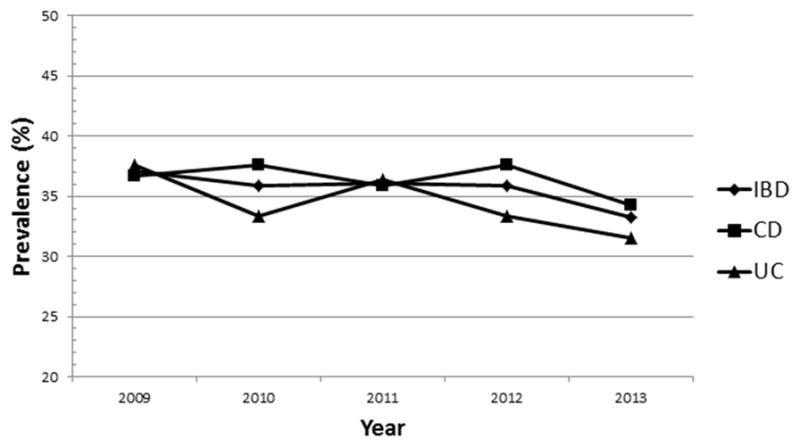
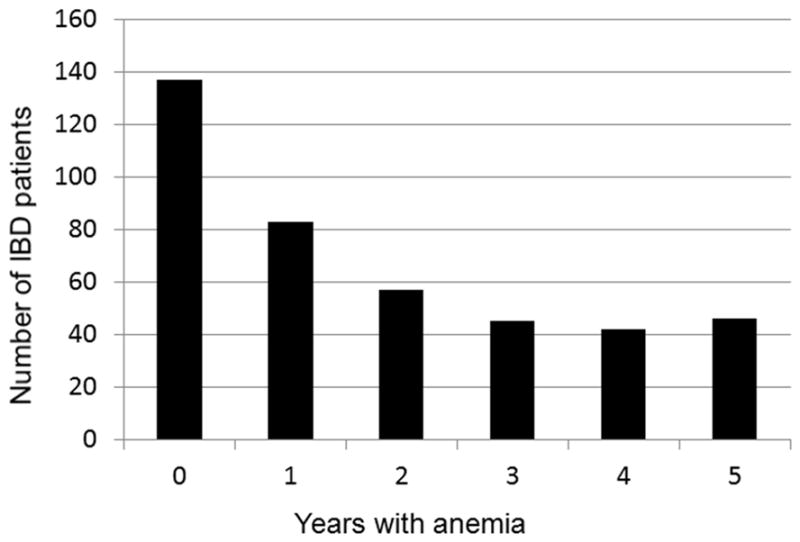
Results: A total of 410 IBD patients (245 with Crohn's disease, 165 with ulcerative colitis; 50.5% female) were included. The prevalence of anemia in patients with IBD was 37.1% in 2009 and 33.2% in 2013. Patients with IBD and anemia required significantly more health care and had higher indices of disease activity, as well as a lower average quality of life, than patients without anemia (P < .0001). Anemia (persistent or recurrent) for 3 or more years was correlated independently with hospitalizations (P < .01), visits to gastroenterology clinics (P < .001), telephone calls (P < .004), surgeries for IBD (P = .01), higher levels of C-reactive protein (in patients with ulcerative colitis, P = .001), and a higher erythrocyte sedimentation rate (P < .0001). Anemia was correlated negatively with quality-of-life scores (P < .03).
Conclusions: Based on a longitudinal analysis of 410 patients, persistent or recurrent anemia correlates with more aggressive or disabling disease in patients with IBD.
Keywords: C-Reactive Protein; Crohn's Disease; Erythrocyte Sedimentation Rate; Quality of Life; Ulcerative Colitis.
Copyright © 2015 AGA Institute. Published by Elsevier Inc. All rights reserved.
Figures
Comment in
-
Anemia in Inflammatory Bowel Disease: The Opening of Pandora's Box?Clin Gastroenterol Hepatol. 2015 Oct;13(10):1767-9. doi: 10.1016/j.cgh.2015.06.004. Epub 2015 Jun 16. Clin Gastroenterol Hepatol. 2015. PMID: 26091737 No abstract available.
References
-
- Munkholm P, Langholz E, Davidsen M, et al. Disease activity courses in a regional cohort of Crohn’s disease patients. Scand J Gastroenterol. 1995;30:699–706. - PubMed
-
- Langholz E, Munkholm P, Davidsen M, et al. Course of ulcerative colitis: analysis of changes in disease activity over years. Gastroenterology. 1994;107:3–11. - PubMed
-
- Blonski W, Buchner AM, Lichtenstein GR. Clinical predictors of aggressive/disabling disease: ulcerative colitis and Crohn disease. Gastroenterol Clin North Am. 2012;41:443–62. - PubMed
-
- Levesque BG, Sandborn WJ, Ruel J, et al. Converging Goals of Treatment for Inflammatory Bowel Disease, from Clinical Trials and Practice. Gastroenterology. 2015;148:37–51. - PubMed
-
- D’Haens G, Sandborn WJ, Feagan BG, et al. A review of activity indices and efficacy end points for clinical trials of medical therapy in adults with ulcerative colitis. Gastroenterology. 2007;132:763–86. - PubMed
Publication types
MeSH terms
Substances
Grants and funding
LinkOut - more resources
Full Text Sources
Other Literature Sources
Medical
Research Materials
