


Isoform-selective Genetic Inhibition of Constitutive Cytosolic Hsp70 Activity Promotes Client Tau Degradation Using an Altered Co-chaperone Complement
- PMID: 25864199
- PMCID: PMC4505567
- DOI: 10.1074/jbc.M115.637595
Isoform-selective Genetic Inhibition of Constitutive Cytosolic Hsp70 Activity Promotes Client Tau Degradation Using an Altered Co-chaperone Complement
Abstract
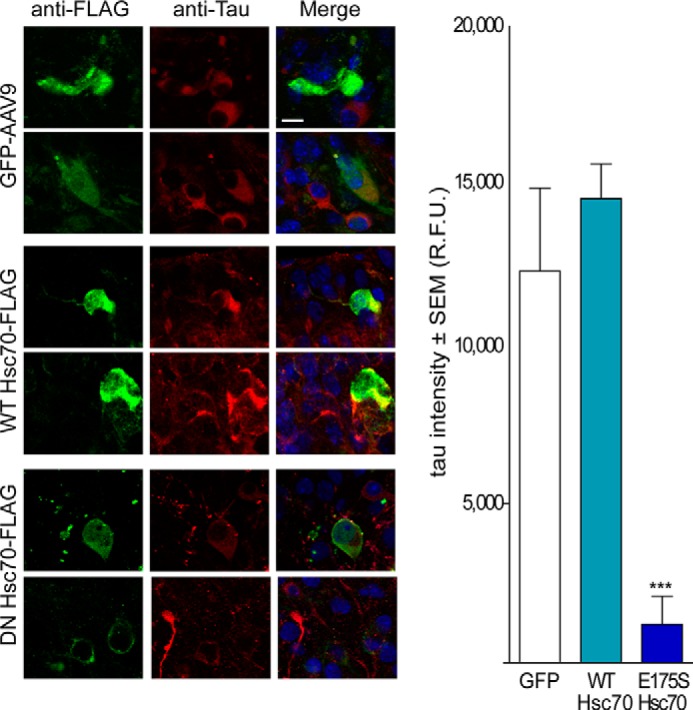
The constitutively expressed heat shock protein 70 kDa (Hsc70) is a major chaperone protein responsible for maintaining proteostasis, yet how its structure translates into functional decisions regarding client fate is still unclear. We previously showed that Hsc70 preserved aberrant Tau, but it remained unknown if selective inhibition of the activity of this Hsp70 isoform could facilitate Tau clearance. Using single point mutations in the nucleotide binding domain, we assessed the effect of several mutations on the functions of human Hsc70. Biochemical characterization revealed that one mutation abolished both Hsc70 ATPase and refolding activities. This variant resembled the ADP-bound conformer at all times yet remained able to interact with cofactors, nucleotides, and substrates appropriately, resembling a dominant negative Hsc70 (DN-Hsc70). We then assessed the effects of this DN-Hsc70 on its client Tau. DN-Hsc70 potently facilitated Tau clearance via the proteasome in cells and brain tissue, in contrast to wild type Hsc70 that stabilized Tau. Thus, DN-Hsc70 mimics the action of small molecule pan Hsp70 inhibitors with regard to Tau metabolism. This shift in Hsc70 function by a single point mutation was the result of a change in the chaperome associated with Hsc70 such that DN-Hsc70 associated more with Hsp90 and DnaJ proteins, whereas wild type Hsc70 was more associated with other Hsp70 isoforms. Thus, isoform-selective targeting of Hsc70 could be a viable therapeutic strategy for tauopathies and possibly lead to new insights in chaperone complex biology.
Keywords: 70-kilodalton heat shock protein (Hsp70); Alzheimer disease; Tau protein (Tau); chaperone; heat shock protein (HSP); inhibitor.
© 2015 by The American Society for Biochemistry and Molecular Biology, Inc.
Figures




References
-
- Palleros D. R., Reid K. L., Shi L., Welch W. J., Fink A. L. (1993) ATP-induced protein-Hsp70 complex dissociation requires K+ but not ATP hydrolysis. Nature 365, 664–666 - PubMed
-
- Cheetham M. E., Jackson A. P., Anderton B. H. (1994) Regulation of 70-kDa heat-shock-protein ATPase activity and substrate binding by human DnaJ-like proteins, HSJ1a and HSJ1b. Eur. J. Biochem. 226, 99–107 - PubMed
-
- Wittung-Stafshede P., Guidry J., Horne B. E., Landry S. J. (2003) The J-domain of Hsp40 couples ATP hydrolysis to substrate capture in Hsp70. Biochemistry 42, 4937–4944 - PubMed
-
- McKay D. B. (1993) Structure and mechanism of 70-kDa heat-shock-related proteins. Adv. Protein Chem. 44, 67–98 - PubMed
-
- Mayer M. P. (2010) Gymnastics of molecular chaperones. Mol. Cell 39, 321–331 - PubMed
Publication types
MeSH terms
Substances
Grants and funding
LinkOut - more resources
Full Text Sources
Miscellaneous
