


Efficacy-oriented compatibility for component-based Chinese medicine
- PMID: 25864650
- PMCID: PMC4594187
- DOI: 10.1038/aps.2015.8
Efficacy-oriented compatibility for component-based Chinese medicine
Abstract
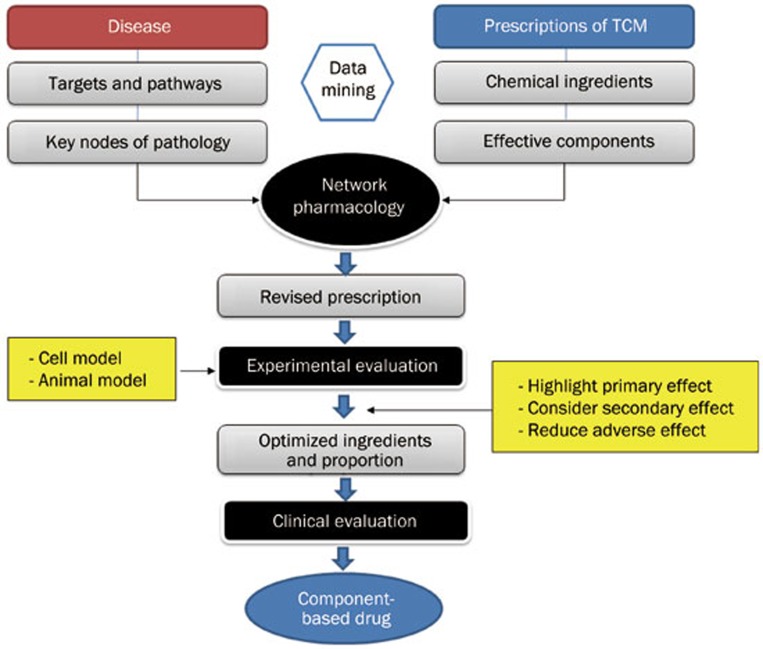
Single-target drugs have not achieved satisfactory therapeutic effects for complex diseases involving multiple factors. Instead, innovations in recent drug research and development have revealed the emergence of compound drugs, such as cocktail therapies and "polypills", as the frontier in new drug development. A traditional Chinese medicine (TCM) prescription that is usually composed of several medicinal herbs can serve a typical representative of compound medicines. Although the traditional compatibility theory of TCM cannot be well expressed using modern scientific language nowadays, the fundamental purpose of TCM compatibility can be understood as promoting efficacy and reducing toxicity. This paper introduces the theory and methods of efficacy-oriented compatibility for developing component-based Chinese medicines.
Figures
References
-
- 2Sams-Dodd F. Target-based drug discovery: is something wrong? Drug Discov Today 2005; 10: 139–47. - PubMed
-
- 3Zhang Bl, Wang Yy. Theories and Methods Used in the Research of Modern Chinese Medicine by Drug Combination Chin J Nat Med 2005; 3: 258–61.
-
- 4Szuromi P, Vinson V, Marshall E. Rethinking drug discovery Science 2004; 303: 1795.
-
- 5Yang Y, Adelstein SJ, Kassis AI. Target discovery from data mining approaches Drug Discov Today 2012; 17: S16–23. - PubMed
Publication types
MeSH terms
Substances
LinkOut - more resources
Full Text Sources
Other Literature Sources
