. 2015 May 7;96(5):695-708.
doi: 10.1016/j.ajhg.2015.02.018. Epub 2015 Apr 9.

Genome-wide Analysis of Body Proportion Classifies Height-Associated Variants by Mechanism of Action and Implicates Genes Important for Skeletal Development

Affiliations

Genome-wide Analysis of Body Proportion Classifies Height-Associated Variants by Mechanism of Action and Implicates Genes Important for Skeletal Development

Yingleong Chan et al. Am J Hum Genet. .

Abstract

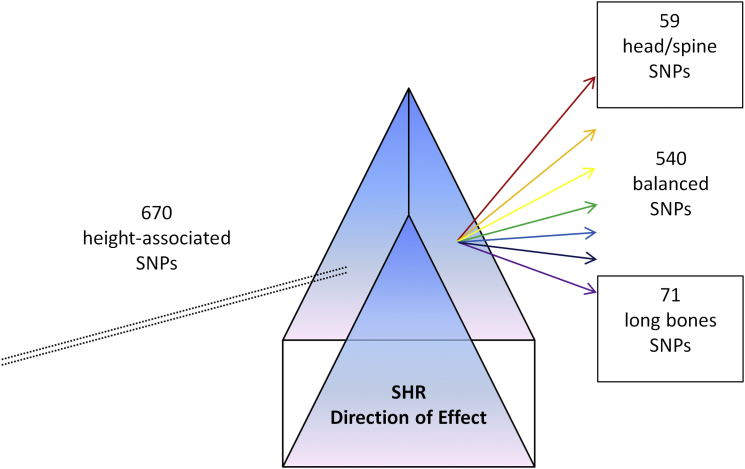
Human height is a composite measurement, reflecting the sum of leg, spine, and head lengths. Many common variants influence total height, but the effects of these or other variants on the components of height (body proportion) remain largely unknown. We studied sitting height ratio (SHR), the ratio of sitting height to total height, to identify such effects in 3,545 African Americans and 21,590 individuals of European ancestry. We found that SHR is heritable: 26% and 39% of the total variance of SHR can be explained by common variants in European and African Americans, respectively, and global European admixture is negatively correlated with SHR in African Americans (r(2) ≈ 0.03). Six regions reached genome-wide significance (p < 5 × 10(-8)) for association with SHR and overlapped biological candidate genes, including TBX2 and IGFBP3. We found that 130 of 670 height-associated variants are nominally associated (p < 0.05) with SHR, more than expected by chance (p = 5 × 10(-40)). At these 130 loci, the height-increasing alleles are associated with either a decrease (71 loci) or increase (59 loci) in SHR, suggesting that different height loci disproportionally affect either leg length or spine/head length. Pathway analyses via DEPICT revealed that height loci affecting SHR, and especially those affecting leg length, show enrichment of different biological pathways (e.g., bone/cartilage/growth plate pathways) than do loci with no effect on SHR (e.g., embryonic development). These results highlight the value of using a pair of related but orthogonal phenotypes, in this case SHR with height, as a prism to dissect the biology underlying genetic associations in polygenic traits and diseases.


Figures

Figure 1
Figure 1
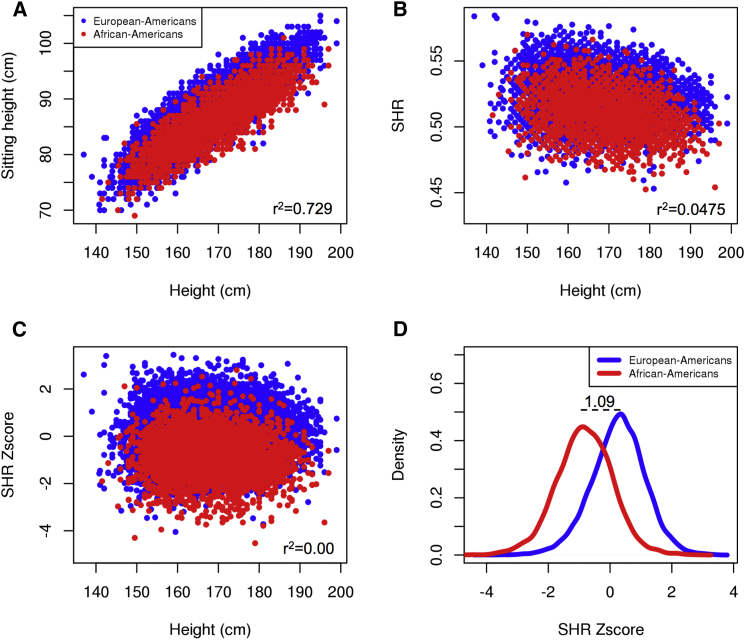
Comparing the Distribution of SHR between European Americans and African Americans Plots of sitting height and height of individuals, both European Americans and African Americans, from combining the ARIC, CARDIA, and CHS cohorts. Red points indicate individuals of African ancestry; blue points indicate individuals of European ancestry. (A) Values of sitting height and height in centimeters. (B) Values of SHR and height in centimeters. (C) Values of SHR Z scores (adjusted for height, sex, BMI, age, and cohort) and height in centimeters. (D) The histograms of the SHR Z scores of African Americans (red line) and European Americans (blue line). The dotted horizontal line indicates the mean difference (in standard deviation units) between the two distributions.
Figure 2
Figure 2
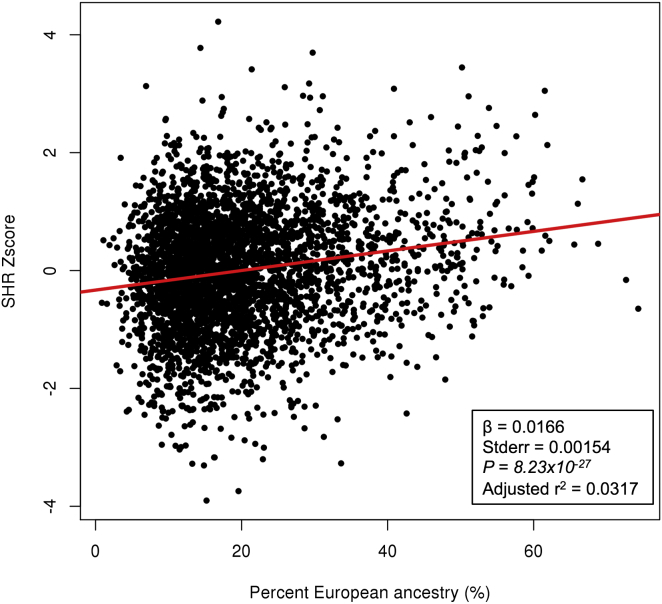
Association of Global European Admixture with SHR in African-American Individuals The association of global European admixture (x axis) with SHR (y axis) for African-American individuals in the ARIC, CARDIA, and CHS cohorts (n = 3,545). The correlation (red line) obtained from linear regression is shown with the corresponding effect size (β), standard deviation, p value, and r2 (inset).
Figure 3
Figure 3
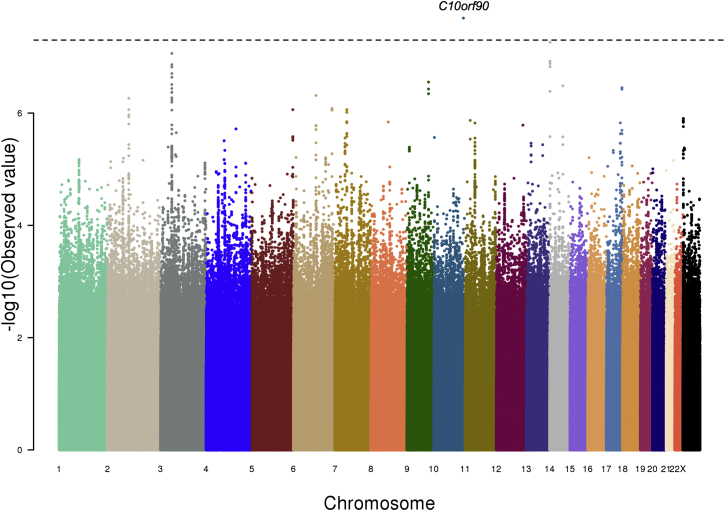
GWAS of SHR of African Americans The GWAS results of SHR of African-American individuals (n = 3,545) shown as a Manhattan plot. The x axis marks the chromosomes and their relative positions of each variant tested and the y axis indicates the –log10 p value. The candidate gene within the locus that reached genome-wide significance is also shown. The horizontal dashed line represents the threshold of genome-wide significance (p < 5 × 10−8).
Figure 4
Figure 4
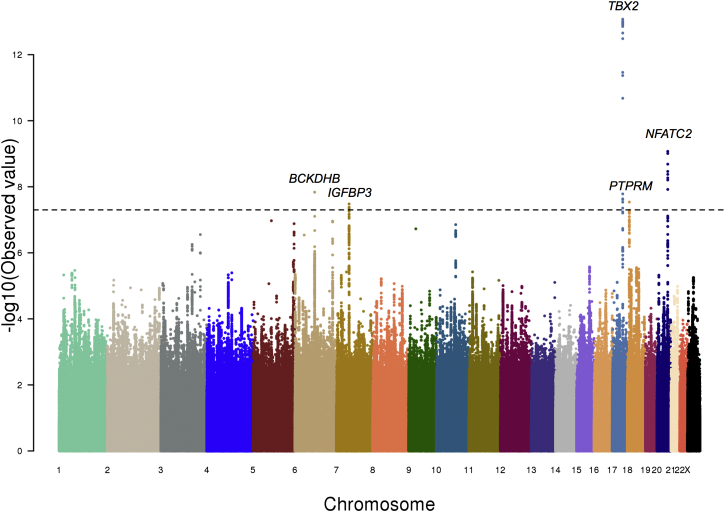
GWAS of SHR of Individuals with Ancestry from Europe The GWAS results of SHR of individuals with ancestry from Europe (n = 21,590) shown as a Manhattan plot. The x axis marks the chromosomes and their relative positions of each variant tested and the y axis indicates the –log10 p value. Candidate genes within loci that reached genome-wide significance are also shown. The horizontal dashed line represents the threshold of genome-wide significance (p < 5 × 10−8).
Figure 5
Figure 5
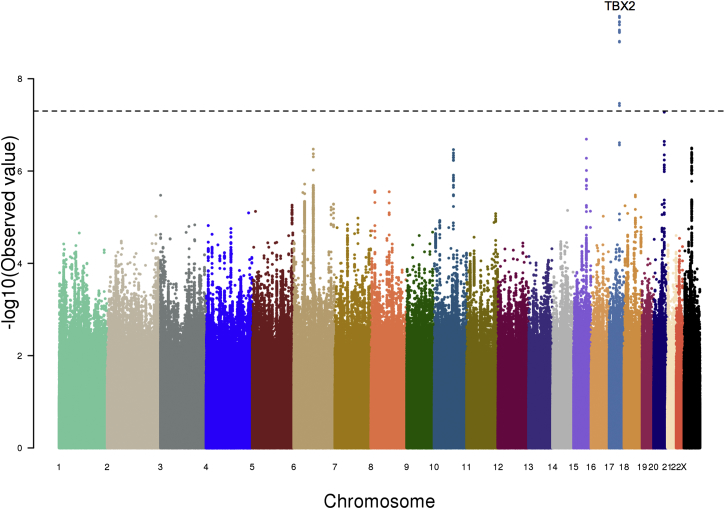
Female-Specific GWAS of SHR of Individuals with Ancestry from Europe The GWAS results of SHR using only the female individuals with ancestry from Europe (n = 12,965) shown as a Manhattan plot. The x axis marks the chromosomes and their relative positions of each variant tested and the y axis indicates the –log10 p value. The candidate gene within the locus that reached genome-wide significance is also shown. The horizontal dashed line represents the threshold of genome-wide significance (p < 5 × 10−8).
Figure 6
Figure 6
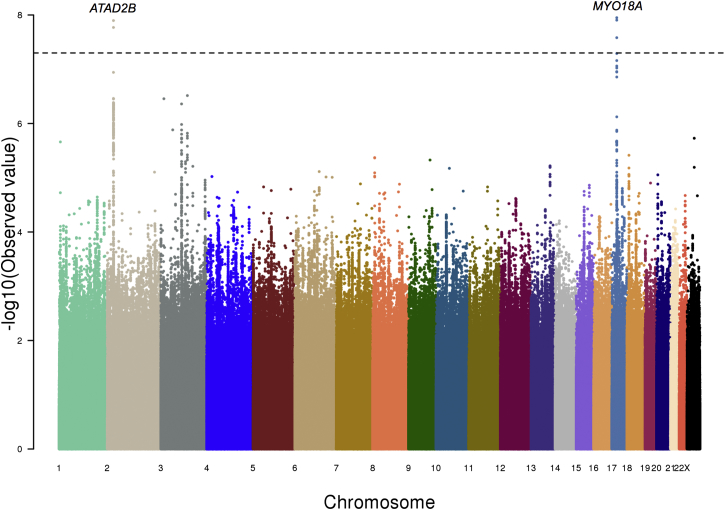
Male-Specific GWAS of SHR of Individuals with Ancestry from Europe The GWAS results of SHR using only the male individuals with ancestry from Europe (n = 8,625) shown as a Manhattan plot. The x axis marks the chromosomes and their relative positions of each variant tested and the y axis indicates the –log10 p value. Candidate genes within loci that reached genome-wide significance are also shown. The horizontal dashed line represents the threshold of genome-wide significance (p < 5 × 10−8).
Figure 7
Figure 7
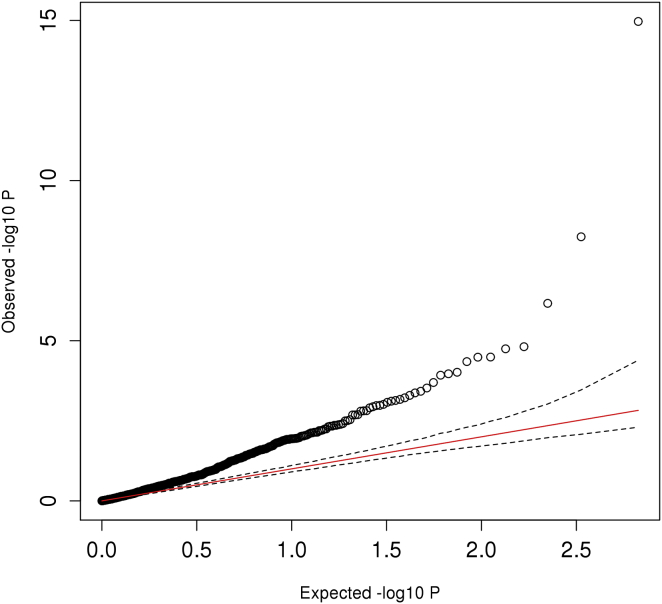
QQ Plot of the 670 Height-Associated SNPs with SHR The plot shows the observed –log10 p values of SHR (y axis) for the 670 height-associated SNPs and compare them with the expected –log10 p values (x axis) under the null hypothesis. The red line is the trend line under the null hypothesis and the dashed lines indicate the 95% confidence interval under the null hypothesis.
Figure 8
Figure 8
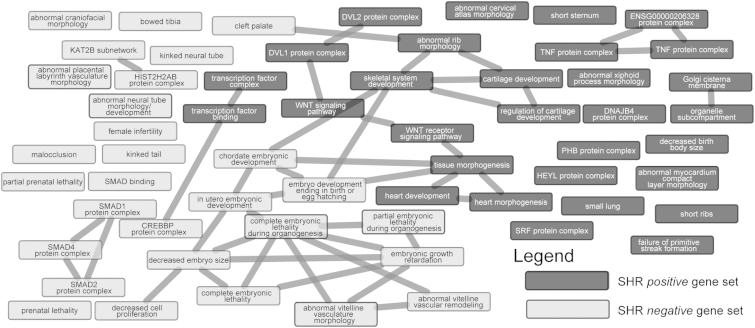
Pathway Analysis by DEPICT of Height-Associated SNPs Comparing the top 30 gene sets obtained by DEPICT for the 130 known height-associated SNPs also nominally associated with SHR (SHR-positive gene set) as well as the 130 known height-associated SNPs least associated with SHR (SHR-negative gene set). A line connecting two gene sets indicates that the gene sets have a Pearson correlation coefficient > 0.6.
Figure 9
Figure 9
SHR as a Prism to Dissect the Height-Associated SNPs into Functional Classes This diagram illustrates the use of an orthogonal phenotype like SHR to partition the known variants associated with overall height into various functional classes (head/spine, long bones, and balanced).

References

    1. Lango Allen H., Estrada K., Lettre G., Berndt S.I., Weedon M.N., Rivadeneira F., Willer C.J., Jackson A.U., Vedantam S., Raychaudhuri S. Hundreds of variants clustered in genomic loci and biological pathways affect human height. Nature. 2010;467:832–838. - PMC - PubMed
    1. Wood A.R., Esko T., Yang J., Vedantam S., Pers T.H., Gustafsson S., Chu A.Y., Estrada K., Luan J., Kutalik Z., Electronic Medical Records and Genomics (eMEMERGEGE) Consortium. MIGen Consortium. PAGEGE Consortium. LifeLines Cohort Study Defining the role of common variation in the genomic and biological architecture of adult human height. Nat. Genet. 2014;46:1173–1186. - PMC - PubMed
    1. Fredriks A.M., van Buuren S., van Heel W.J.M., Dijkman-Neerincx R.H., Verloove-Vanhorick S.P., Wit J.M. Nationwide age references for sitting height, leg length, and sitting height/height ratio, and their diagnostic value for disproportionate growth disorders. Arch. Dis. Child. 2005;90:807–812. - PMC - PubMed
    1. de Arriba Muñoz A., Domínguez Cajal M., Rueda Caballero C., Labarta Aizpún J.I., Mayayo Dehesa E., Ferrández Longás Á. Sitting height/standing height ratio in a Spanish population from birth to adulthood. Arch. Argent. Pediatr. 2013;111:309–314. - PubMed
    1. Krakow D., Rimoin D.L. The skeletal dysplasias. Genet. Med. 2010;12:327–341. - PubMed

Publication types