


Longevity and skeletal muscle mass: the role of IGF signalling, the sirtuins, dietary restriction and protein intake
- PMID: 25866088
- PMCID: PMC4531066
- DOI: 10.1111/acel.12342
Longevity and skeletal muscle mass: the role of IGF signalling, the sirtuins, dietary restriction and protein intake
Abstract
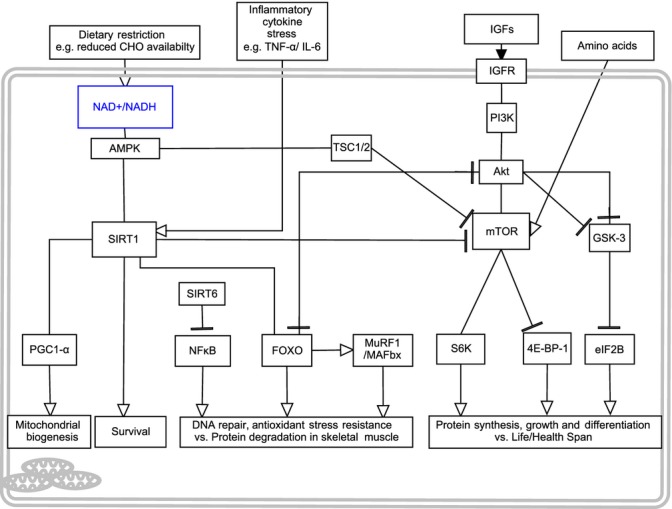
Advancing age is associated with a progressive loss of skeletal muscle (SkM) mass and function. Given the worldwide aging demographics, this is a major contributor to morbidity, escalating socio-economic costs and ultimately mortality. Previously, it has been established that a decrease in regenerative capacity in addition to SkM loss with age coincides with suppression of insulin/insulin-like growth factor signalling pathways. However, genetic or pharmacological modulations of these highly conserved pathways have been observed to significantly enhance life and healthspan in various species, including mammals. This therefore provides a controversial paradigm in which reduced regenerative capacity of skeletal muscle tissue with age potentially promotes longevity of the organism. This paradox will be assessed and considered in the light of the following: (i) the genetic knockout, overexpression and pharmacological models that induce lifespan extension (e.g. IRS-1/s6K KO, mTOR inhibition) versus the important role of these signalling pathways in SkM growth and adaptation; (ii) the role of the sirtuins (SIRTs) in longevity versus their emerging role in SkM regeneration and survival under catabolic stress; (iii) the role of dietary restriction and its impact on longevity versus skeletal muscle mass regulation; (iv) the crosstalk between cellular energy metabolism (AMPK/TSC2/SIRT1) and survival (FOXO) versus growth and repair of SkM (e.g. AMPK vs. mTOR); and (v) the impact of protein feeding in combination with dietary restriction will be discussed as a potential intervention to maintain SkM mass while increasing longevity and enabling healthy aging.
Keywords: AKT; AMPK; FOXO; IGF-I; IRS-1; MAFBx; MURF; SIRT; SkM; TSC; cachexia; calorie restriction; high-protein diets; lifespan; longevity; mTOR; regeneration; sarcopenia; satellite cells.
© 2015 The Authors. Aging Cell published by the Anatomical Society and John Wiley & Sons Ltd.
Figures
References
-
- Adamo ML, Farrar RP. Resistance training, and IGF involvement in the maintenance of muscle mass during the aging process. Ageing Res. Rev. 2006;5:310–331. - PubMed
-
- Aguilar V, Alliouachene S, Sotiropoulos A, Sobering A, Athea Y, Djouadi F, Miraux S, Thiaudiere E, Foretz M, Viollet B, Diolez P, Bastin J, Benit P, Rustin P, Carling D, Sandri M, Ventura-Clapier R, Pende M. S6 kinase deletion suppresses muscle growth adaptations to nutrient availability by activating AMP kinase. Cell Metab. 2007;5:476–487. - PubMed
-
- Al-Shanti N, Stewart CE. Inhibitory effects of IL-6 on IGF-1 activity in skeletal myoblasts could be mediated by the activation of SOCS-3. J. Cell. Biochem. 2011;113:923–933. - PubMed
Publication types
MeSH terms
Substances
LinkOut - more resources
Full Text Sources
Other Literature Sources
Medical
Research Materials
Miscellaneous
