


Determining ethyl glucuronide cutoffs when detecting self-reported alcohol use in addiction treatment patients
- PMID: 25866234
- PMCID: PMC4400217
- DOI: 10.1111/acer.12699
Determining ethyl glucuronide cutoffs when detecting self-reported alcohol use in addiction treatment patients
Abstract
Background: Ethyl glucuronide (EtG) is an alcohol biomarker with potential utility as a clinical research and alcohol treatment outcome. Debate exists regarding the appropriate cutoff level for determining alcohol use, particularly with the EtG immunoassay. This study determined the EtG immunoassay cutoff levels that most closely correspond to self-reported drinking in alcohol-dependent outpatients.
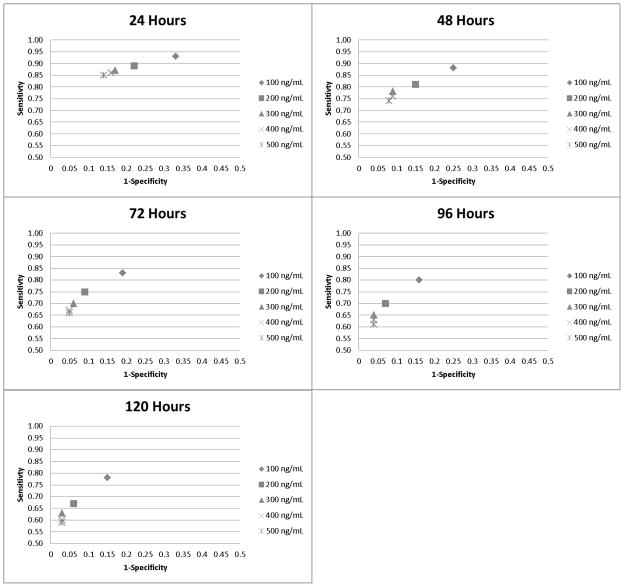
Methods: Eighty adults with alcohol dependence and mental illness, taking part in an alcohol treatment study, provided urine samples 3 times per week for up to 16 weeks (1,589 samples). Self-reported drinking during 120 hours prior to each sample collection was assessed. Receiver operating characteristic analyses were conducted to assess the ability of the EtG immunoassay to detect self-reported alcohol use across 24- to 120-hour time periods. Sensitivity and specificity of EtG immunoassay cutoff levels was compared in 100 ng/ml increments (100 to 500 ng/ml) across 24 to 120 hours.
Results: Over half (57%) of the 1,589 samples indicated recent alcohol consumption. The EtG immunoassay closely corresponded to self-reported drinking from 24 (area under the curve [AUC] = 0.90, 95% confidence interval [CI]: 0.88, 0.92) to 120 hours (AUC = 0.88, 95% CI: 0.87, 0.90). When cutoff levels were compared across 24 to 120 hours, 100 ng/ml had the highest sensitivity (0.93 to 0.78) and lowest specificity (0.67 to 0.85). Relative to 100 ng/ml, the 200 ng/ml cutoff demonstrated a reduction in sensitivity (0.89 to 0.67), but improved specificity (0.78 to 0.94). The 300, 400, and 500 ng/ml cutoffs demonstrated the lowest sensitivity (0.86 to 0.33) and highest specificity (0.86 to 0.97) over 24 to 120 hours.
Conclusions: For detecting alcohol use for >24 hours, the 200 ng/ml cutoff level is recommended for use as a research and clinical outcome.
Keywords: Alcohol Biomarkers; Alcohol Treatment; Ethyl Glucuronide; Urine Testing.
Copyright © 2015 by the Research Society on Alcoholism.
Figures
References
-
- Albermann ME, Musshoff F, Doberentz E, Heese P, Banger M, Madea B. Preliminary investigations on ethyl glucuronide and ethyl sulfate cutoffs for detecting alcohol consumption on the basis of an ingestion experiment and on data from withdrawal treatment. Int J Legal Med. 2012;126:757–764. - PubMed
-
- Anton RF. Carbohydrate-deficient transferrin for detection and monitoring of sustained heavy drinking. What have we learned? Where do we go from here? Alcohol. 2001;25(3):185–8. - PubMed
-
- Arndt T, Gierten B, Güssregen B, Werle A, Grüner J. False-positive ethyl glucuronide immunoassay screening associated with chloral hydrate medication as confirmed by LC-MS/MS and self-medication. Forensic Sci Int. 2009;184:e27–29. - PubMed
-
- Babor TF, Steinberg K, Anton R, Del Boca F. Talk is cheap: measuring drinking outcomes in clinical trials. J Stud Alcohol Drugs. 2000;61:55–63. - PubMed
Publication types
MeSH terms
Substances
Grants and funding
LinkOut - more resources
Full Text Sources
Other Literature Sources
Medical
