


A study of the association between urinary aluminum concentration and pre-clinical findings among aluminum-handling and non-handling workers
- PMID: 25866547
- PMCID: PMC4393619
- DOI: 10.1186/s12995-015-0055-8
A study of the association between urinary aluminum concentration and pre-clinical findings among aluminum-handling and non-handling workers
Abstract
Background: Aluminum is considered to be a relatively safe metal for humans. However, there are some reports that aluminum can be toxic to humans and animals. In order to estimate the toxicity of aluminum with respect to humans, we measured the aluminum concentration in urine of aluminum-handling and non-handling workers and investigated the relationships between their urinary aluminum concentrations and pre-clinical findings.
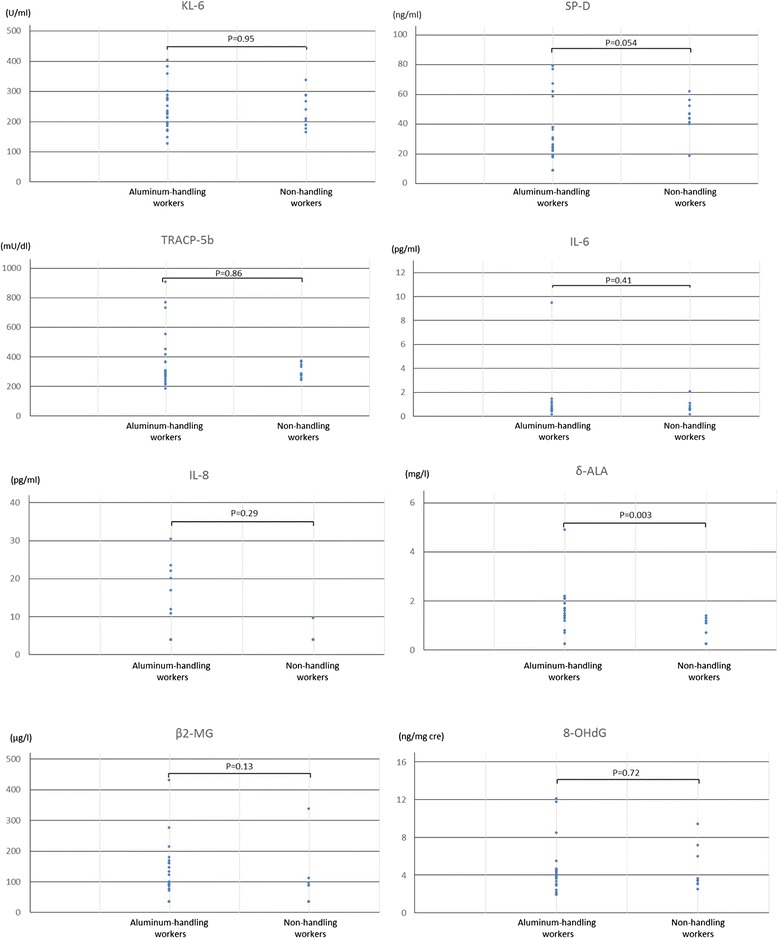
Methods: Twenty-three healthy aluminum-handling workers and 10 healthy non-aluminum-handling workers participated in this study. Their medical examinations, which were otherwise unremarkable, included the collection of urine and blood. Urinary aluminum levels were analyzed using ICP analysis. As pre-clinical tests, we measured KL-6, SP-D, TRCP-5b, IL-6, and IL-8 in blood and δ-ALA and β2-microglobulin in urine. These were considered to be lung, bone, kidney and inflammation markers. Moreover, we measured 8-OHdG in urine as an oxidative DNA damage marker.
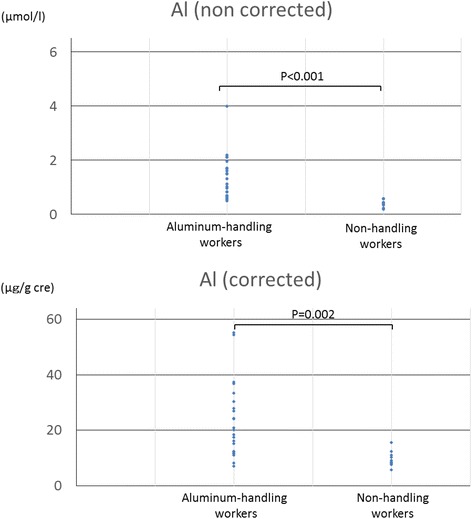
Results: The aluminum concentration in urine ranged from 6.9 to 55.1 μg/g cre (median: 20.1 μg/g cre) in the aluminum-handling workers and from 5.6 to 15.6 μg/g cre (median: 8.8 μg/g cre) in the non-aluminum-handling workers, with a significant difference between them. In the pre-clinical findings, there were no significant differences between these two groups except in the case of δ-ALA. However, there were no significant relationships between aluminum concentration and the pre-clinical findings, work years, age or 8-OHdG in the aluminum-handling workers.
Conclusions: While the excretion of aluminum in urine was elevated in aluminum-handling workers, our findings suggest that low-dose aluminum is not directly harmful to humans, at least when workers' urinary aluminum concentration is below 55 μg/g cre.
Keywords: Aluminum; Biological monitoring; Pre-clinical marker.
Figures
References
-
- Food and Agriculture Organization of the United Nations: Summary report of the seventy-fourth meeting of JECFA [ftp://ftp.fao.org/ag/agn/jecfa/JECFA_74_Summary_Report_4July2011.pdf]
-
- Food and Agriculture Organization of the United Nations: Joint FAO/WHO food standards programme codex committee on contaminants in foods fifth session [ftp://ftp.fao.org/codex/meetings/CCCF/cccf5/cf05_INF.pdf]
-
- American Conference of Governmental Industrial Hygienists (ACGIH) Documentation of the TLVs and BEIs with other worldwide occupational exposure values [CD-ROM] Cincinnati: ACGIH; 2014. Aluminum metal and insoluble compounds.
-
- Al-Masalkhi A, Walton SP. Pulmonary fibrosis and occupational exposure to aluminum. J Ky Med Assoc. 1994;92:59–61. - PubMed
LinkOut - more resources
Full Text Sources
Other Literature Sources
Research Materials
